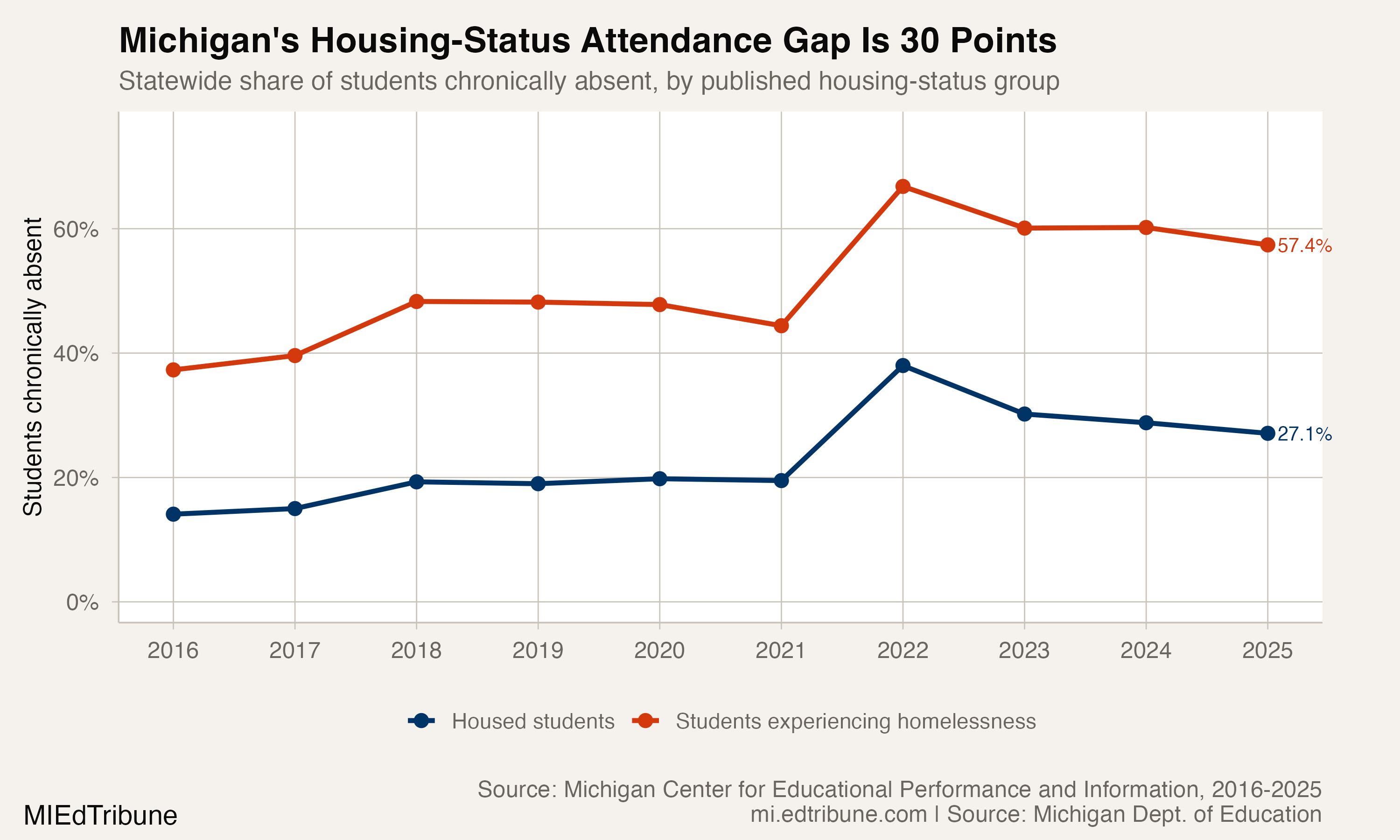
Michigan's chronic-absence rate for students experiencing homelessness has fallen from its pandemic-era peak. It reached 57.4% in 2025, down 9.4 percentage points from 66.8% in 2022.
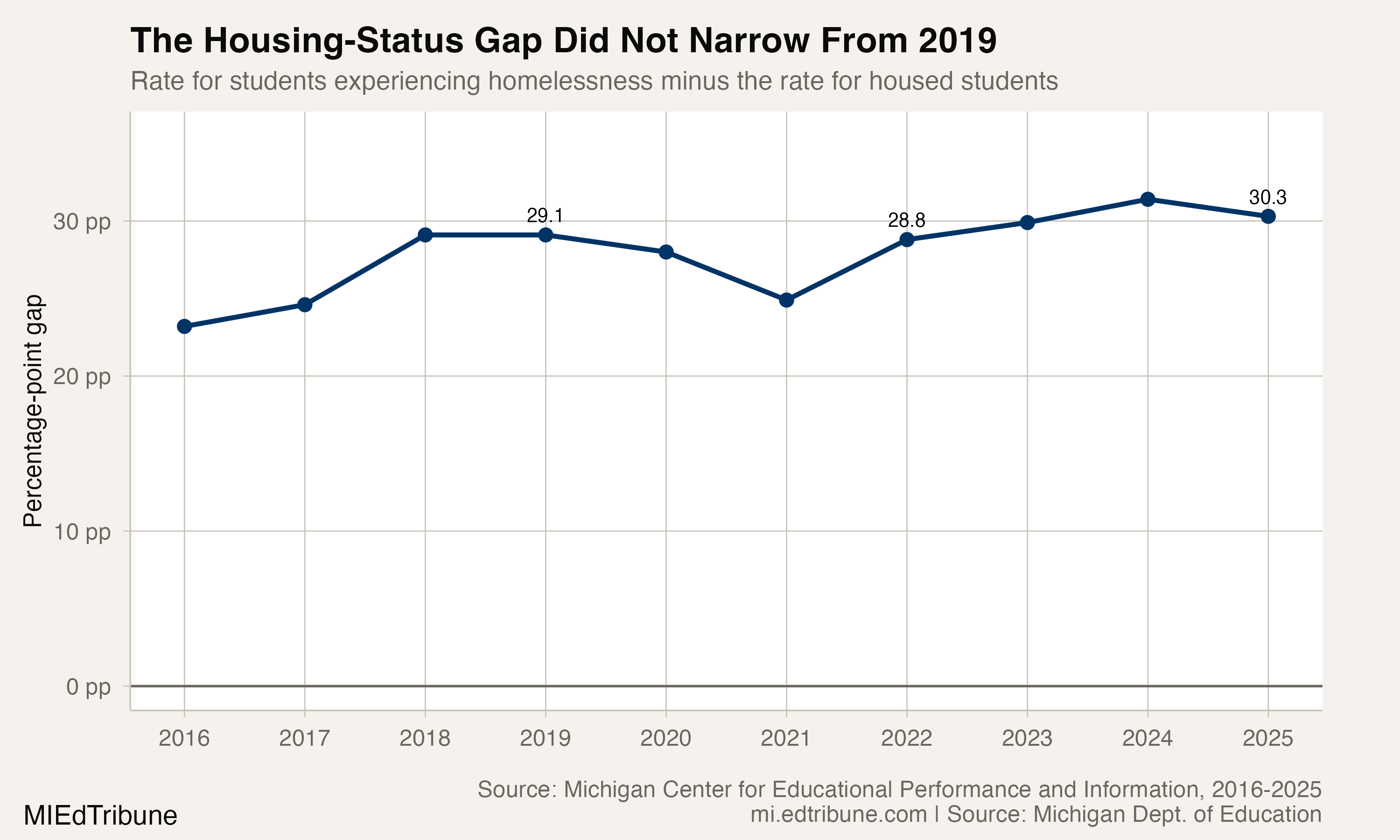
The improvement did not close the housing-status divide. The 2025 rate for housed students was 27.1%, leaving a 30.3-point gap.
In Detroit Public Schools Community District↗ET, 2,918 of 3,933 students identified as experiencing homelessness met the chronic-absence definition in 2025. That was a 74.2% rate.
Improvement without convergence
The statewide rate for students experiencing homelessness fell sharply after 2022, changed little in 2024 and fell again in 2025. The rate for housed students followed a different path and stayed much lower throughout the comparable 2016-2025 panel.
The housing-status gap was 29.1 points in 2019. It stood at 30.3 points in 2025. The endpoints show that the overall recovery did not narrow this particular divide.
Michigan's Department of Education lists transportation, inconsistent housing, health issues, clothing needs and family-care responsibilities among the barriers that can keep students from school. Those factors are context, not a causal finding from the attendance file. The statewide data do not identify which barrier accounts for how much of the gap. MDE describes those barriers and local responses in its September 2025 attendance release.
The state's McKinney-Vento program gives districts a practical framework for responding. It directs families and schools to local liaisons and provides guidance on immediate enrollment, transportation and removing barriers to school participation. The data here do not measure the effect of those supports.
The widest paired gap in the state file
The analysis tested seven direct statewide comparisons in 2025. Housing status produced the largest absolute difference at 30.3 points. The Black-white difference was 27.1 points, and the economic-status difference was 22.8 points.
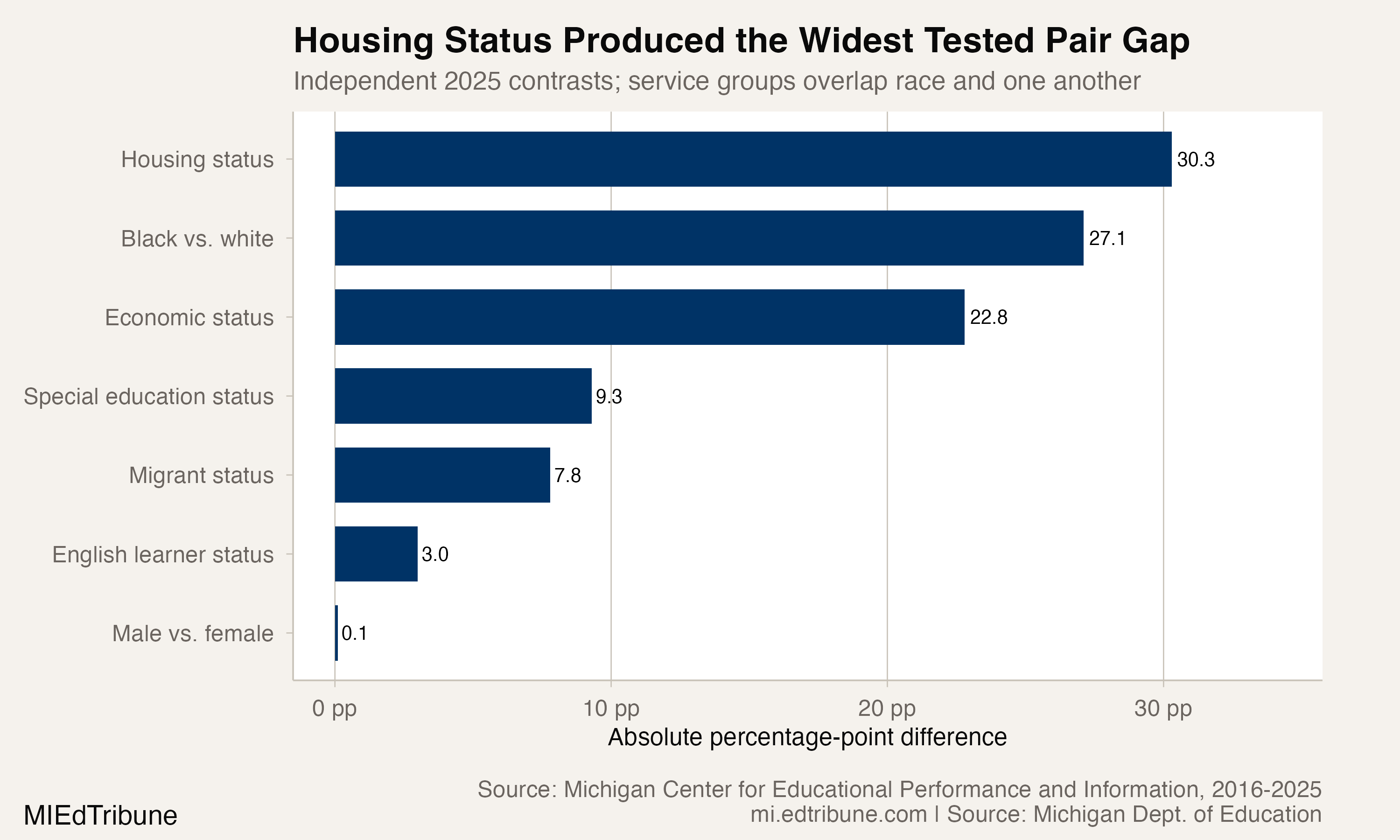
Those are separate comparisons, not pieces of one population. Housing, economic, special-education, English-learner and migrant statuses overlap with race and with one another. The chart ranks the size of each paired difference without treating the categories as mutually exclusive.
Michigan reported 34,976 students experiencing homelessness in the statewide attendance row for 2025. Of them, 20,087 met the chronic-absence definition. Both numbers are published subgroup counts, not an estimate built from district rows.
District rows are more uneven because small groups can be suppressed. The Detroit figures are useful for understanding local scale, but they cannot explain the statewide gap by themselves. Kalamazoo Public Schools↗ET, Lansing Public School District↗ET and Grand Rapids Public Schools↗ET were also among the 10 district rows with the largest identified groups; each reported a rate above 70%.
The statewide comparison therefore sets a clear boundary for the next decision: attendance supports have to reach the students represented by the 30.3-point gap, while local leaders still need evidence about which supports close it rather than merely accompany it.
Detailed code that reproduces the analysis and figures in this article is available exclusively to EdTribune subscribers.
Discussion
Sign in to join the discussion.
Loading comments...