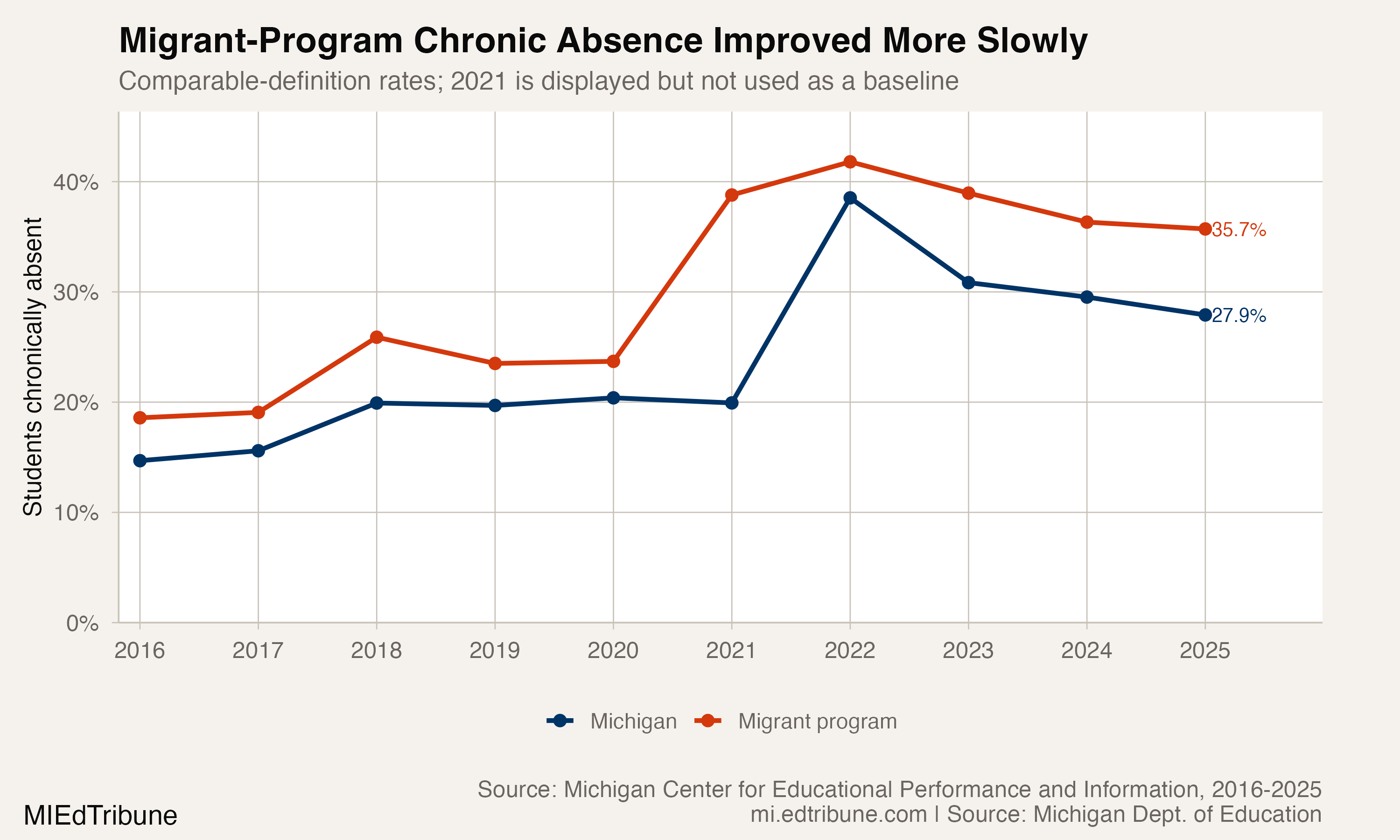
Michigan's chronic-absence rate for students in its migrant program fell for a third consecutive year in 2025. The rate improved 6.1 points from its 41.8% peak in 2022 to 35.7%.
The statewide rate improved faster. It fell 10.6 points, from 38.5% to 27.9%, across the same period. That left the migrant-program rate 7.8 points above Michigan's rate in 2025, compared with a 3.3-point gap at the peak.
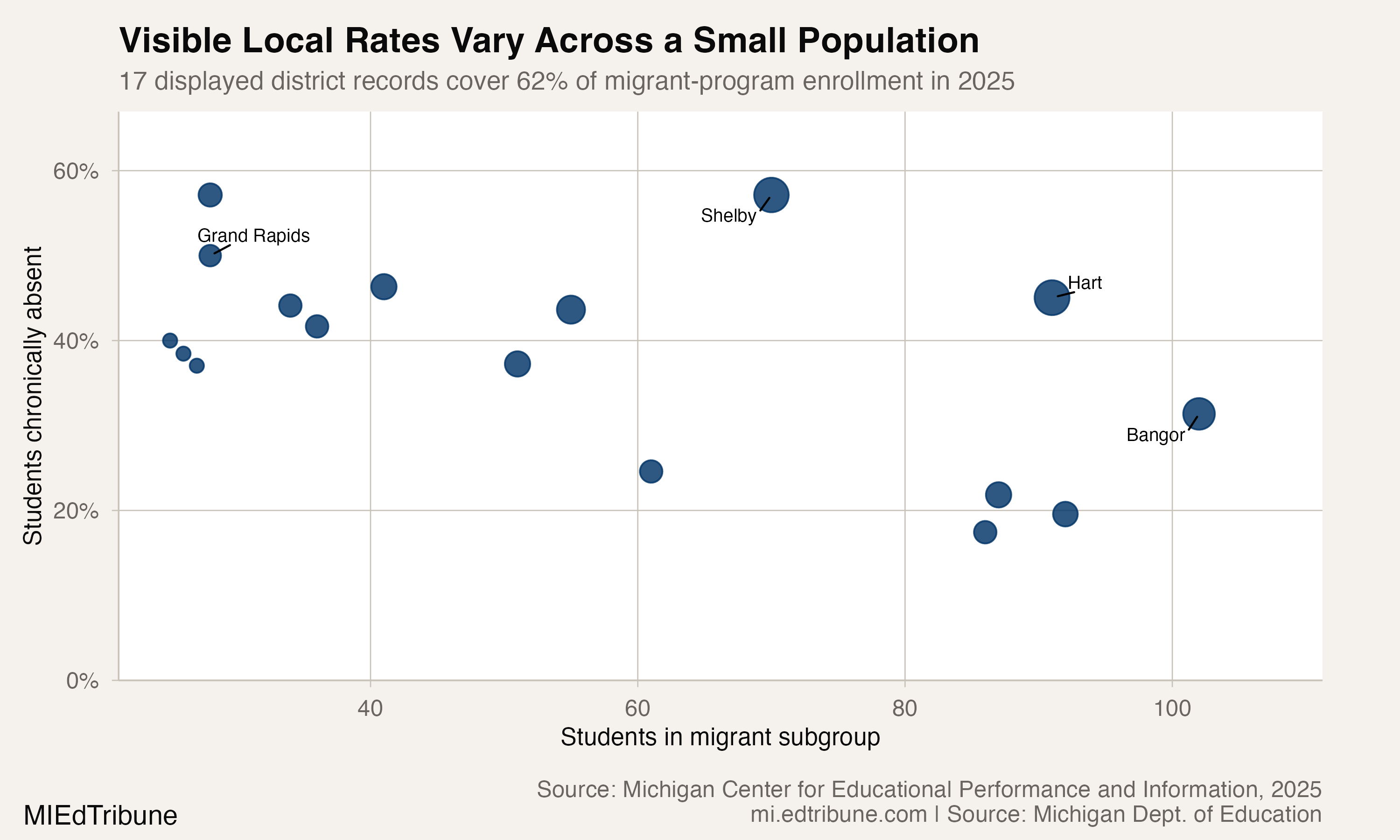
Bangor Public Schools (Van Buren)↗ET offers one local view. State records show 32 of 102 students in the district's migrant subgroup were chronically absent in 2025, a 31.4% rate. Those district records do not support a statewide local ranking because visible district rates cover only 62.0% of Michigan's migrant-program enrollment.
The recovery did not close the gap
The migrant-program rate declined 2.8 points in 2023, 2.6 points in 2024 and 0.6 point in 2025. The direction was consistently better, but the pace slowed.
Michigan's migrant-state gap did not move in a straight line. It widened to 8.1 points in 2023, narrowed to 6.8 points in 2024 and ended at 7.8 points in 2025. The endpoint comparison shows that the subgroup's post-peak improvement did not keep pace with the state as a whole.
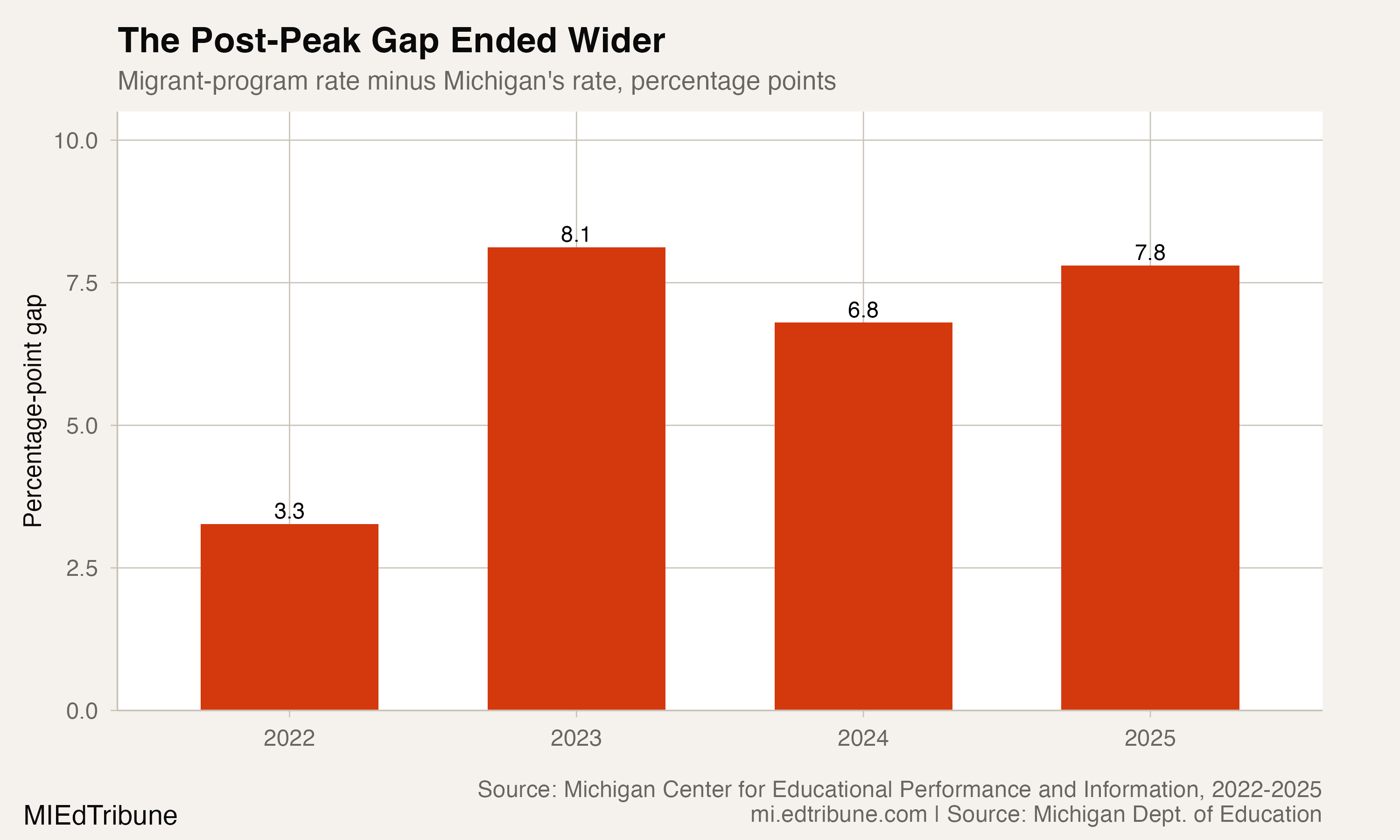
The gap also exceeds its pre-pandemic level. In 2019, the migrant-program rate was 23.5%, 3.8 points above Michigan. By 2025, the difference was about twice as wide.
A small statewide group
The statewide migrant-program row covered 1,515 students in 2025, including 541 who were chronically absent. Enrollment in the subgroup was 2,186 in 2019. A population of this size makes the rate more sensitive to changes involving a few dozen students than the statewide rate is.
The district detail has another limit. Districts with displayed migrant-program enrollment account for 89.4% of the statewide subgroup, while districts with a visible chronic-absence rate account for 62.0%. Suppression prevents the local records from supporting a complete district leaderboard or a claim about how broadly the statewide pattern is distributed.
The federal Migrant Education Program is designed to help students maintain educational progress when moves cross state systems. The program allows academic services as well as support involving health care, clothing and transportation.
Those authorized supports identify plausible barriers, not the cause of Michigan's measured trend. The aggregate attendance file cannot distinguish changes in mobility, eligibility, attendance reporting, local services, health or transportation.
The comparable window starts in 2016
This analysis begins in 2016 because Michigan's chronic-absence definition changed at that boundary. Earlier rates are not comparable with the current series, so the article does not use a lower pre-boundary rate to claim a long-run reversal.
Within the valid 2016-2025 window, the migrant-program rate was above the statewide rate in every reporting year. Three annual gains reduced the rate while leaving the gap wider than both its pre-pandemic level and the pandemic-era peak.
Detailed code that reproduces the analysis and figures in this article is available exclusively to EdTribune subscribers.
Discussion
Sign in to join the discussion.
Loading comments...