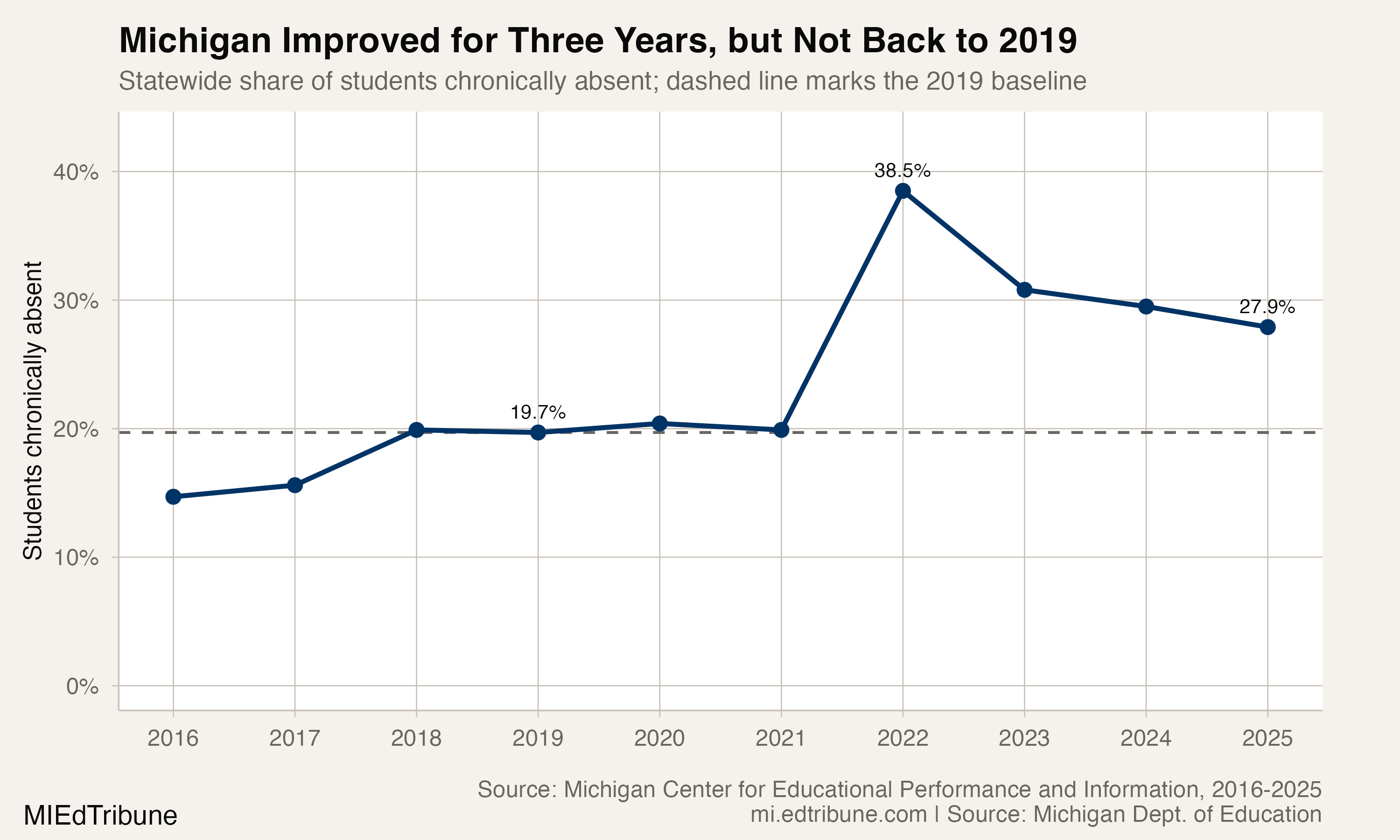
Michigan recorded three straight years of improvement in chronic absenteeism through 2024-25, the most recent school year in the state attendance files this analysis uses. That year's rate, 27.9%, was 10.6 percentage points below the pandemic-era peak.
The recovery is not finished. The 2024-25 rate was still 8.2 points above Michigan's 19.7% level in 2018-19, the last school year completed before the pandemic.
The remaining gap is visible at district scale. Detroit Public Schools Community District↗ET reported 31,913 students meeting the chronic-absence definition in 2024-25, more than any other district in the state file. Its rate was 60.9%.
Three steps down from the peak
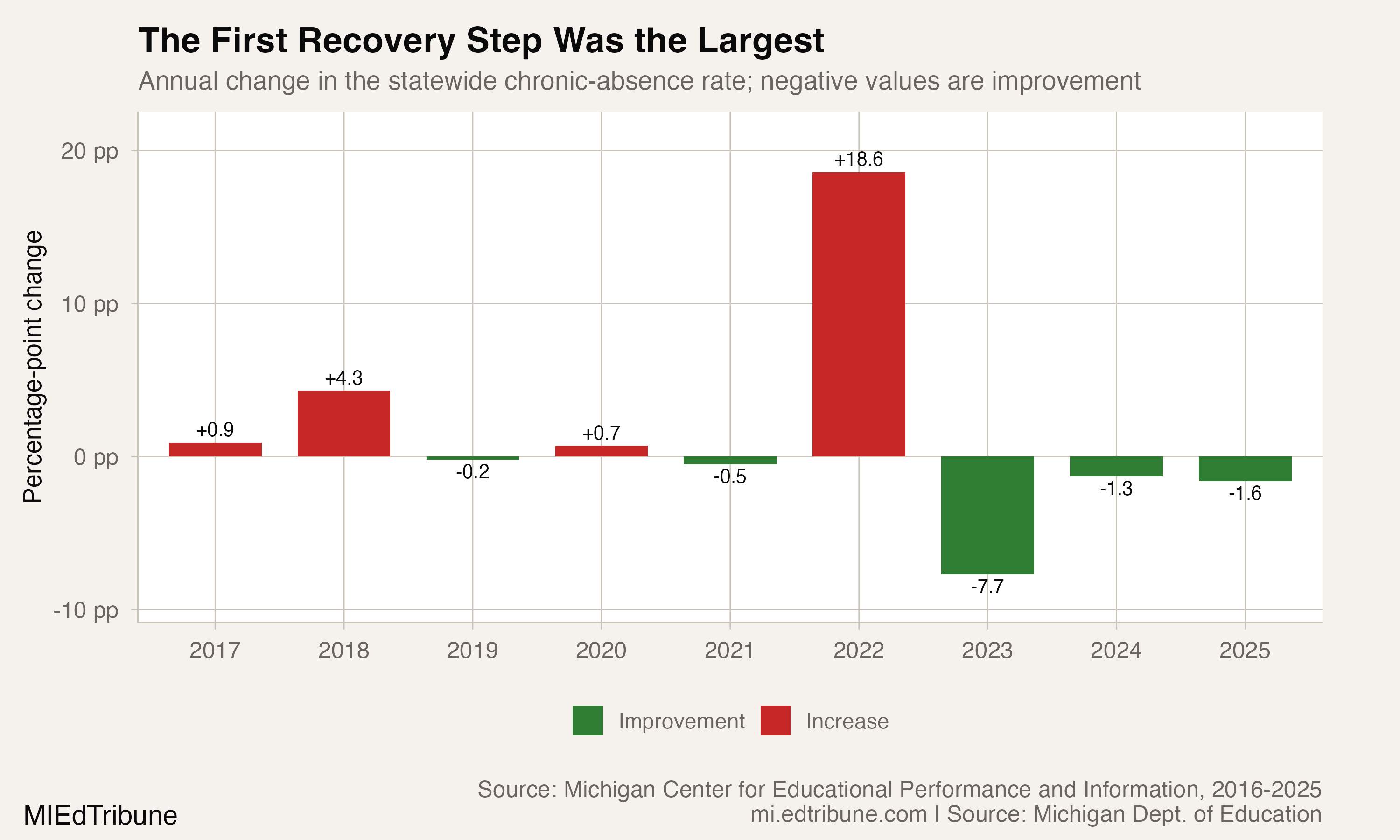
Michigan's statewide rate reached 38.5% in 2021-22. It then fell by 7.7 points in 2022-23, 1.3 points in 2023-24 and 1.6 points in 2024-25. Those are three consecutive annual declines across four reporting years.
The first year of improvement was much larger than either of the next two. The streak held, but the pace slowed.
The headcount moved with the rate. Michigan reported 546,622 students meeting the definition in 2021-22 and 387,934 in 2024-25, a decline of 158,688 students.
The Michigan Department of Education defines a student as chronically absent when the student has been enrolled for at least 10 consecutive days and misses 10% or more of possible school days. In announcing the latest results, MDE described the third annual improvement while also saying the state had not returned to its pre-pandemic level. The department listed family contact, mental-health interventions, home visits and early-warning supports among the approaches districts have used, without attributing a measured share of the statewide change to any one approach in its September 2025 release.
A statewide number built from local burdens
Detroit's reported count was far ahead of the next-largest district counts. Ann Arbor Public Schools↗ET reported 6,058 students meeting the definition, Grand Rapids Public Schools↗ET reported 5,984 and Lansing Public School District↗ET reported 5,558.
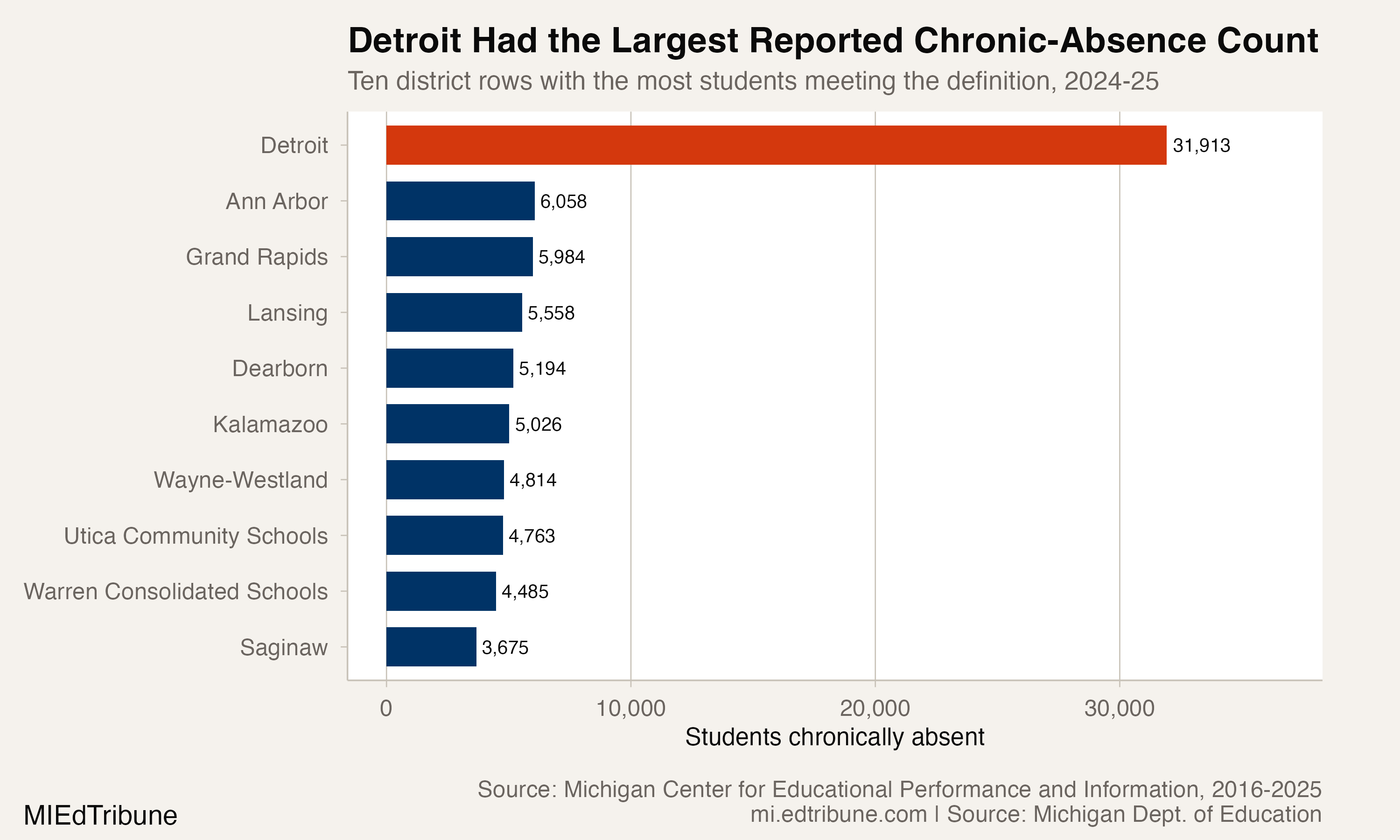
The district chart compares published district figures. It does not rebuild the state total. In 2024-25, 50 of the 878 district entries in the state file had a suppressed enrollment or chronic-absence count, so the available district figures do not add up exactly to the separately published state figure. This story keeps the two apart.
The statewide trend starts in 2016, the 2015-16 school year. Michigan's earlier figures used a different definition, so joining them to the current series would make a change in measurement look like a change in attendance.
Put together, the data show a sustained recovery from an extraordinary peak, with part of the pre-pandemic gap still to close.
The figures come from Michigan Center for Educational Performance and Information state and district attendance records for the 2015-16 through 2024-25 school years, available through the official MI School Data Student Attendance report.
Detailed code that reproduces the analysis and figures in this article is available exclusively to EdTribune subscribers.
Discussion
Sign in to join the discussion.
Loading comments...