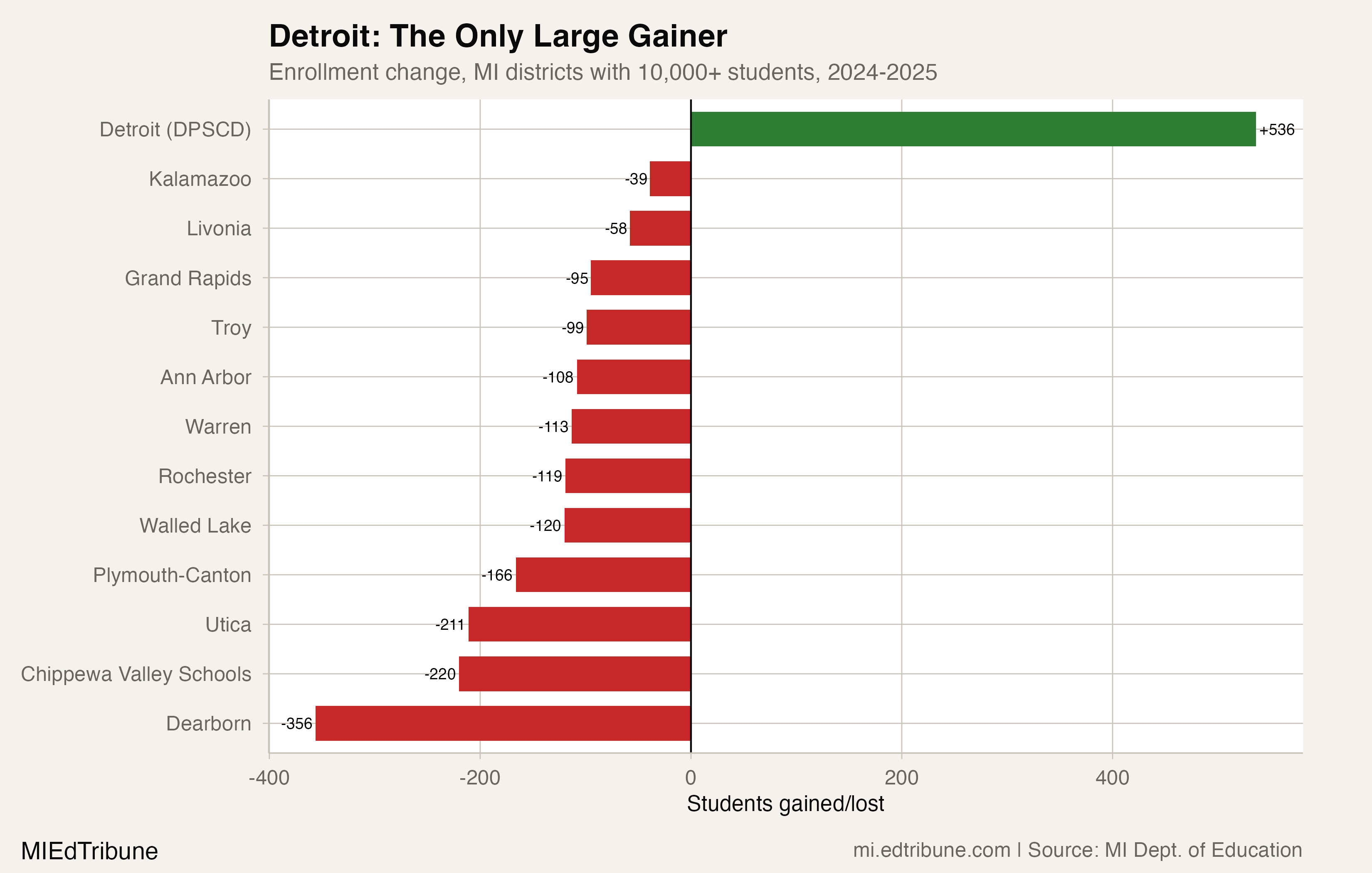
In 2024-25, Detroit Public Schools Community District↗ET added 536 students. That is not, on its face, a large number. But it is the only enrollment gain posted by any Michigan district with more than 10,000 students. Kalamazoo, the next-closest large district, lost 39. Dearborn lost 356. Across the 13 districts in the state enrolling at least 10,000 students, Detroit was the sole gainer.
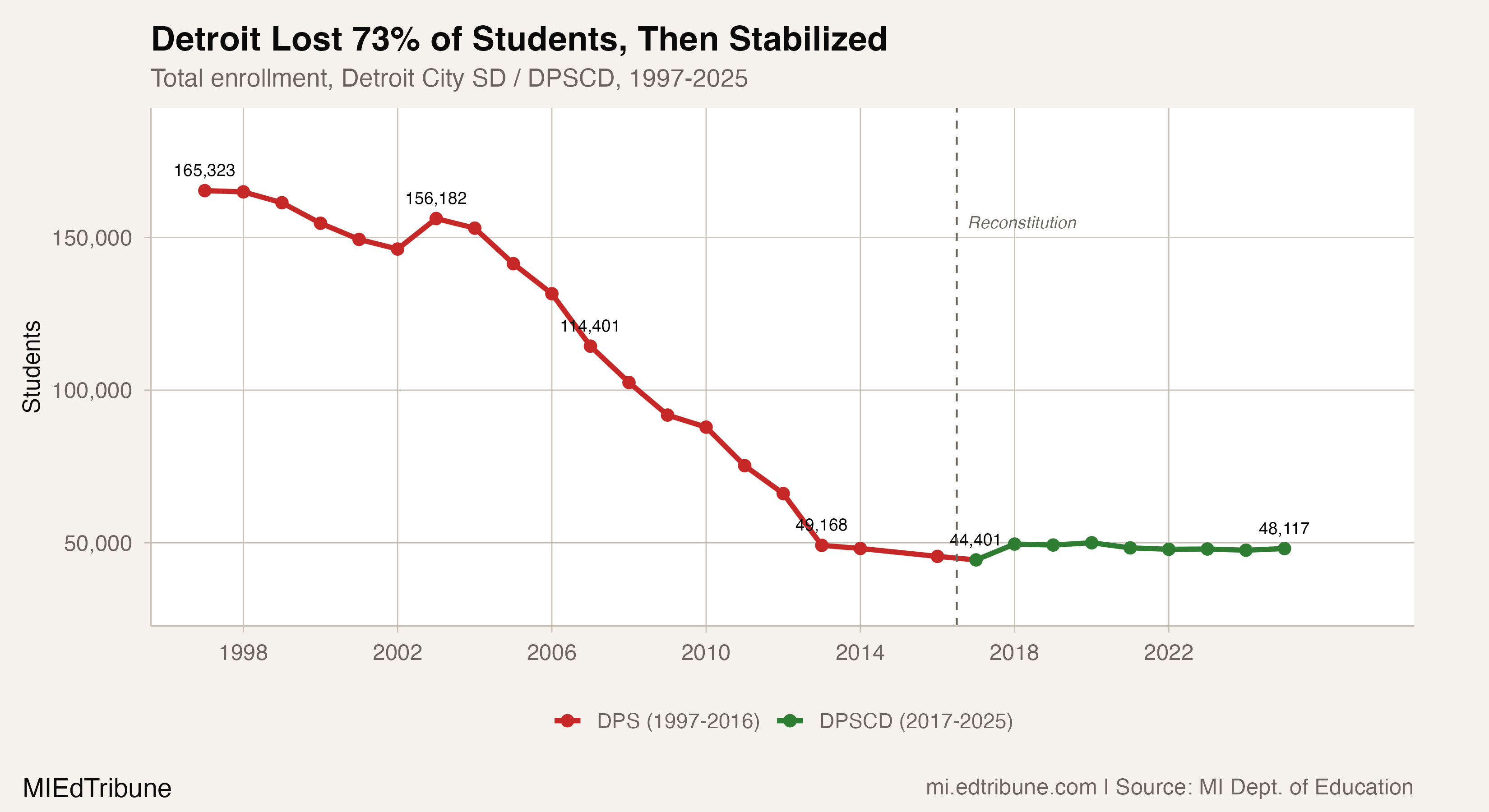
That fact becomes more striking in context. The district reporting this gain is a successor entity to one that lost 120,922 students, a 73.1% decline, between 1997 and 2017. Few traditional public school districts in any major American city have lost a comparable share of their enrollment and continued operating.
Three eras of a single district
Detroit's enrollment history since 1997 falls into three distinct periods, each shaped by a different set of forces.
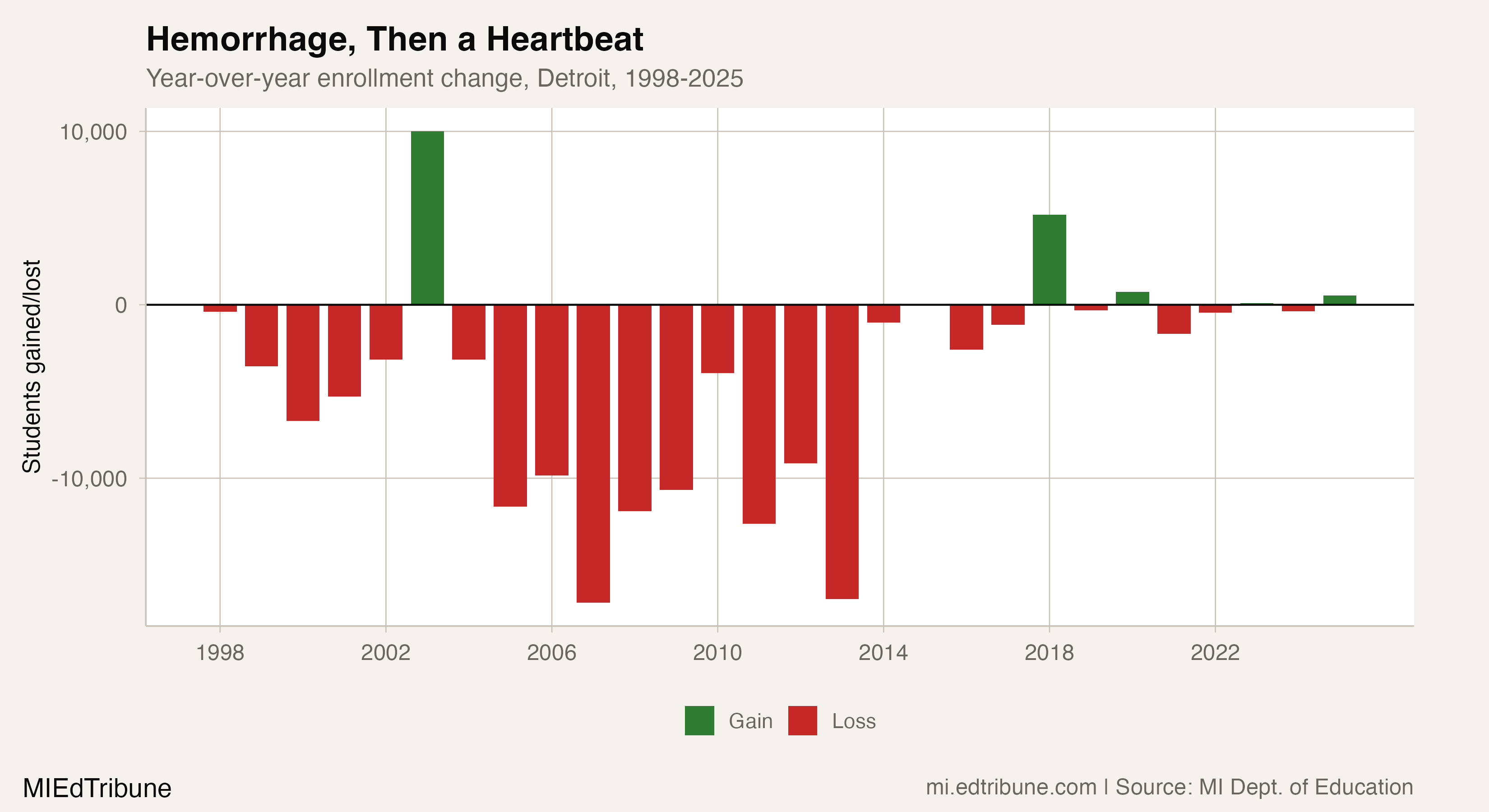
The slow bleed (1997-2004). The old Detroit City School District peaked at 165,323 students in 1997 and lost roughly 3,000-6,000 students per year through 2002, driven by population loss and the early years of Michigan's charter school expansion. The state authorized charter schools in 1994, and by the early 2000s, thousands of Detroit families had opted for alternatives. A brief anomaly in 2003, when reported enrollment jumped by 9,993, likely reflects a counting methodology change rather than an actual surge.
The collapse (2005-2016). The losses accelerated sharply. Between 2005 and 2013, the district lost more than 90,000 students, with single-year drops exceeding 10,000 in five of those nine years. The worst single year was 2007, when 17,167 students disappeared from the rolls, a 13.0% decline. Emergency manager Robert Bobb closed 72 schools between 2009 and 2011, but the closures did not slow the exodus. By 2013, the district had hemorrhaged 16,964 students in a single year, a 25.7% drop that reflected school closures and the continuing shift to charters. The district's operating deficit ballooned to $600 million by 2010.
Reconstitution and stabilization (2017-present). In 2016, Michigan's legislature restructured the district with a $617 million bailout modeled on Detroit's city bankruptcy. The old DPS was retained as a shell to pay down legacy debts. A new entity, Detroit Public Schools Community District, launched debt-free under an elected board. Superintendent Nikolai Vitti arrived in 2017. In its first full year under DPSCD, enrollment jumped by 5,191, an 11.7% gain that partly reflects students returning from charter alternatives and partly reflects organizational consolidation. Since then, the district has held between 47,500 and 50,000 students for eight consecutive years.
What stabilization actually looks like
The word "recovery" overstates the math. DPSCD's 2025 enrollment of 48,117 represents a gain of 3,716 students, or 8.4%, from its 2017 trough of 44,401. That recovery reclaims just 3.1% of the 120,922 students the district lost over the prior two decades.
The more precise description is stabilization. Since 2018, the annual swing has stayed within a band of roughly 1,700 students in either direction, a volatility range of about 3.5%. For a district that once lost 17,167 students in a single year, that consistency is notable. The district has now posted six consecutive years without a loss exceeding 1,700 students and two years of gains (2020 and 2025).
That stability comes as the rest of Michigan continues to shrink. The state's total enrollment peaked at 1,715,048 in 2004 and has fallen to 1,366,207, a decline of 348,841 students (20.3%). Detroit's share of state enrollment has actually grown from 3.01% in 2017 to 3.52% in 2025, not because Detroit is surging, but because the state around it is receding.
Who is arriving, who is leaving
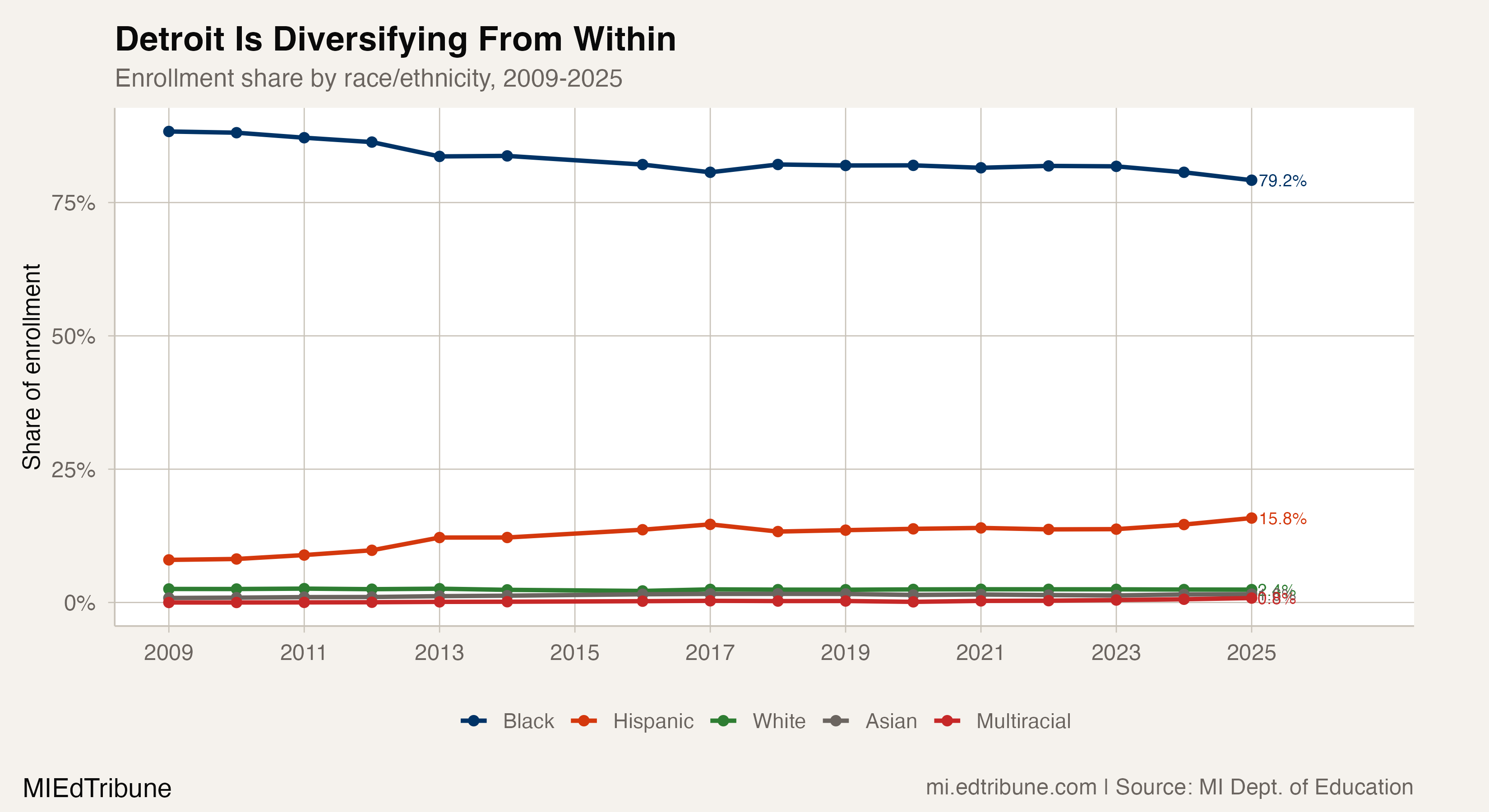
The demographic composition of the 2025 gain reveals a specific pattern. Hispanic enrollment grew by 665 students, accounting for more than the entire net gain. Multiracial enrollment added 110. Black enrollment, still the overwhelming majority at 79.2% of the district, declined by 282 students.
Over the full DPSCD era, the shift is more pronounced. Hispanic students grew from 6,504 (14.6% of enrollment) in 2017 to 7,618 (15.8%) in 2025, a 17.1% increase. Multiracial students nearly tripled from 139 to 399. Black enrollment, while still comprising four in five students, has gradually declined as a share from 80.7% to 79.2%.
This mirrors a broader population trend. The city of Detroit added 6,791 residents in 2024, a 1.1% gain that exceeded both the state and national growth rates, marking the first back-to-back population increases since the 1950s. Most Downriver communities saw double-digit percentage growth in their Latino populations over the 2010-2020 decade, according to Census data compiled by the Southeast Michigan Council of Governments. That regional growth has been extending into the city itself.
The charter question
More than half of Detroit's school-age children attend charter schools or schools outside the district. In 2017, when Vitti became superintendent, DPSCD authorized 13 charter schools. It now authorizes seven. The competitive landscape has shaped the district's enrollment reality since the 1990s: with each student who left for a charter or a suburban district, DPS lost over $6,000 in state per-pupil funding.
Vitti's posture toward charters has shifted over his tenure. In a March 2026 board discussion about authorizing a new athletics-focused charter school, he acknowledged: "Over time, I've come to accept that charter schools are not going anywhere." The proposed charter would cap enrollment of DPSCD students at 20%, a novel restriction that attempts to limit direct competition for the district's own families.
That the district can afford to authorize competitors rather than fight them reflects a changed calculus. When enrollment is in freefall, every student lost to a charter accelerates the death spiral. When enrollment is stable, selective charter authorization becomes a strategic tool.
The financial floor
The fiscal story undergirding Detroit's stabilization is as important as the enrollment numbers. The 2016 restructuring separated the old district's $3.5 billion in long-term debt into a legacy entity, giving DPSCD a clean financial slate. The new district has posted balanced budgets in every year since its creation.
The results have been substantial. DPSCD's fund balance grew from $79 million in 2017 to projected reserves of $674 million by the end of fiscal year 2024, bolstered by $800 million in one-time federal COVID relief funds. The legacy debts are projected to be fully retired in 2026, a decade after restructuring, which will return local property tax proceeds to classroom operations.
"Financial stress has not been an obstacle for DPSCD to address the learning needs of all students." — Citizens Research Council of Michigan, 2022
That statement would have been absurd a decade ago, when teachers staged sickouts over rats, mold, and crumbling ceilings. The financial turnaround does not undo those years. But it does mean the district is no longer choosing between textbooks and heating.
What the data cannot show
Enrollment counts measure how many students show up. They do not measure whether those students stay through the school year, attend regularly, or are learning. DPSCD's chronic absenteeism rate stood at 66% in 2023-24, down from nearly 80% during the pandemic peak but still meaning two-thirds of students miss significant instructional time. A district can stabilize enrollment while still struggling to keep those enrolled students in seats.
The 2025 gain also masks uneven dynamics across grade levels. Grade 12 enrollment surged by 430 students (16.6%), the largest single-grade gain, while Grade 9 dropped by 400 (-8.8%) and Grades 1 and 2 each lost more than 120 students. Whether the senior-year spike reflects improved retention, fifth-year students completing delayed graduations, or a cohort anomaly is not discernible from enrollment data alone.
The district's $94.4 million literacy lawsuit settlement, which funded 250 academic interventionists in kindergarten through second grade, represents an investment that enrollment data will only capture if it generates word-of-mouth improvements that attract families. Enrollment stability is the necessary condition for such investments to compound. It is not sufficient evidence that they are working.
The test ahead
Detroit's enrollment story is often framed as a comeback narrative. The data supports a narrower claim: a district that was losing 10,000-17,000 students per year for a decade has held steady at roughly 48,000 for eight years, and in 2025 posted the largest gain of any big Michigan district. That is real, and it is fragile.
The federal COVID relief funds that boosted DPSCD's reserves are one-time money that must be committed by September 2024 and spent by 2026. The legacy debt retirement, while welcome, does not eliminate the $1.5 billion in outstanding bond obligations extending to 2052. Michigan's statewide enrollment continues to fall. The competitive pressure from charter schools, which educate more Detroit children than DPSCD does, is structural and permanent.
The legacy debts retire in 2026. The $305 million in federal relief is spent. What DPSCD has, heading into the next phase, is a clean balance sheet, a superintendent who has been in the job since 2017, and a student body that grew by 536 last year while every comparable Michigan district shrank. The 665 additional Hispanic students in 2025 suggest the district is capturing at least some of the city's population rebound. But in a city where more school-age children attend charters than the traditional district, every October headcount is a referendum.
Detailed code that reproduces the analysis and figures in this article is available exclusively to EdTribune subscribers.
Discussion
Sign in to join the discussion.
Loading comments...