Grand Rapids Public Schools has 13,566 students. That is fewer than at any point in the district's recorded history, which stretches back 29 years. Livonia, with 12,818 students, is in the same position. So is Warren Consolidated, at 12,421. So are Walled Lake, Lansing, Traverse City, Portage, Huron Valley, Port Huron, Waterford, Grosse Pointe, and Bay City.
They are not alone. In 2024-25, 231 of Michigan's 878 districts are at their all-time enrollment low. That is 26.3% of every district in the state, and the number more than tripled in a single year: just 66 districts held the same distinction in 2023-24.
The spike no one saw coming
The count of districts hitting record lows had been rising gradually since the pandemic. In 2020-21, 58 districts bottomed out. The number climbed to 66 by 2023-24. Then it exploded to 231.
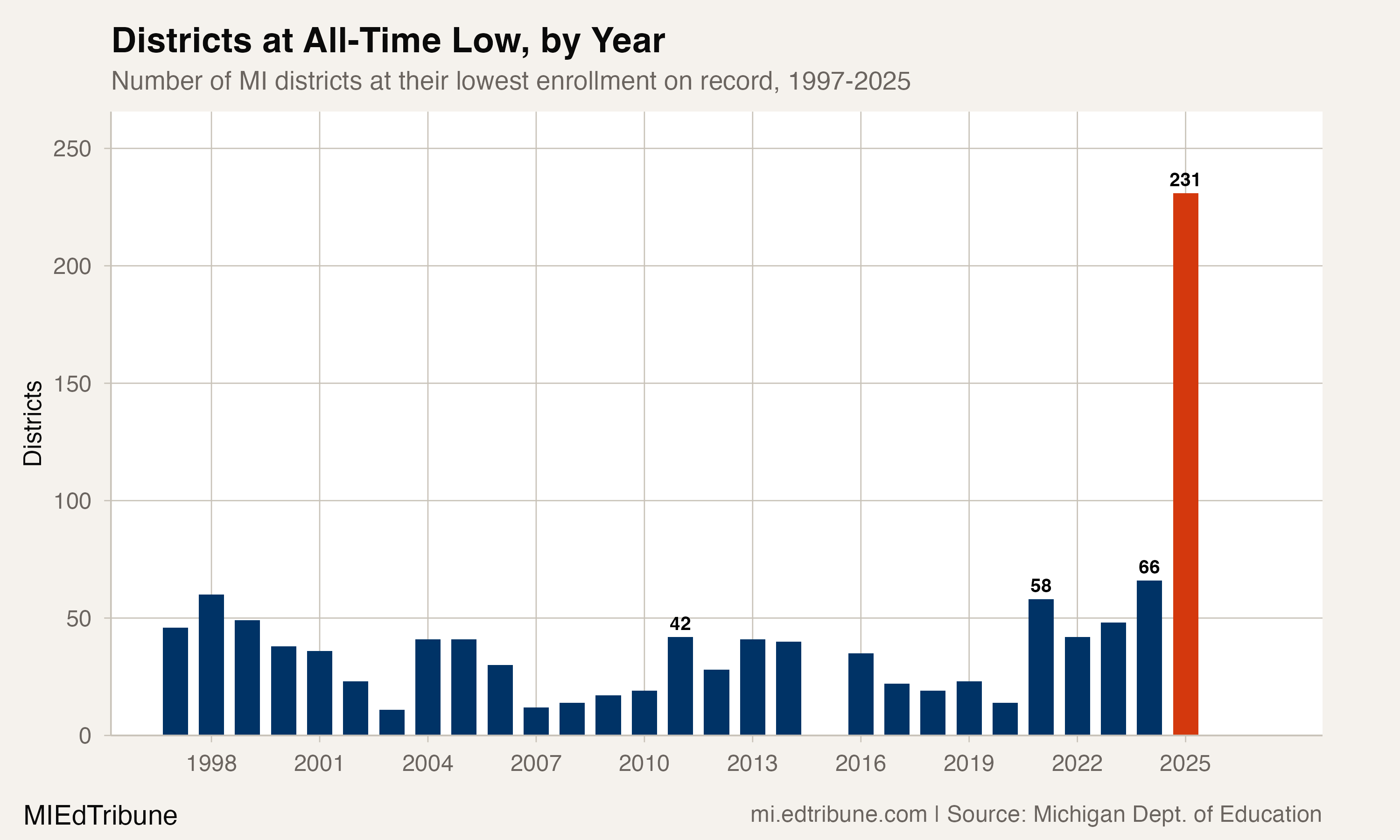
To put the 2025 number in context: the previous post-1996 peak was 66 districts. The 2025 count is 3.5 times that. No prior year comes close.
The districts at all-time low collectively enroll 418,353 students. That is 30.6% of Michigan's total K-12 enrollment. At the state's foundation allowance of $10,050 per pupil, these districts have lost a combined 278,032 students from their respective peaks, representing roughly $2.8 billion in annual state funding that followed those students elsewhere or simply vanished as the children were never born.
Not just small towns
The conventional framing of enrollment decline in Michigan centers on rural districts losing families. The 2025 data undermines that framing.
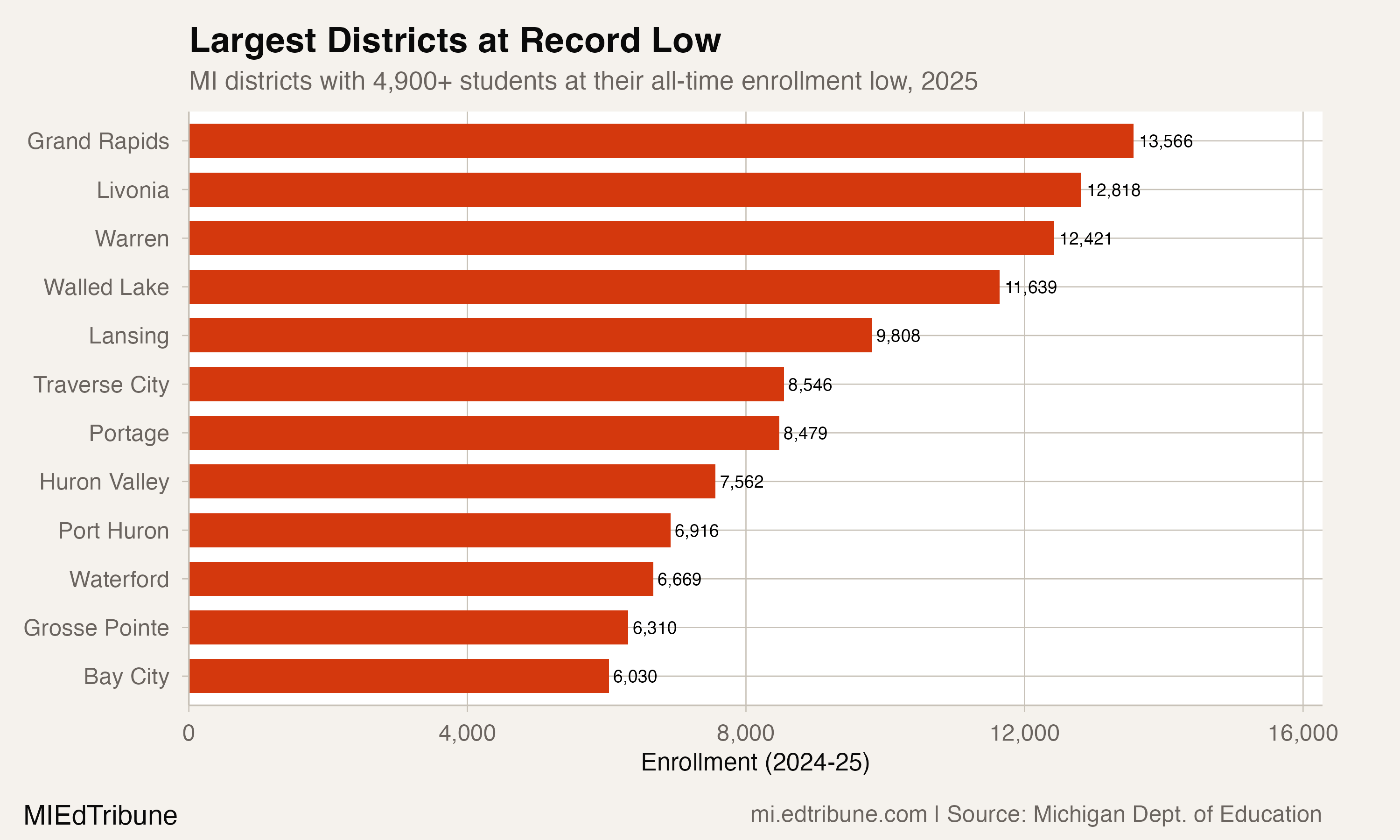
Four districts above 10,000 students are at all-time lows: Grand Rapids (13,566), Livonia (12,818), Warren Consolidated (12,421), and Walled Lake Consolidated (11,639). Ten more districts between 5,000 and 10,000 students hold the same record. Grand Rapids is a mid-sized city. The others are suburban communities in Oakland, Macomb, and Wayne counties. All grew steadily through the 1990s and 2000s before the trajectory reversed.
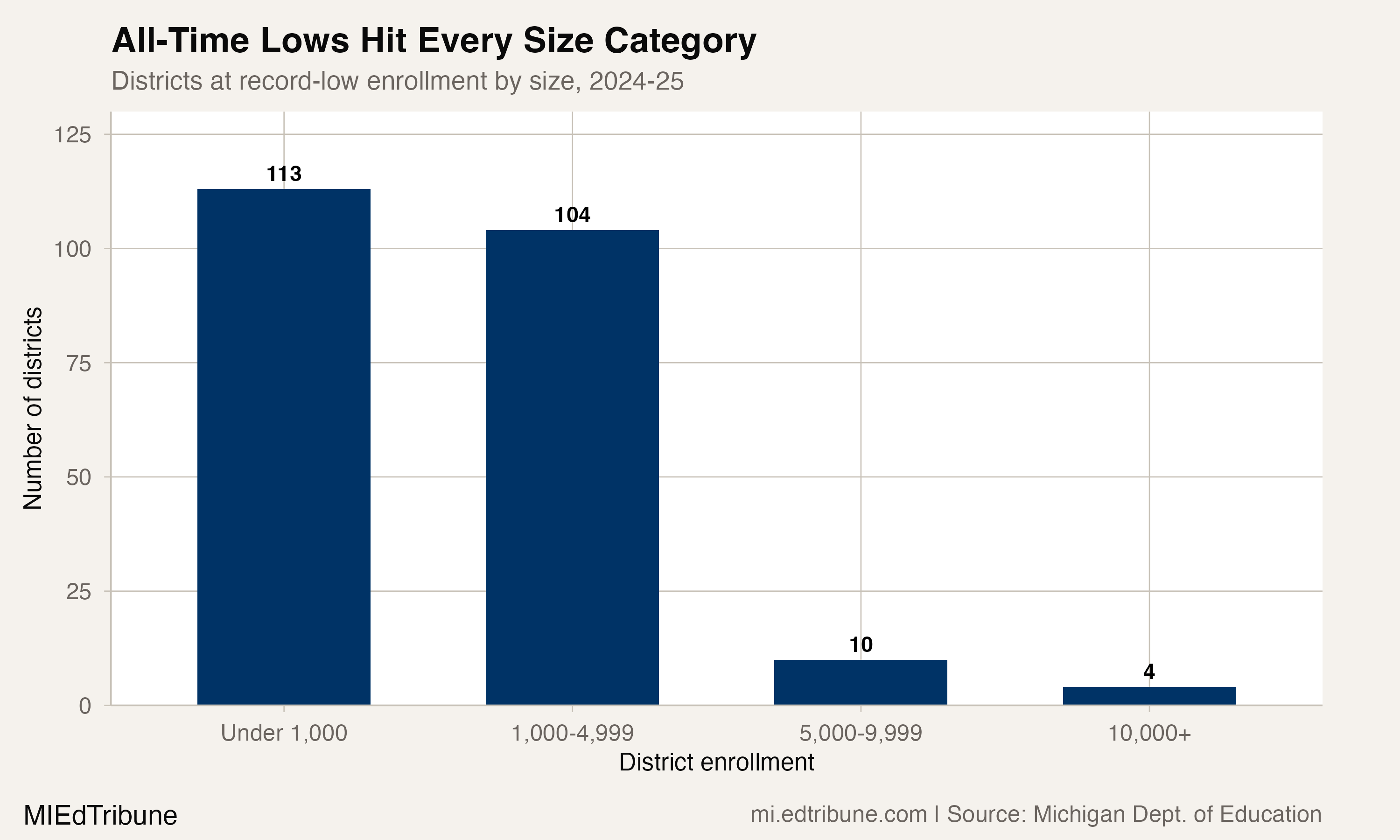
The size distribution of all-time-low districts tells the story clearly. Of the 231 districts, 113 enroll fewer than 1,000 students, but 104 enroll between 1,000 and 4,999. The problem runs through every tier.
Another 126 districts are within 5% of their all-time low but have not yet crossed the threshold. Utica Community Schools, the state's fourth-largest traditional district at 25,092 students, sits just 1.6% above its 1996 baseline. Plymouth-Canton Community Schools (15,885 students) is 3.5% above its record low. Troy School District (12,128 students) is 2.1% above. These are not struggling districts by reputation. They are among the most sought-after school systems in metro Detroit.
A 21-year ratchet
Michigan's statewide enrollment peaked at 1,715,048 in 2003-04. Every year since has been lower than the one before, with the sole exception of a gap in 2015 data. The state now enrolls 1,366,207 students, a loss of 348,841 from peak, or 20.3%.
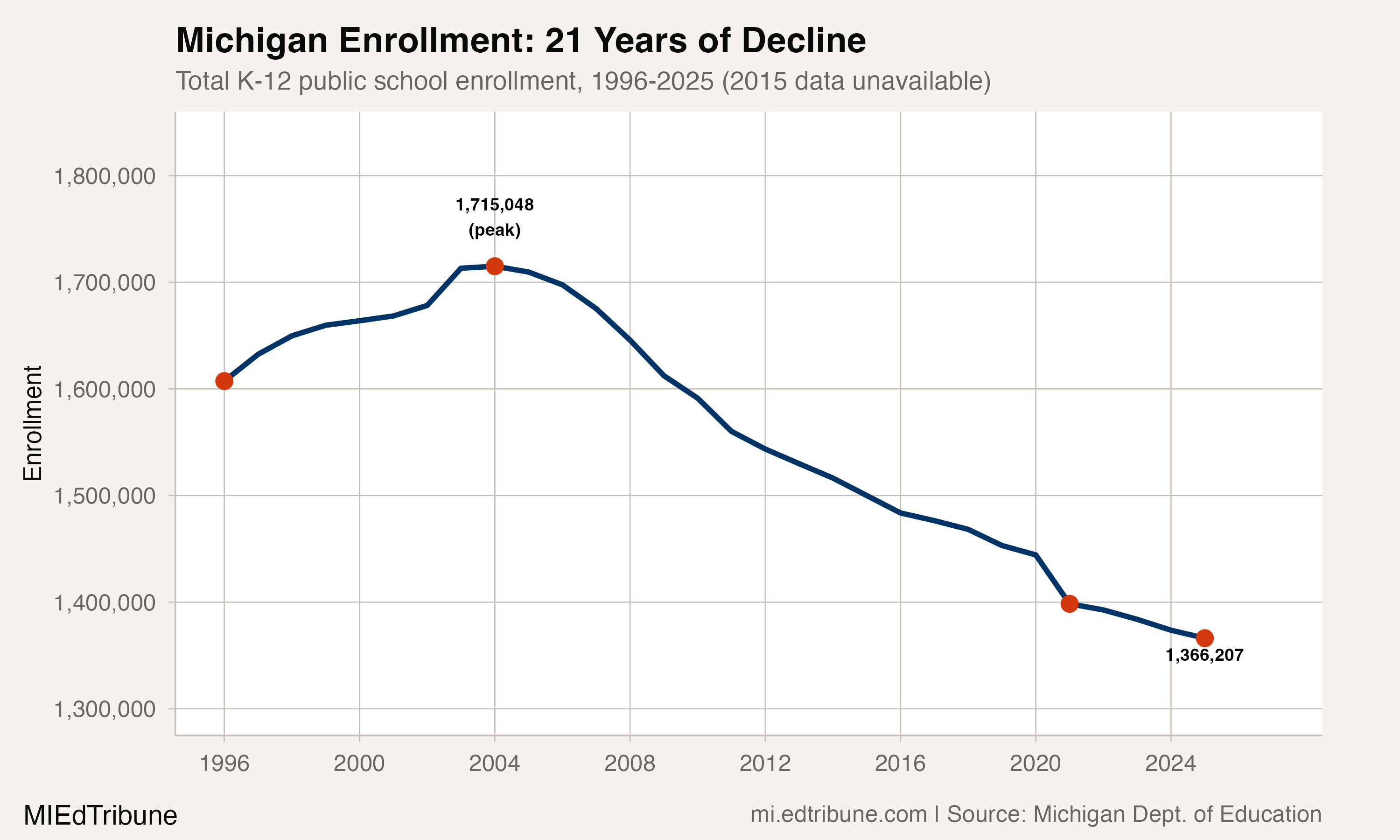
The 2024-25 decline of 7,479 students (-0.5%) is modest by Michigan's standards. The state lost 45,858 students in a single year during the pandemic (2020-21), and lost more than 30,000 annually during the Great Recession era. The slow bleed of recent years has not produced headlines, but districts that absorbed years of small losses are now falling below floors set when they were much larger.
Of the 646 districts that lost enrollment between 2018-19 and 2020-21, only 90 have recovered to their pre-pandemic level. That 13.9% recovery rate means the vast majority of districts have been declining continuously for at least six years.
The districts that lost the most
The cumulative toll is staggering for some districts. Flint, which enrolled 25,011 students at its peak, now has 2,541, a loss of 89.8%. Grand Rapids has lost 13,415 students from its high of 26,981, a 49.7% decline. Lansing lost 9,924 from a peak of 19,732, halving its enrollment. Saginaw lost 8,265 from 13,223.
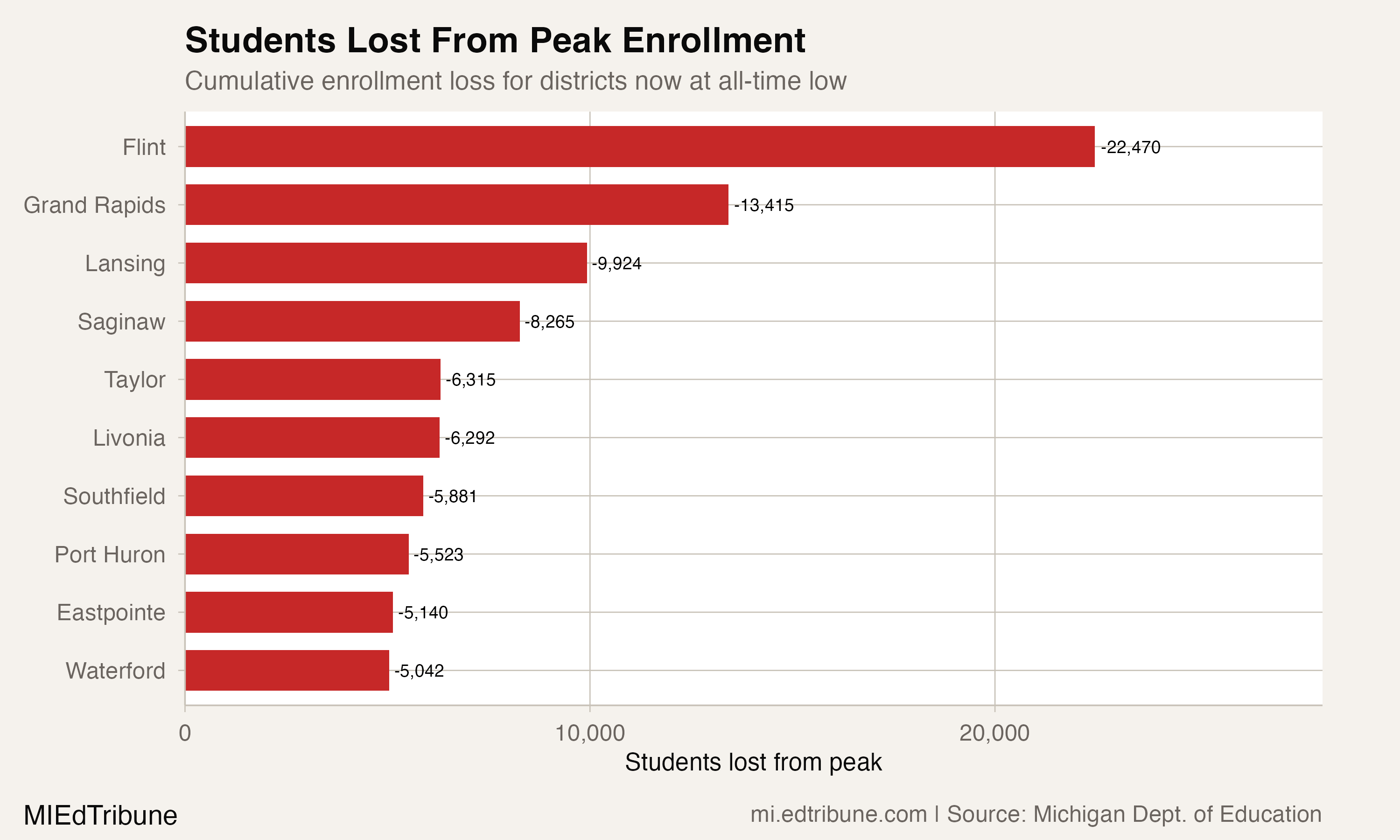
Flint's collapse is well documented, driven by the water crisis, state takeover, and decades of deindustrialization. But the losses in Grand Rapids, Lansing, and Livonia cannot be attributed to any single catastrophe. These are cumulative declines produced by Michigan's particular combination of demographic pressure and structural incentives.
Fewer children, more competition, less money
Michigan's enrollment crisis compounds because its causes reinforce each other.
Start with the demographic floor: Michigan recorded 97,696 births in 2023, the lowest number since the 1930s. The Citizens Research Council of Michigan projects the state's five-to-seventeen-year-old population will fall another 18% by 2050, to around 1.26 million. Kindergarten enrollment statewide fell 8.0% between 2018-19 and 2024-25 (from 117,694 to 108,230), a leading indicator that the decline will deepen before it stabilizes.
Layer school choice on top. One in four Michigan students now attends a school outside their home district or a charter school, up from one in six a decade ago. A shrinking pool of students is being redistributed across a growing number of providers. The state has nearly 900 combined districts and charters, producing the fourth-lowest students-per-district ratio nationwide at approximately 1,600 (the national average is 2,600). Of the 91 districts at all-time highs in 2025, 51 are virtual academies, charter schools, or academy-branded entities.
Then remove the safety net. Michigan schools received approximately $6 billion in federal pandemic aid that allowed districts to delay difficult decisions about staffing and facilities. The Citizens Research Council warned that once those funds expired, districts would face the full fiscal weight of enrollment losses that the one-time money had papered over. That expiration came at the end of 2024.
"The schools of choice (program) has negatively affected the district of Morenci." — Brad Moran, Morenci school board vice president, Bridge Michigan
Morenci is a case study in how these forces converge. The district's enrollment fell over 25% in a decade, losing $1.7 million in state aid in 2022-23 alone. Of its 674 resident students, 28% attended other districts.
The consolidation question
Michigan has more school districts per student than nearly any state, and since 2009, 80% of traditional districts have experienced enrollment declines. The state recently awarded $75 million in consolidation grants to three districts: Flint received nearly $36 million to close four buildings and reduce from 11 active schools to seven. Union City received $23.6 million to merge three buildings into two. North Central Area Schools received $15.4 million to consolidate from two buildings to one.
But the grants cover three of 878 districts. The state's K-12 building stock has shrunk only 12% despite a 16% enrollment decline since 2009-10, and that gap is widening. State superintendent Michael Rice has acknowledged that school choice has "exacerbated the enrollment declines in districts, affecting the breadth of academic offerings."
The data does not reveal whether the 2025 spike to 231 districts at all-time low reflects a structural acceleration or simply the moment when years of gradual erosion finally pushed a large cohort of districts below their previous floors. The distinction matters. If it is the former, the count will keep climbing. If the latter, 2025 may be a one-time correction rather than the new normal.
What the data can say: 126 more districts sit within 5% of their own records. Utica, Plymouth-Canton, and Troy, three of metro Detroit's most sought-after systems, are all within striking distance of their own lows. Michigan's kindergarten classes are smaller than its graduating classes. The 231 districts already at bottom were built for students who are not coming. The 126 on the edge will join them soon enough.
Detailed code that reproduces the analysis and figures in this article is available exclusively to EdTribune subscribers.
Discussion
Sign in to join the discussion.
Loading comments...