Draw a straight line through Michigan's 2010-2019 enrollment trend and extend it to 2025. The projection lands at roughly 1,361,900 students. The actual 2025 figure is 1,366,207, about 4,300 students above the line. In other words, Michigan is roughly where it would have been if COVID-19 had never happened.
That is the most unsettling finding in the state's enrollment data. The pandemic's 45,858-student drop between 2020 and 2021, a 3.2% single-year decline, was the largest in state history. It scattered families into private schools, homeschooling, and virtual academies. But the aggregate trajectory barely changed. Michigan was already losing an average of 16,921 students per year in the 16 years before the pandemic. The COVID-era rate of loss (15,621 students annually since 2020) is actually slightly slower. The pandemic did not break a stable system. It delivered one catastrophic year in the middle of a decline that was already well underway.
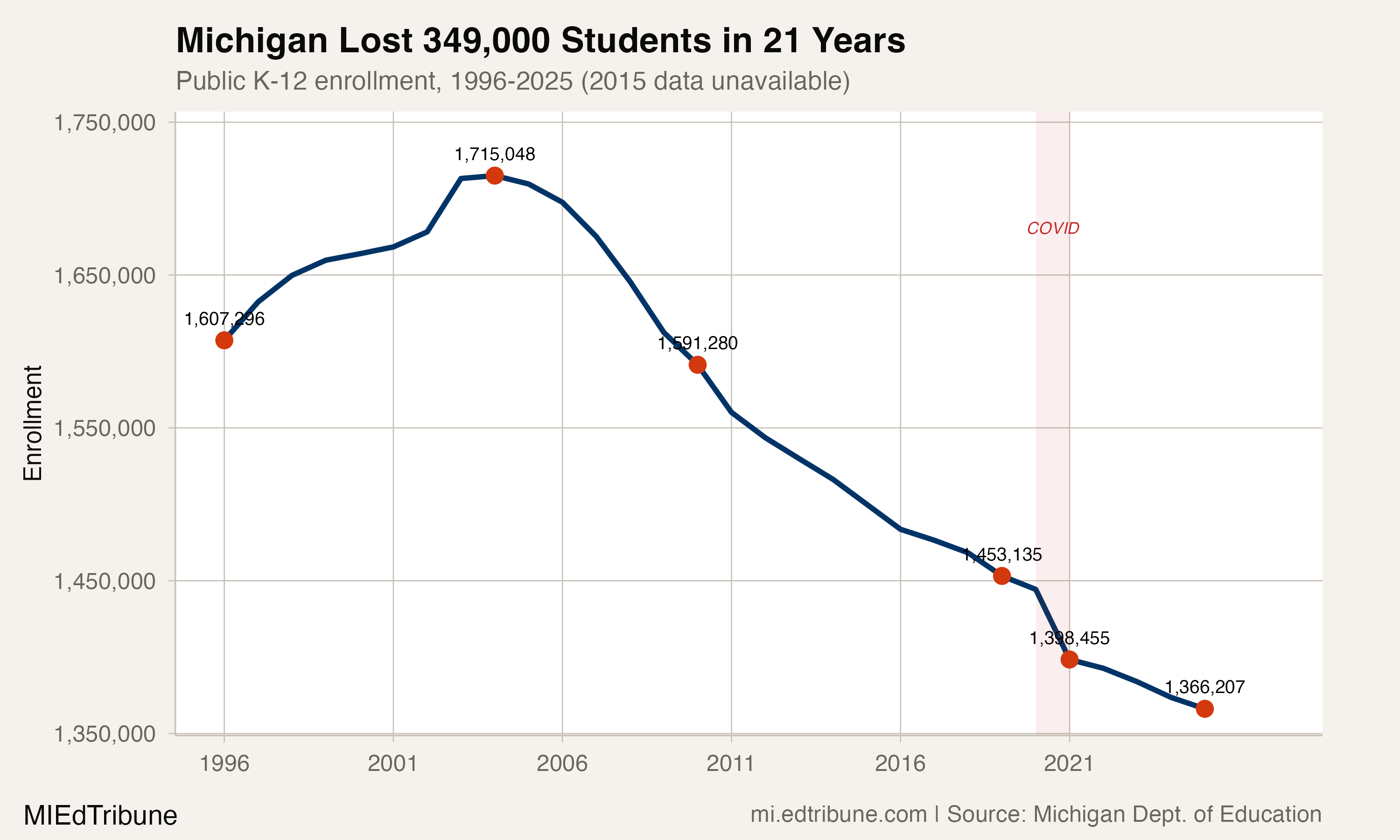
The decline before the decline
The framing matters for policy. If COVID "caused" Michigan's enrollment crisis, then the solution is recovery: get families back. If the state was already losing 15,000 to 17,000 students per year before the pandemic, the problem is structural. Recovery from a single bad year is beside the point.
This does not mean COVID had no effect. The pandemic pulled forward years of losses into a single year. Some of those students came back. Many did not. But the aggregate trajectory barely changed, and the distinction between "COVID caused this" and "COVID accelerated this" carries real consequences for how the state allocates resources.
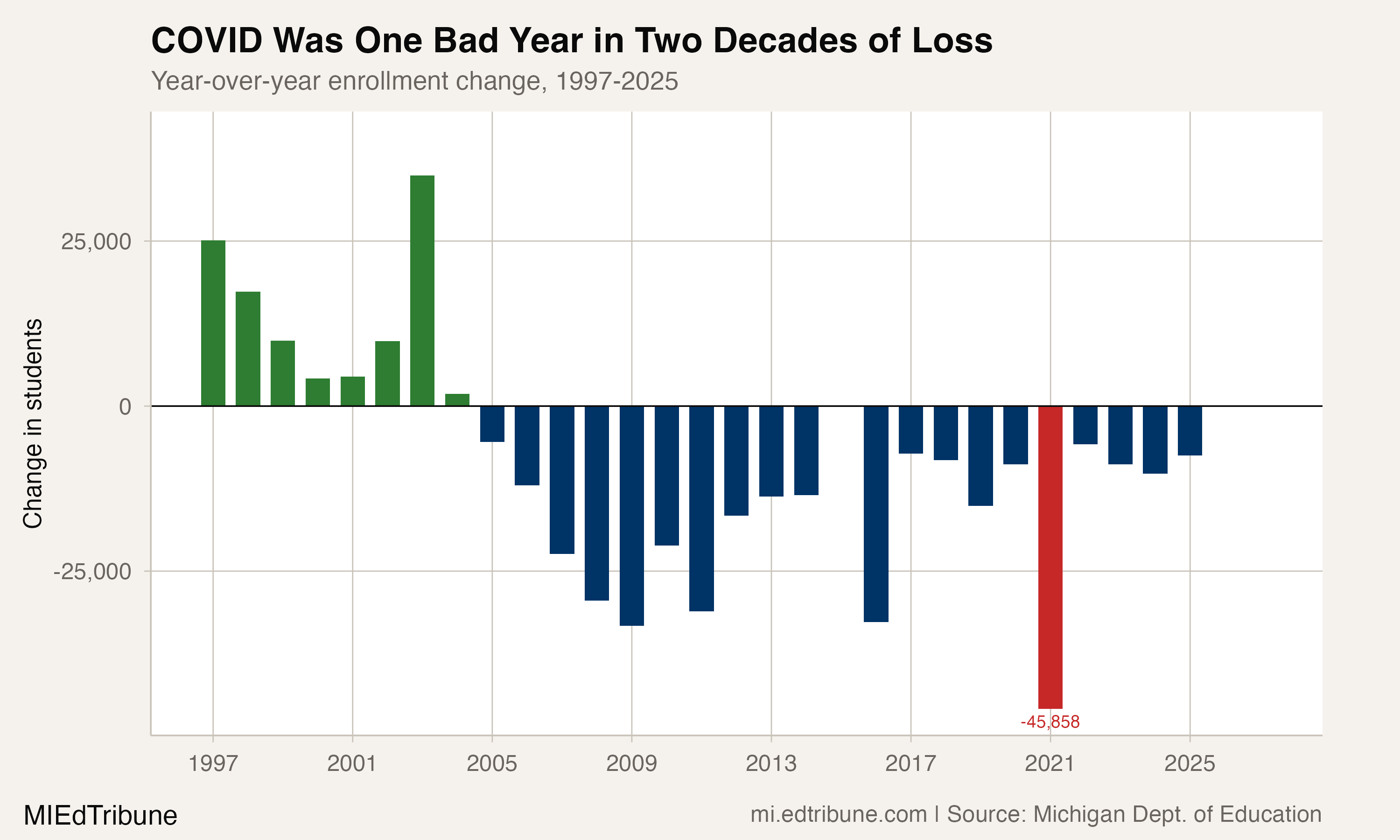
Where the students aren't coming back
Since 2019, Michigan has lost 86,928 public school students, a 6.0% decline across six years. Only 217 of 795 districts with comparable data, 27.3%, have returned to their 2019 enrollment levels.
The recovery rate is sharply divided by district size. Among the smallest districts, those with fewer than 500 students in 2019, 41.1% have recovered or grown. Among mid-size districts of 500 to 2,000 students, the rate drops to 22.8%. For districts enrolling 2,000 to 10,000 students, 17.9% have recovered. And among the 16 districts that enrolled 10,000 or more students in 2019, from Detroit Public Schools Community District↗ET to Utica Community Schools↗ET, the recovery rate is zero. Not one has returned to pre-pandemic levels.
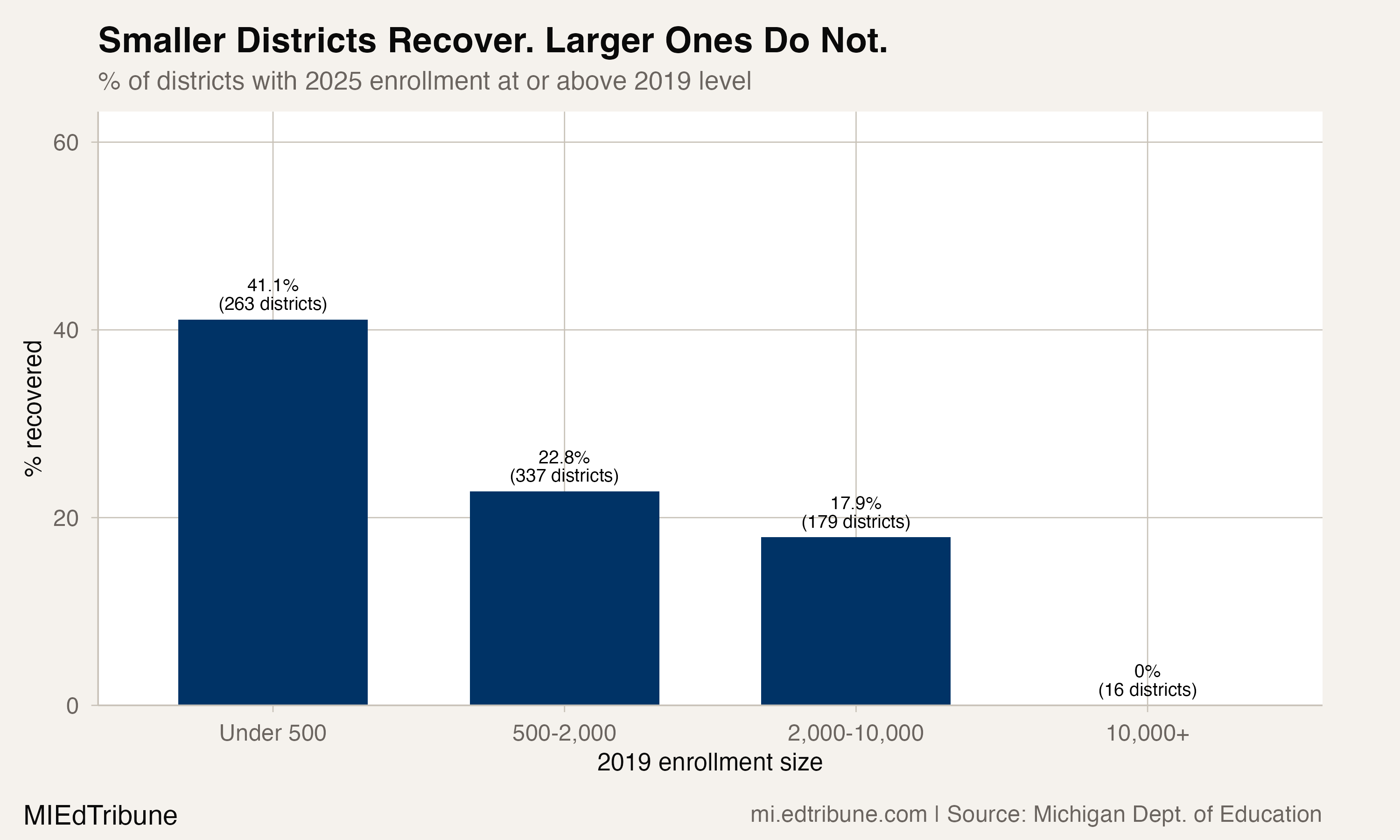
The pattern is consistent with what the Citizens Research Council of Michigan described in January 2024: larger districts face compounding pressures from school choice transfers, charter expansion, and demographic change that smaller, more geographically captive districts do not.
The virtual school surge
Among the few enrollment categories that grew during this period, virtual schools stand out. Combined enrollment at Michigan's identifiable virtual and online academies rose from roughly 11,400 students in 2019 to 18,400 in 2025, an increase of about 60%. Highpoint Virtual Academy of Michigan more than quadrupled, from 837 to 3,455 students. Lighthouse Connections Academy went from 274 to 2,056.
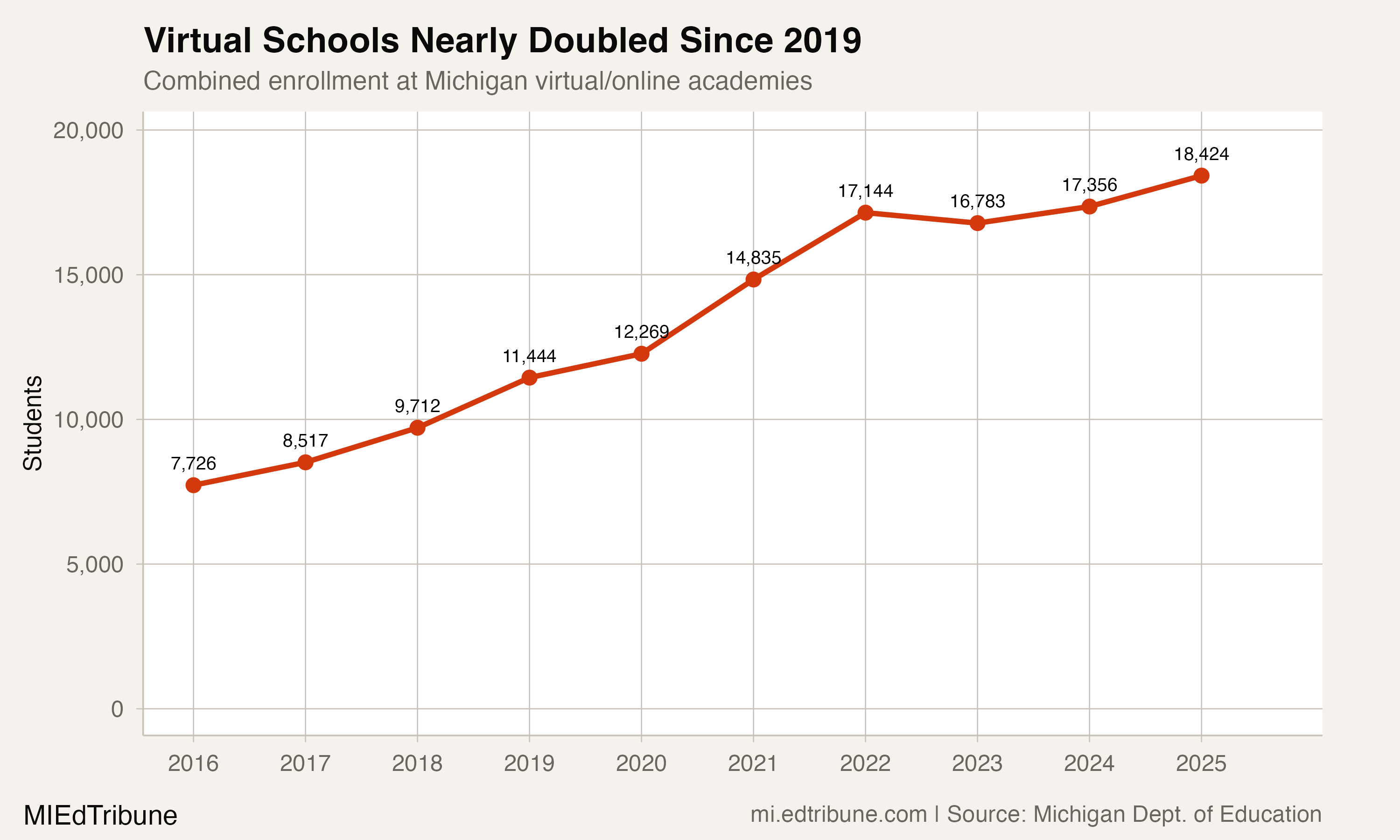
The pandemic jump is visible in the data, but the trajectory was upward before 2020 and has continued afterward. Virtual enrollment is not a temporary pandemic artifact in Michigan. It has become a permanent, growing segment of the public system, enrolling 18,400 students across at least 10 identifiable virtual academies.
A demographic transformation underneath the headline number
The net enrollment loss of 86,928 students since 2019 masks a significant compositional shift. White enrollment fell by 103,853 students, a 10.8% decline, accounting for more than the entire net loss. Black enrollment fell by 10,370 students, or 4.0%. Meanwhile, Hispanic enrollment grew by 12,724 students (10.9%), multiracial enrollment grew by 14,598 (24.1%), and Asian enrollment grew modestly by 1,070 (2.1%).
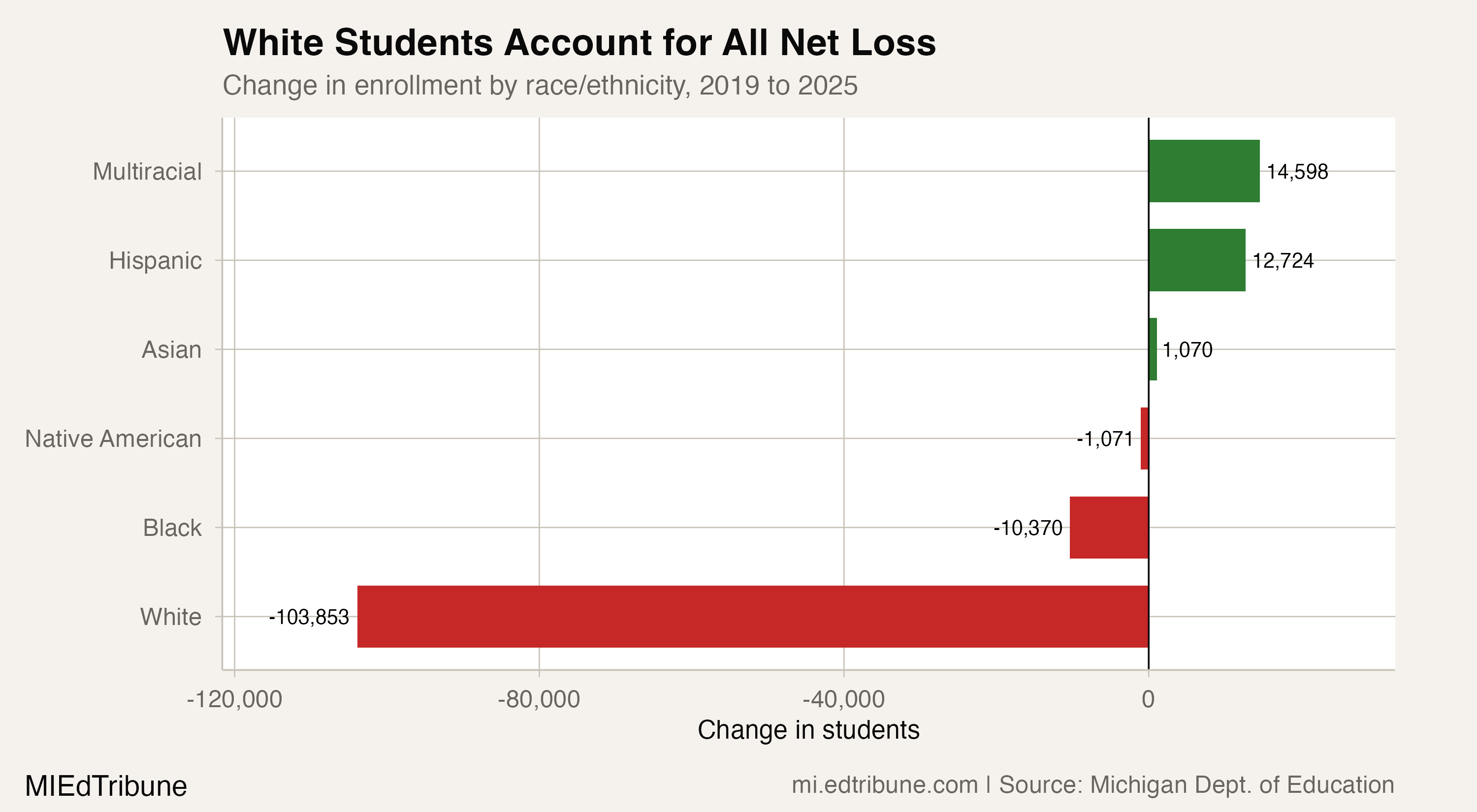
White students made up 66.0% of Michigan's public school enrollment in 2019. By 2025, that share had fallen to 62.6%. The student body is diversifying even as it shrinks, a pattern that has fiscal and programmatic implications for districts whose instructional programs were built for a different demographic profile.
What COVID actually changed
The pandemic did not alter Michigan's trajectory, but it did change two things about the enrollment landscape that show no sign of reverting.
The first is where families send their children. Private school enrollment in Michigan grew by nearly 10% in the four years following 2020, absorbing roughly 8,800 students from the public system. The initial trigger was frustration over pandemic closures, but the shift has largely persisted. Virtual school enrollment surged from roughly 11,400 to 18,400 students, a 60% increase. Combined, these exits pulled students out of traditional districts without reducing the overall school-age population.
The second change is the acceleration of kindergarten losses. Michigan enrolled 117,694 kindergartners in 2018-19. The pandemic year saw that collapse to 106,539. By 2024-25, kindergarten had recovered only to 108,230, still 8.0% below pre-pandemic levels. Those missing kindergartners are now missing first and second graders. The pandemic did not cause Michigan's birth rate to fall (it was already dropping), but it permanently lowered the share of five-year-olds whose families choose public school as the default entry point.
The Citizens Research Council of Michigan warned in January 2024 that schools face "the prospect of whether to close buildings with lower enrollments to ensure their long-term fiscal stability." That prospect is no longer hypothetical. Michigan schools received $6 billion in federal pandemic relief that temporarily insulated budgets from enrollment-driven funding losses. That money expired in late 2024. Districts now face the full fiscal weight of having fewer students in buildings designed for larger populations.
The building problem
The number of school buildings operated by traditional public school districts decreased by 12% since 2009-10, while enrollment dropped 16% over the same period. Buildings have closed, but not fast enough to match the decline.
This mismatch creates a per-pupil cost problem. Fixed costs like building maintenance, transportation routes, and administrative overhead do not shrink proportionally with enrollment. A district that loses 200 students still heats the same buildings, runs the same bus routes, and staffs the same central office. At $9,608 per pupil in state foundation funding, every departing student removes revenue without proportionally reducing costs.
Three districts recently received $75 million in state consolidation grants to merge and modernize: Flint Community Schools, North Central Area Schools, and Union City Community Schools. Flint plans to close four underused buildings, reducing its active facilities to seven. But district consolidation remains rare. Despite 231 districts sitting at all-time enrollment lows in 2025, local resistance to merging is strong.
What the next decade looks like
Michigan's enrollment trajectory is not a mystery. The children who will enter kindergarten in 2030 have already been born. The state's demographic projections, which predate the pandemic, point to continued decline regardless of what happens with school choice, private schools, or post-pandemic recovery. The five-to-17-year-old population is projected to fall from 1.58 million to about 1.26 million by 2050, a further decline of roughly 300,000 children.
Michigan's enrollment will not recover. The children who would have filled those seats were never born. The 231 districts at all-time lows are operating on timelines measured in budget cycles, not decades, and the $6 billion federal safety net that bought them time ran out at the end of 2024. Flint just received $36 million to close four buildings. The other 230 districts at record lows have not received anything.
Detailed code that reproduces the analysis and figures in this article is available exclusively to EdTribune subscribers.
Discussion
Sign in to join the discussion.
Loading comments...