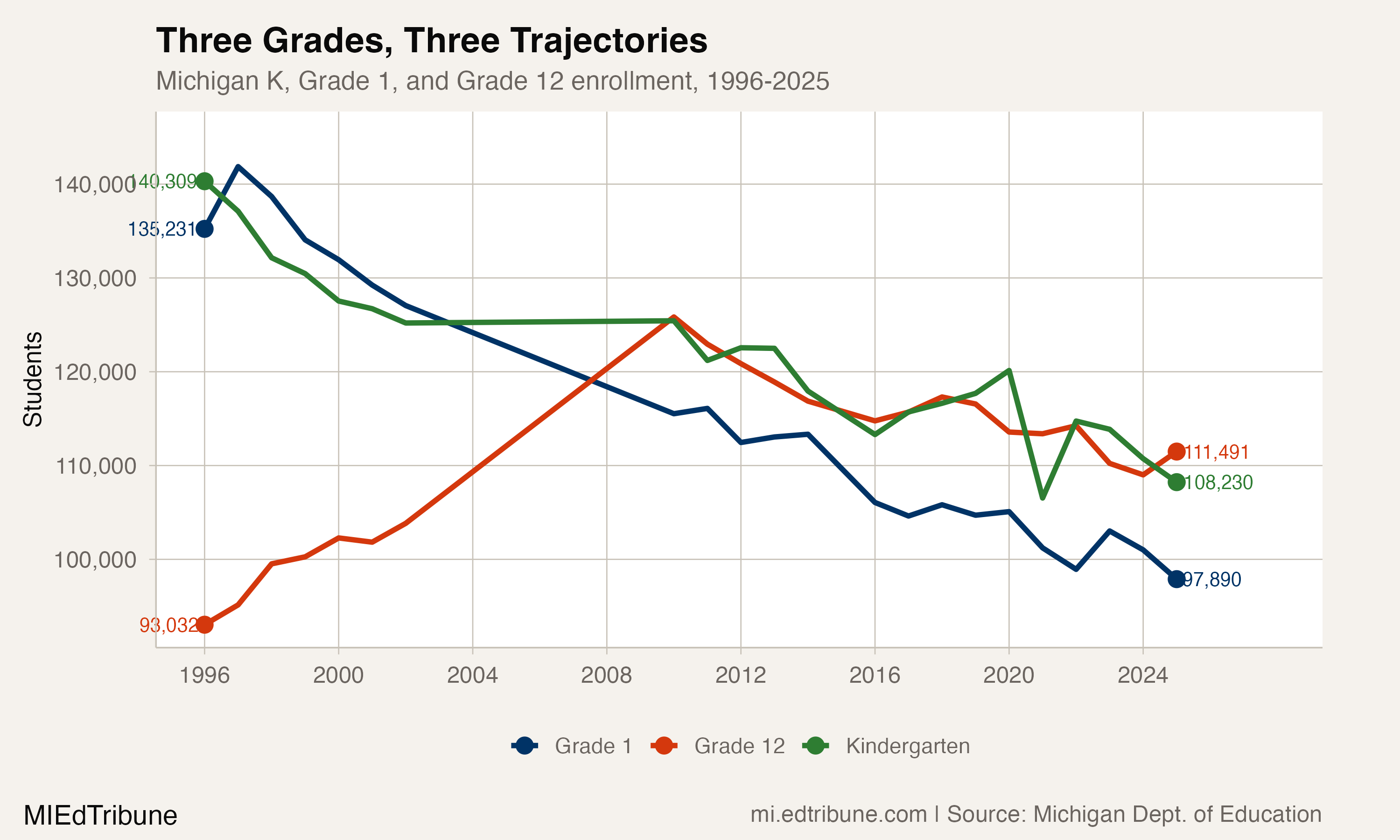
In 1996, Michigan enrolled 140,309 kindergartners and 93,032 seniors. The front of the pipeline was 51% larger than the back. In 2025, that relationship has reversed: 108,230 kindergartners feed a system with 111,491 seniors. Grade 12 now outnumbers kindergarten by 3,261 students.
The inversion took 29 years to build. Grade 1 enrollment fell 27.6%, from 135,231 to 97,890. Grade 12 grew 19.8%, from 93,032 to 111,491. Those two numbers, moving in opposite directions across nearly three decades, define a structural problem that Michigan's K-12 system is only beginning to feel at the high school level.
The elementary system absorbed the losses first
The damage is not evenly distributed across the grade span. Michigan's K-8 grades have lost 229,625 students since 1996, a 19.9% decline. Grades 9-12 have lost just 11,464, a 2.5% decline. The high school system has been insulated for decades by the simple mechanics of time: it takes 13 years for a small kindergarten class to reach senior year.
That insulation is ending. High school enrollment peaked at 525,168 in 2010, when the large cohorts of the late 1990s moved through, and has since fallen 16.2% to 440,089. The decline accelerated after 2019, with 9-12 enrollment dropping 31,611 in six years.
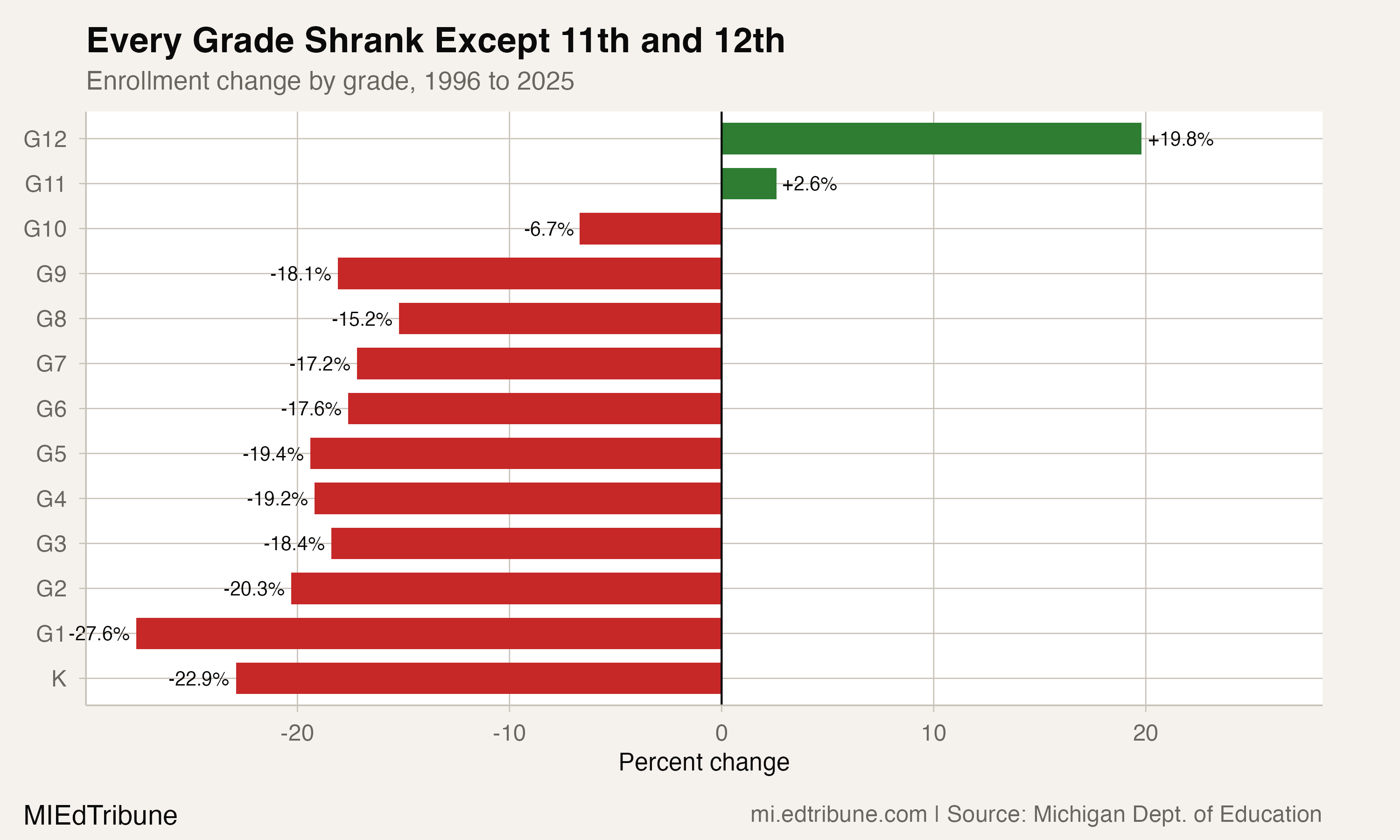
Every grade except 11th and 12th has fewer students today than in 1996. The pattern is broadly linear: the younger the grade, the steeper the loss. Kindergarten has shed 22.9% of its students. The elementary grades (1 through 5) have each lost between 18% and 28%, while middle school grades are down 15% to 18%. The line does not cross into growth until 11th grade (+2.6%) and 12th (+19.8%).
Where the kindergartners go
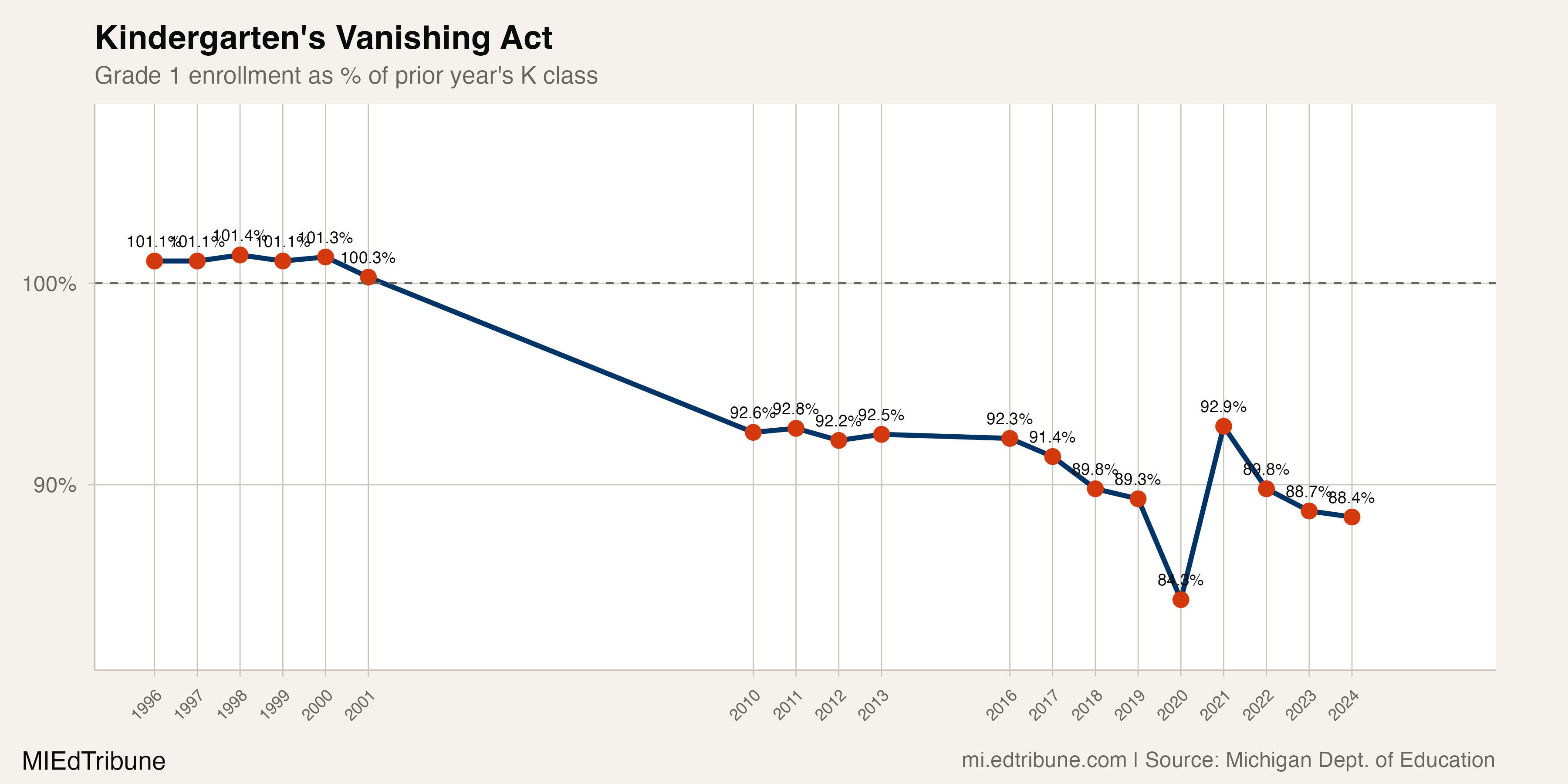
One of the more puzzling features of Michigan's grade data is what happens between kindergarten and first grade. In the late 1990s, more students showed up in first grade than had been in kindergarten the prior year, with transition rates of 101%. By 2025, only 88.4% of the prior year's kindergartners appeared in first grade, meaning roughly one in nine kindergartners vanishes from the system before first grade.
Michigan does not require kindergarten attendance. The state is one of more than a dozen where enrollment before age six is optional. S.B. 285, which would have mandated kindergarten starting in 2025-26, passed the Senate in April 2024 but died in the House. The opt-out provision and general non-requirement mean some families enroll children in kindergarten to test the waters, then hold them back or move to private or homeschool settings before first grade.
The K-to-G1 drop also reflects a broader shift in how families approach early education. The pandemic accelerated this: only 84.3% of the 2019-20 kindergarten class appeared as first graders in fall 2020, the lowest transition rate in the dataset. Michigan's K enrollment then cratered to 106,539 in the 2020-21 school year as families delayed entry entirely. The rate has not returned to pre-pandemic levels, sitting between roughly 88% and 89% for the three most recent G1 classes.
The 9th grade bulge
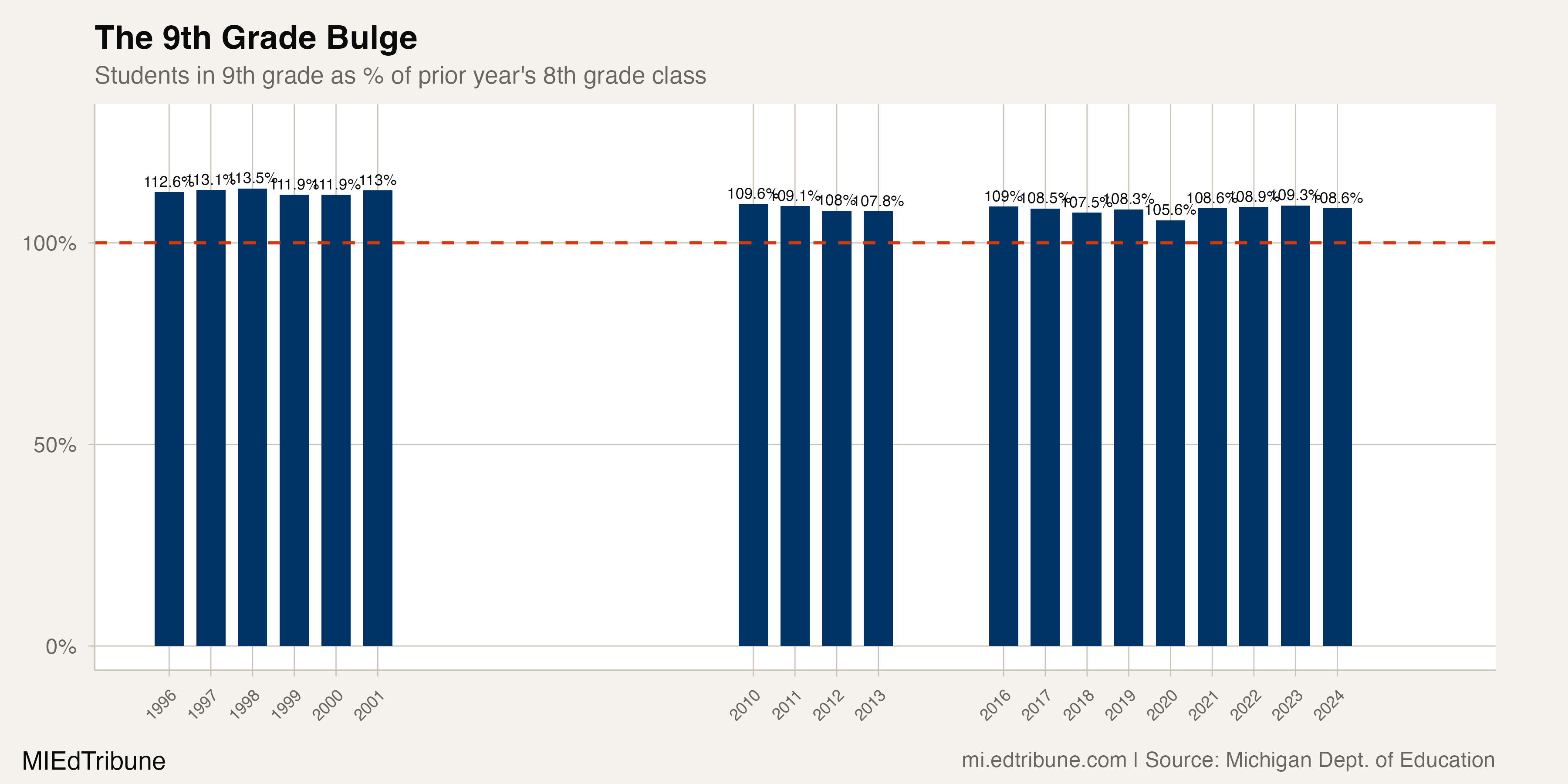
At the other end of the system, a persistent anomaly inflates high school numbers. Every year in the dataset, Michigan's 9th grade class is larger than the 8th grade class that preceded it. The average cohort transition rate from 8th to 9th grade is 109.7%, meaning roughly 11,500 additional students appear in 9th grade each year beyond what the 8th grade pipeline would predict.
This is not a Michigan-specific phenomenon. Research from the Everyone Graduates Center at Johns Hopkins has documented the "9th grade bulge" as a national pattern driven primarily by retention. Students who fail 9th grade repeat it, inflating the count. A study published in the Journal of Research on Educational Effectiveness found that about 14% of first-time 9th graders were retained, and that "annual exit rates of 30 percent or more for students who fail 9th or 10th grade mean it is very unlikely that such students will ever graduate."
The bulge has narrowed somewhat in Michigan. In the late 1990s, the excess ran 11% to 13%. In recent years it has fluctuated between 7% and 11%. The COVID-disrupted 2020-21 cohort showed the smallest bulge (105.6%), possibly reflecting relaxed retention policies during the pandemic. By 2023-24, it had climbed back to 109.3%.
Seniors are staying longer too
A parallel shift has occurred at the 11th-to-12th transition. In the late 1990s, only 91% to 92% of juniors appeared as seniors the following year. By 2016, the rate crossed 100% for the first time. It has stayed above 100% every year since, reaching 101.8% in the most recent cohort.
More seniors are in the pipeline than juniors fed into it. This likely reflects a combination of 5th-year seniors completing credit recovery, students returning from alternative placements, and transfer-ins from other systems. Michigan's graduation rate has climbed to 84% for the Class of 2025, the highest on record, suggesting that schools are retaining more students through completion rather than losing them to dropout.
What this means for high school budgets
The high school system's relative stability is a temporary condition. The 2025 kindergarten class of 108,230 will reach 12th grade around 2037. If that cohort follows the same K-to-G12 attrition pattern as the 2013 kindergarten class (which became the 2025 senior class), Michigan would graduate roughly 98,500 seniors that year, about 13,000 fewer than the 2025 senior class.
The fiscal arithmetic is straightforward. At Michigan's current per-pupil foundation allowance of $9,608, each lost student removes nearly $10,000 from a district's operating budget. The K-8 enrollment decline since 1996 (229,625 students) represents over $2.2 billion in annual funding that elementary and middle schools no longer receive. High schools have been largely shielded from this pressure, but the smaller cohorts now moving through middle school will arrive.
The pipeline inversion creates a particular kind of staffing trap. A district with shrinking elementary grades and stable high school grades cannot simply shift teachers from one level to the other: elementary certification does not cover secondary content areas. The result is simultaneous overstaffing at one end and sustained demand at the other. Districts that closed elementary wings years ago are now watching those savings get absorbed by high school classes that have not yet thinned out.
The Citizens Research Council has documented how Michigan's school-age population is projected to continue shrinking through mid-century. Traditional public schools have already reduced buildings by 12% since 2010, but enrollment has fallen 16% over the same period, leaving many facilities underutilized.
High school's growing share
The pipeline inversion has quietly reshaped the composition of Michigan's K-12 system. In 1996, grades 9-12 accounted for 28.1% of all students. By 2025, that share has grown to 32.2%. High school students now make up nearly a third of total enrollment, up from just over a quarter.
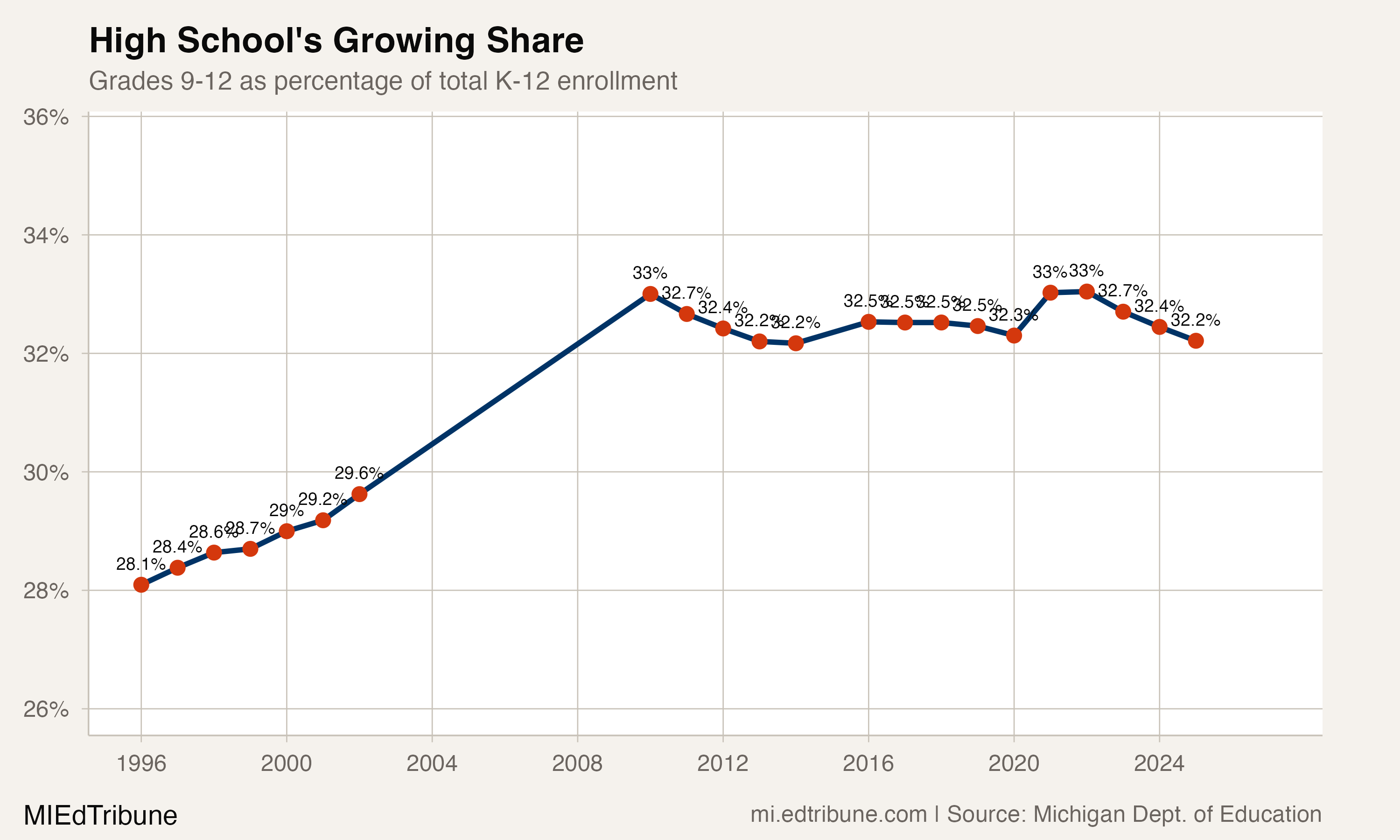
This shift carries operational consequences. High school instruction costs more per pupil than elementary instruction. Smaller class sizes in advanced courses, specialized lab equipment, career and technical education programs, and athletic facilities all carry higher price tags. A system that is proportionally more high school and less elementary faces different staffing ratios, different facility needs, and different transportation patterns than the one Michigan built in the 1990s.
The 2025 grade staircase tells the story in a single snapshot. Grade 1 is the smallest class in the system at 97,890. Grade 9 is the largest at 112,014. The difference between those two grades, 14,124 students, is the pipeline gap that will take eight years to close as the smaller entry-point classes work their way through.
High school enrollment will decline. The kindergarten classes of the last decade have already decided that. The 2025 first-grade class of 97,890 will become the senior class of 2037, roughly 13,000 fewer than the 111,491 students in the 2025 senior class. Grand Rapids Public Schools↗ET is closing 10 buildings over five years. The districts that do not begin planning now will be making the same announcements in 2030, except they will be closing high school wings instead of elementary ones.
Detailed code that reproduces the analysis and figures in this article is available exclusively to EdTribune subscribers.
Discussion
Sign in to join the discussion.
Loading comments...