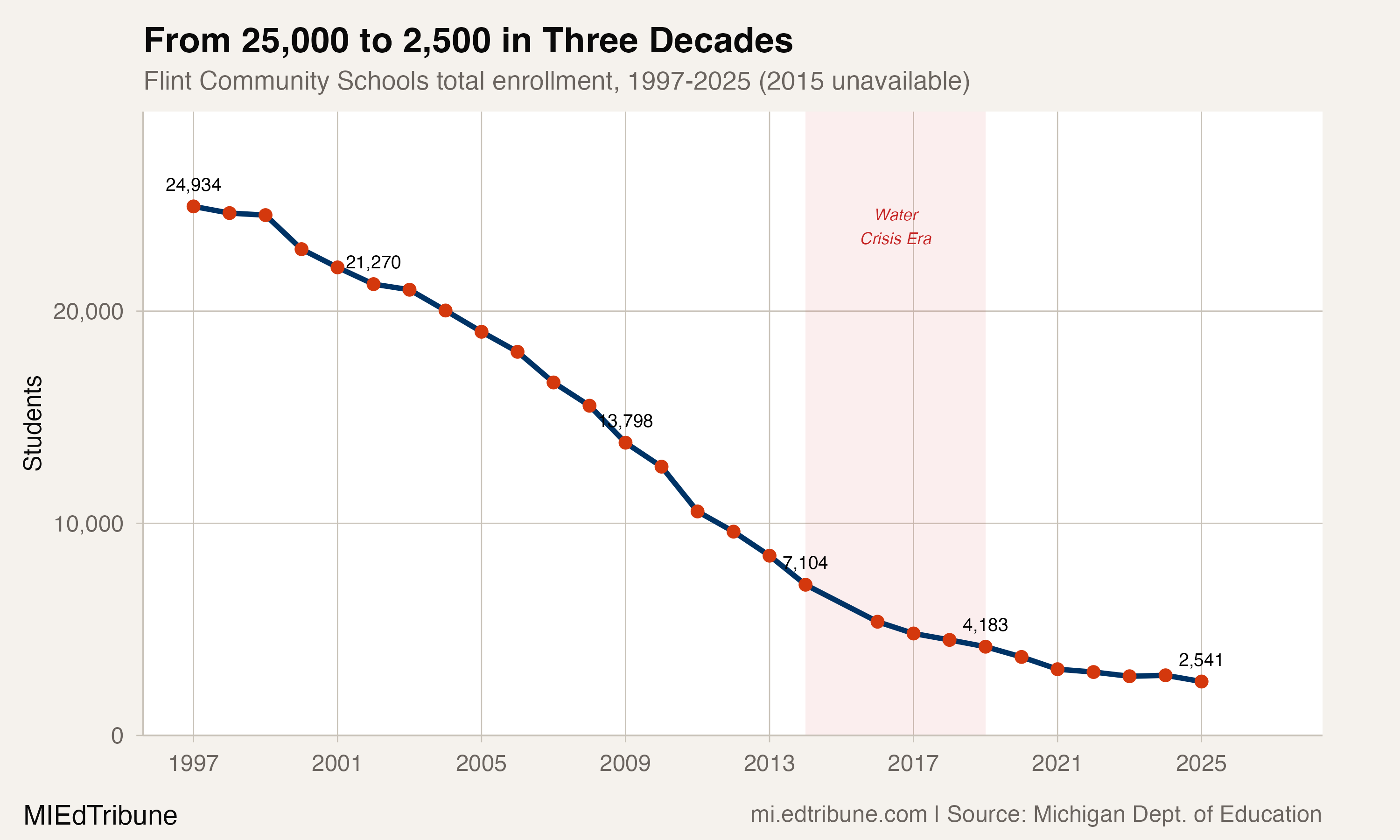
In 1997, Flint Community Schools↗ET enrolled 24,934 students. In 2025, that number is 2,541. Nine out of every ten students are gone.
The water crisis, which became national news in 2015, is the chapter most people know. It accelerated the collapse. But the enrollment data tells a longer, more layered story: Flint was hemorrhaging students for nearly two decades before lead entered the water supply, and it has continued to lose them for a decade since. The crisis was a turning point, not an origin point.
Five eras of decline
The 89.8% drop from 24,934 to 2,541 did not happen at a constant pace. It moved through distinct phases, each with its own drivers, and the annualized rate of loss tells the story of a district where job losses, charter competition, emergency management, lead contamination, and a pandemic each arrived before the last blow had healed.
1997 to 2002: Deindustrialization takes hold. Flint lost 3,664 students, a 14.7% decline averaging 3.1% per year. General Motors, which once employed 80,000 workers in the Flint area, had been shedding jobs since the 1980s. Population was already falling. The school district lost about 730 students a year during this stretch, a manageable decline by later standards.
2002 to 2009: Charter schools and schools of choice. The decline doubled to 6.0% annually. Flint lost 7,472 students in seven years, falling from 21,270 to 13,798. Michigan's schools of choice program allowed students to transfer to neighboring districts without a release from Flint, and charter school enrollment statewide was expanding rapidly. By 2009, Flint enrolled barely more than half the students it had in 1997.
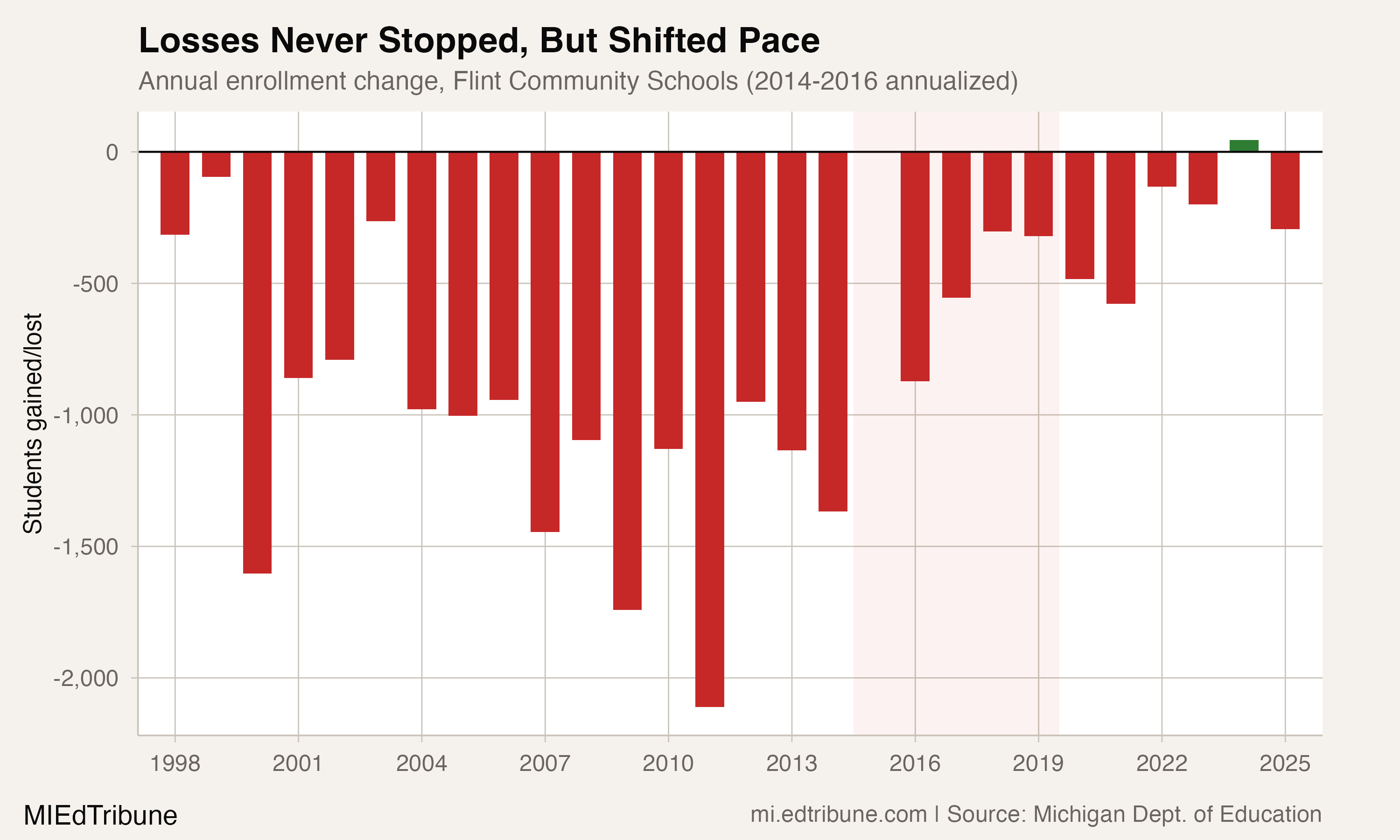
2009 to 2014: Emergency management and school closures. The worst period. Annualized losses hit 12.4%, with enrollment plunging from 13,798 to 7,104. Flint was placed under state-appointed emergency management in 2011, and the district closed and consolidated buildings aggressively. The single worst year on record was 2011, when 2,111 students left, a 16.7% single-year drop. By 2014, Flint enrolled barely half the students it had five years earlier.
2014 to 2019: The water crisis. The city switched its water supply to the Flint River in April 2014, exposing residents to lead contamination. A state of emergency was declared in January 2016. Enrollment fell from 7,104 to 4,183, a 41.1% decline over five years (10.1% annually). The 2014-to-2016 period, which spans the worst of the crisis, saw a 24.5% drop in just two years. Families relocated to surrounding districts and counties. The damage extended beyond enrollment: a 2024 study in Science Advances by researchers at Princeton and the University of Michigan found that math achievement in Flint dropped by 0.14 standard deviations following the crisis, while special education identification rose by 1.2 percentage points.
2019 to 2025: COVID and continued erosion. Another 1,642 students gone, a 39.3% decline at 8.0% per year. The 2019-2021 period alone saw a 25.4% loss of 1,061 students. A brief uptick of 45 students in 2024 was erased by a 294-student loss in 2025, a 10.4% drop.
The crisis did something the factories didn't
The distinction matters. Deindustrialization was a slow grind. The water crisis, by contrast, shattered trust in the institutions meant to protect children.
Bridge Michigan reported in May 2024 that the share of Flint graduating seniors enrolling in college within six months dropped from 59% in 2014-15 to 25% by 2022-23, compared to a statewide average of 53%. The four-year graduation rate fell from 59% to 35% over the same period, while the state average rose from 80% to 82%.
"There are so many aspects beyond lead that influence learning in Flint. Like adequate access to healthy food -- Flint has food deserts." -- Melodie Marsh, Howard University freshman and Flint native, Bridge Michigan, May 2024
The Princeton and University of Michigan researchers found something that complicates the lead-exposure narrative. Children living in homes with lead service lines showed similar academic declines to those with copper pipes, suggesting that the community-wide trauma of the crisis, not just lead poisoning itself, was the dominant force. The crisis triggered a cascade: family relocation, institutional distrust, disrupted routines, and a stigma that made it harder for Flint schools to attract and retain students.
Special education enrollment in Flint rose from 15% of students in 2014-15 to 23% by 2022-23, compared to 14% statewide. Whether that reflects genuine lead-related developmental harm, heightened screening in a community under scrutiny, or lower-need families leaving and concentrating higher-need students in the district is a question the enrollment data alone cannot resolve. The most plausible explanation involves all three.
Worse than anywhere else in Michigan
Every major Michigan city lost enrollment over this period. None lost it like Flint.
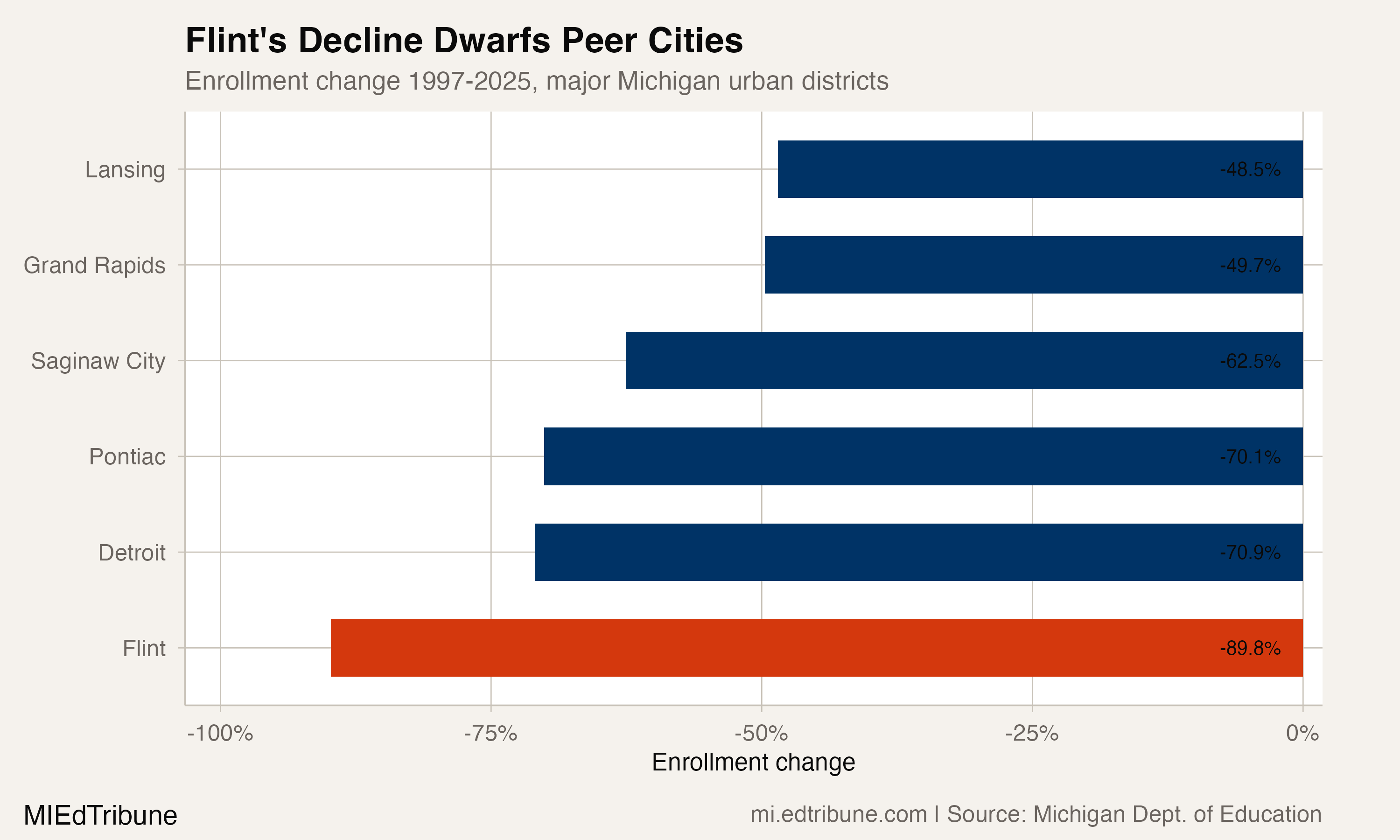
Detroit's 70.9% decline, from 165,323 to 48,117, comes closest. Pontiac is just behind at 70.1%. Saginaw City shed 62.5% of its students, while Grand Rapids and Lansing, cushioned by somewhat more stable economic bases, lost roughly half each (49.7% and 48.5%).
Flint's 89.8% stands apart. The gap between Flint and the next-worst performer, Detroit, is nearly 19 percentage points. In 1997, Flint accounted for 1.53% of Michigan's total enrollment. In 2025, that share is 0.19%, a district that once served more students than many mid-sized suburbs now visible only as a rounding error in statewide totals.
A kindergarten class the size of a single school
The pipeline data points to continued contraction. Flint enrolled 2,456 kindergartners in 1997. In 2025, it enrolled 247, an 89.9% decline that mirrors the overall trajectory almost exactly.
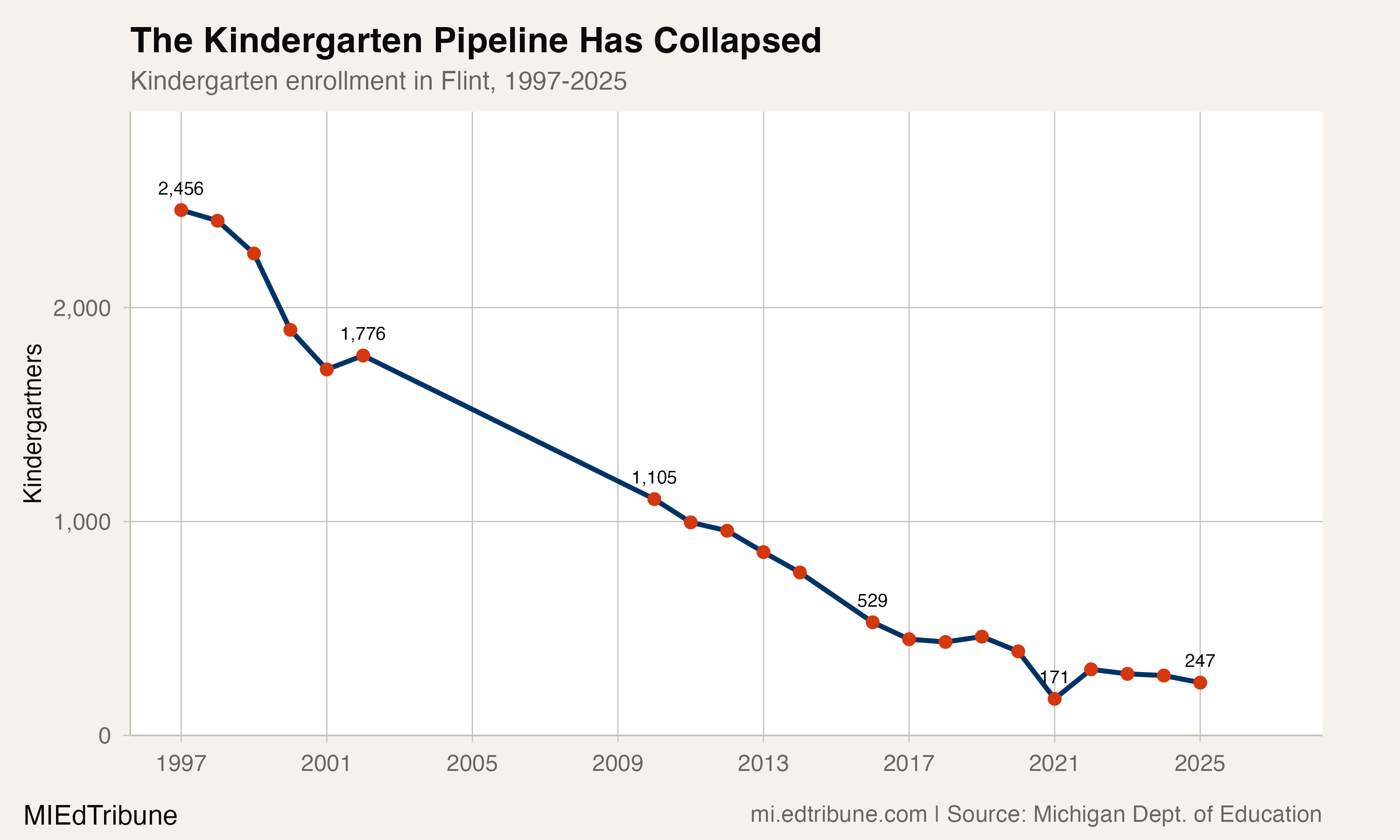
The COVID-era low was 171 kindergartners in 2021. Enrollment has partially recovered from that trough but remains far below pre-pandemic levels. At 247 students, the entire kindergarten class is smaller than a single elementary school in most Michigan districts.
Each kindergarten cohort becomes the district's future. With roughly 250 students entering each year, Flint is on track to sustain total enrollment somewhere near 2,500 to 3,000 for the foreseeable future, assuming retention rates hold. If they don't, the district will shrink further.
Who stayed
The demographic composition of the district has shifted, though less than the raw numbers might suggest.
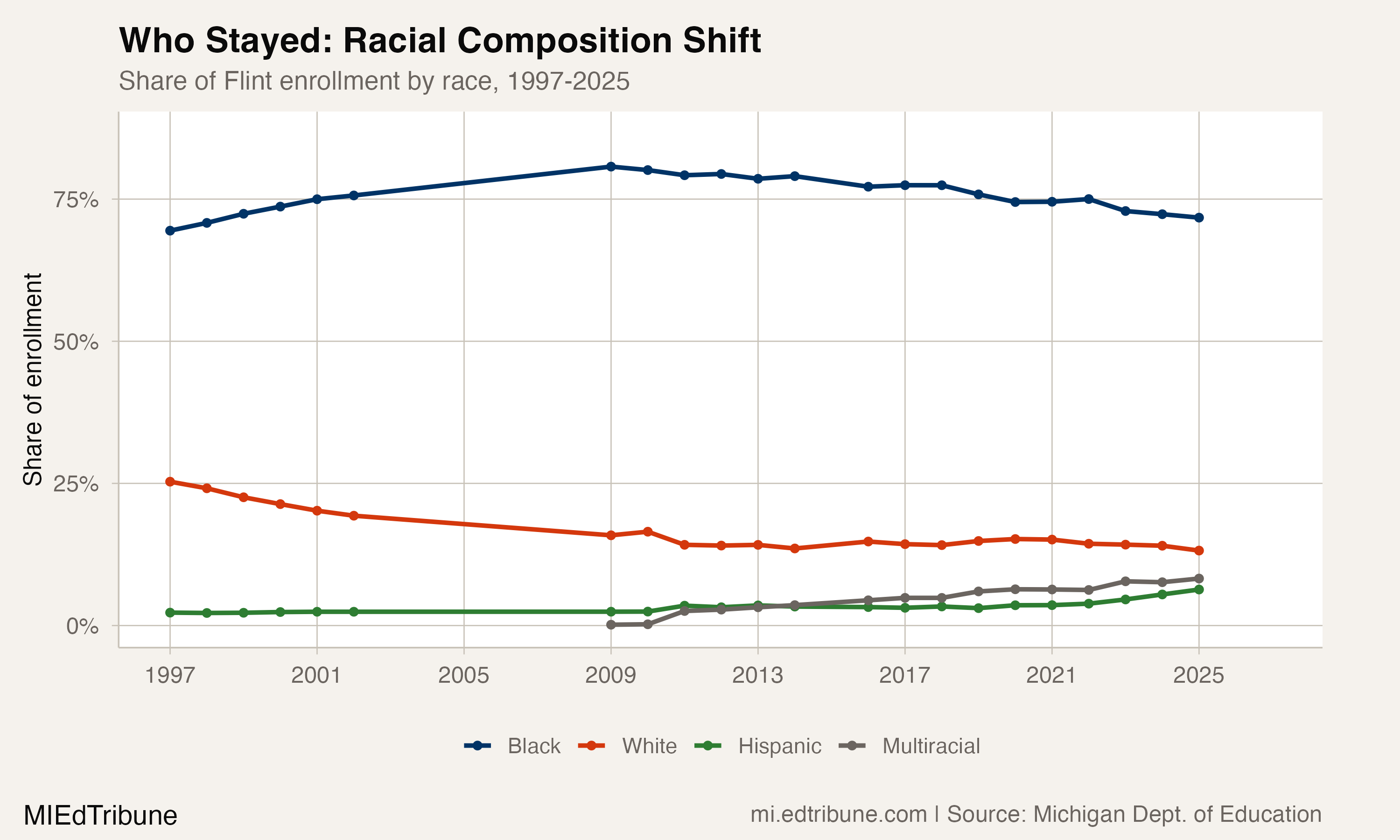
In 1997, Flint was 69.5% Black and 25.3% white. In 2025, it is 71.7% Black and 13.2% white. White enrollment fell 94.7%, from 6,309 to 335 students. Black enrollment fell 89.5%, from 17,317 to 1,823. Both groups lost roughly nine out of ten students, but white families left slightly faster, halving the white share from a quarter to an eighth of the district.
Hispanic enrollment grew from 2.3% to 6.3% of the total, and multiracial students now account for 8.3%, though these rising shares reflect a shrinking denominator more than large absolute gains. In raw numbers, Hispanic enrollment fell from 566 to 161.
A gender imbalance has also emerged. In 1997, the district was 50.2% male and 49.8% female. By 2025, it is 55.5% male and 44.5% female. That 11-point swing suggests families with daughters may be transferring out at higher rates, or that the remaining population of students receiving specialized services skews male, consistent with national patterns in special education enrollment.
Building a smaller district
In April 2025, the Michigan Department of Education awarded Flint Community Schools $35.9 million to consolidate from 11 active school buildings to seven and construct a new high school. The grant was part of a $75 million state appropriation shared among three districts. The Charles Stewart Mott Foundation contributed $750,000 for design and planning.
The consolidation acknowledges a reality the enrollment data has been broadcasting for years: a district that once needed dozens of buildings now operates with a student body that would fit in a single large high school. Closing underutilized facilities and concentrating resources is a rational response to a 90% enrollment decline, but it is also an admission that the students are not coming back.
Forty-five students returned in 2024. Then 294 left in 2025. The $36 million consolidation grant will build a new high school and close four buildings by 2027. If it works, Flint stabilizes near 2,500 students in seven modern facilities. If it does not, the district that once needed dozens of school buildings will continue to contract inside the seven that remain. Two hundred forty-seven kindergartners enrolled in 2025, the most recent year on record. That is the incoming class. That is the floor the new high school will be built for.
Detailed code that reproduces the analysis and figures in this article is available exclusively to EdTribune subscribers.
Discussion
Sign in to join the discussion.
Loading comments...