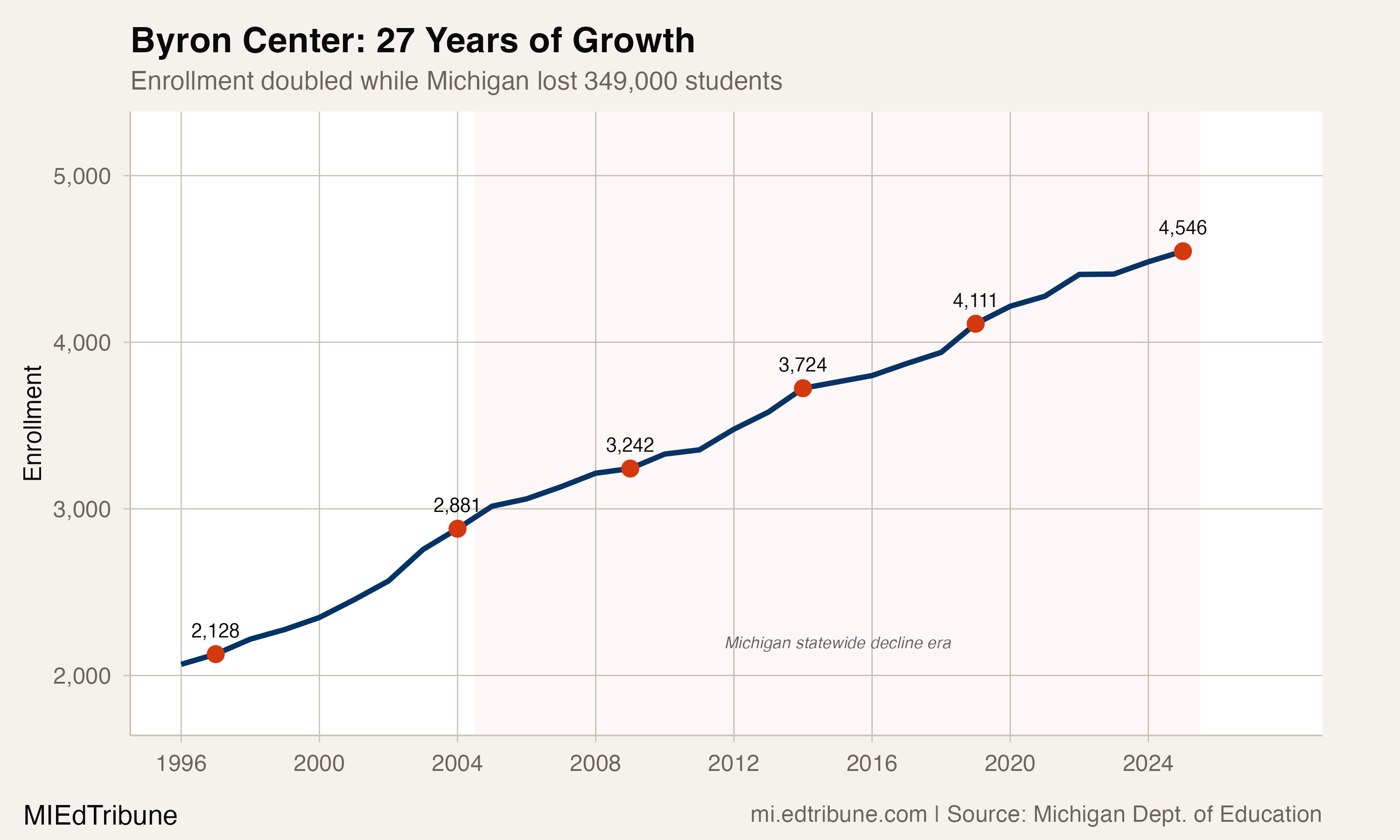
In every year of available data from 1997 through 2025, Byron Center Public Schools has counted more students than the year before. Not once in 28 consecutive measurements has enrollment declined. (Michigan's 2015 data file is unavailable statewide, but the district grew from 3,724 in 2014 to 3,800 in 2016, consistent with the pattern.) The district south of Grand Rapids enrolled 2,128 students in 1997. In 2025, it enrolled 4,546, an increase of 113.6%.
No other district in Michigan comes close. The next-longest active growth streak belongs to Whiteford Agricultural Schools, at 10 years. Byron Center's run is nearly three times as long, maintained through two recessions, a statewide enrollment collapse, and a pandemic that drove tens of thousands of Michigan families out of public schools entirely.
Growth in a state that forgot how
Michigan's statewide enrollment peaked at 1,715,048 in 2004 and has declined every year since, a 20-year losing streak that has erased 348,841 students (20.3% of the total). Only 30.4% of districts with data in both 2004 and 2025 managed any enrollment growth at all during that period.
Byron Center grew through all of it. From 2004 to 2025, the district added 1,665 students, a 57.8% increase, while the state shed a population equivalent to the entire Grand Rapids Public Schools system and then some.
The growth has not been uniform. Byron Center's biggest single-year gain came in 2003, when it added 189 students, a 7.4% jump. Its smallest came in 2023, when it grew by exactly two students, a 0.05% gain that barely kept the streak alive. The average annual addition over the full run is 89 students.
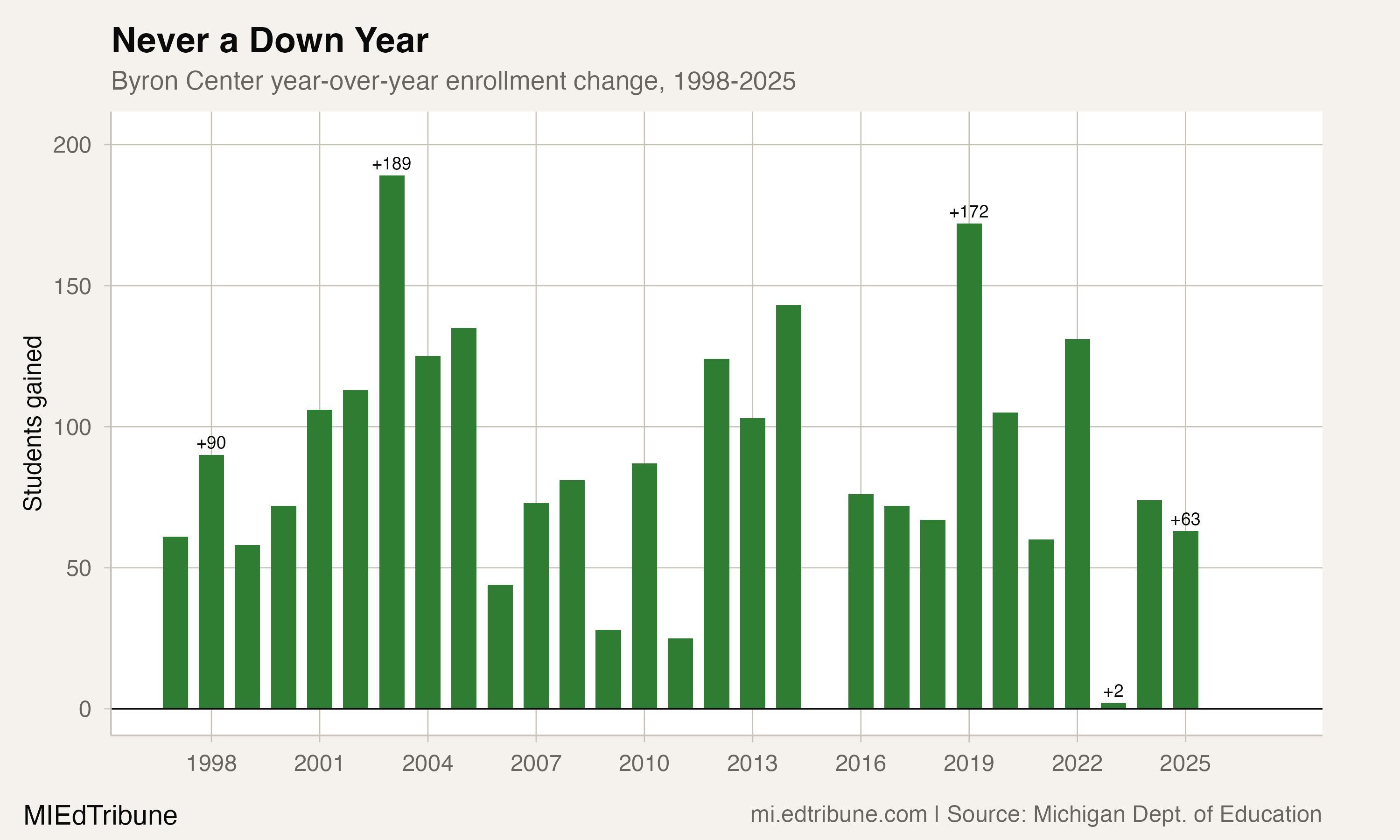
That near-miss in 2023 stands out. Byron Center added 131 students in 2022, then just two the following year, then bounced back to 74 in 2024 and 63 in 2025. Whether the streak survives another decade depends on whether the pipeline of new families moving into Byron Township can keep pace with the demographic headwinds facing the entire state.
The suburban inversion
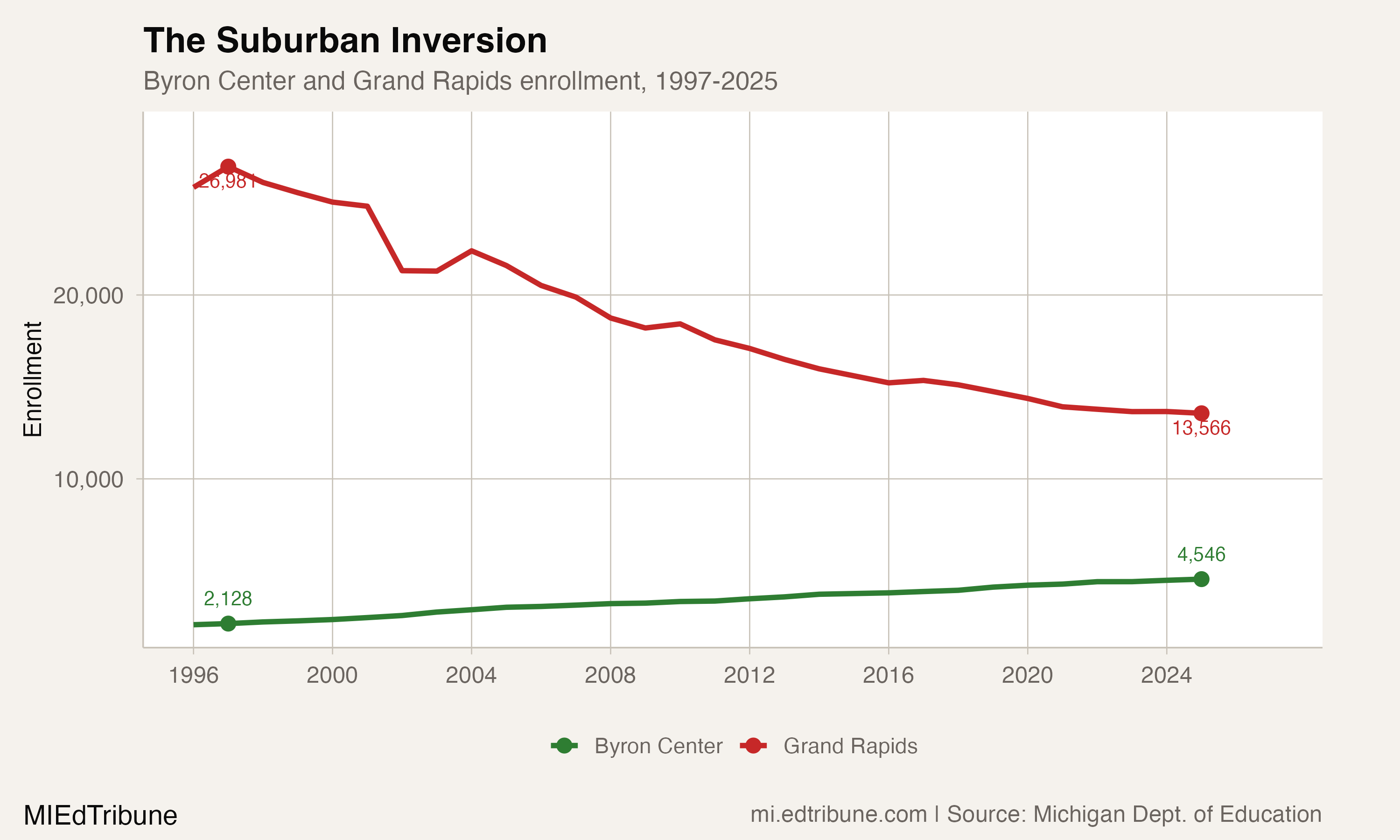
Byron Center's trajectory is inseparable from Grand Rapids' decline. Grand Rapids Public Schools↗ET peaked at 26,981 students in 1997, the same year Byron Center's streak began. Grand Rapids has since lost 49.7% of its enrollment, falling to 13,566 students. In 1997, Byron Center enrolled 7.9% as many students as Grand Rapids. By 2025, the ratio had reached 33.5%.
This is not solely a Byron Center story. Across the Grand Rapids outer ring, most suburban districts have grown since 1997. Caledonia↗ET added 60.1%, Zeeland 43.7%, Forest Hills 24.7%. But Byron Center↗ET leads them all by a wide margin, and it is the only one still growing.
Caledonia, Byron Center's neighbor to the east, ran a 21-year growth streak of its own from 1997 to 2018 before stalling. It peaked at 4,773 students in 2018 and has since declined 4.4% to 4,561. Hudsonville↗ET, another outer-ring district, peaked in 2020 at 6,958 and has declined for five consecutive years to 6,654.
The inner ring tells a starker story. Wyoming Public Schools, which sits between Grand Rapids and Byron Center, lost 32.2% of its enrollment over the same period, falling from 5,552 to 3,767 students.
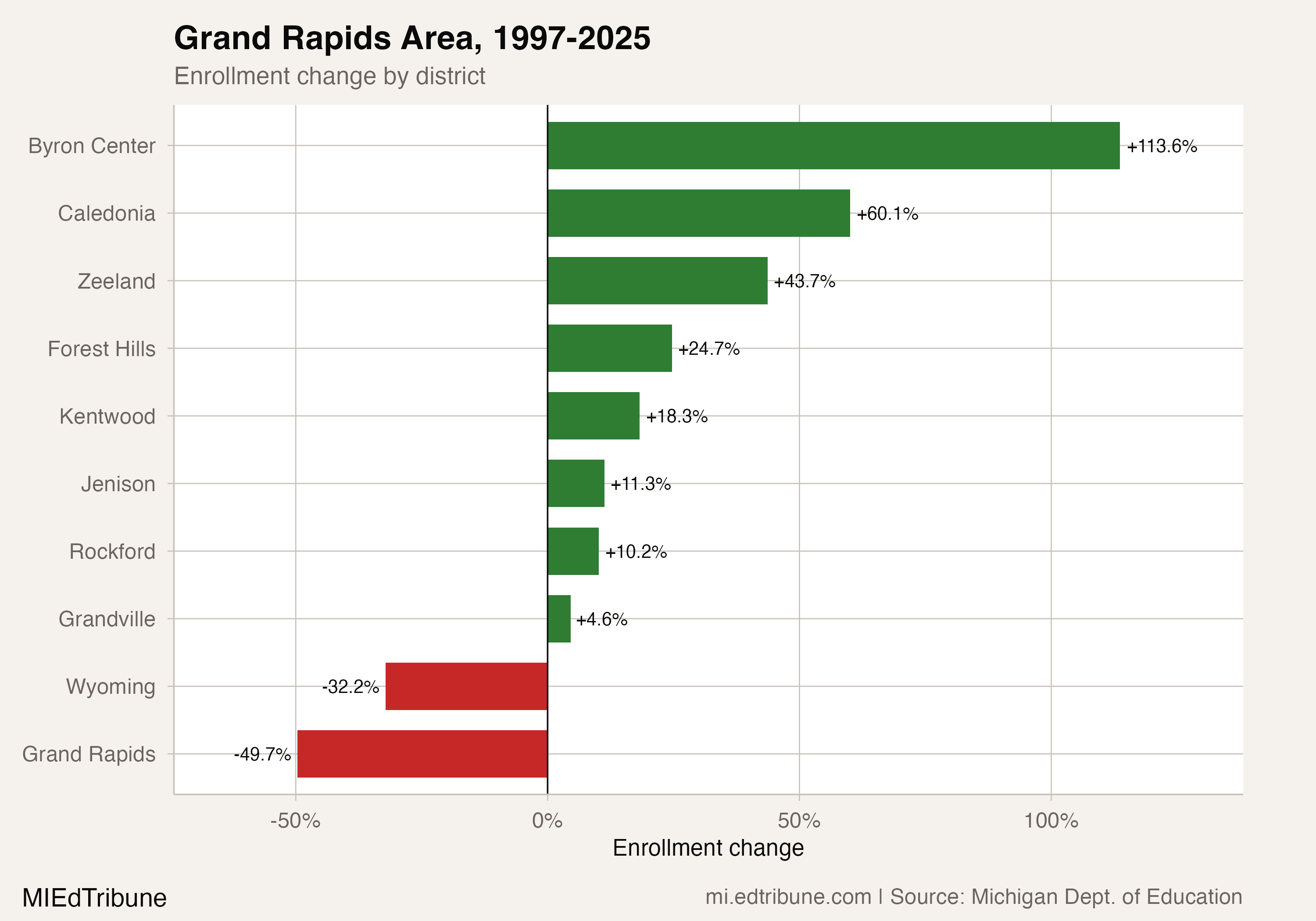
The pattern is a textbook suburban donut: families leaving both the urban core and the aging inner suburbs for newer development on the outer ring. Grand Rapids lost nearly half its students. Wyoming, the bridge between city and suburb, lost a third. The outer-ring districts absorbed families from both directions.
What pulls families south
Michigan's schools-of-choice law allows families to enroll in districts outside their attendance boundary, and one in four Michigan students now attend a school outside their home district, up from one in six a decade ago. Some portion of Byron Center's growth likely reflects choice transfers from Grand Rapids and Wyoming in addition to families physically relocating.
Byron Township itself has been a magnet for residential construction, with the Byron Center census-designated place growing from a population of 5,822 in 2010 to 7,431 in the 2020 census, a 27.7% increase.
School quality reinforces the cycle. Byron Center's superintendent Kevin Macina has described the district as a "destination district", and in November 2025, voters approved a $110 million bond to expand facilities across every building in the district. The bond requires no tax rate increase because the community's growing property tax base can service the debt at the existing rate. Growth funds growth.
Diversifying as it grows
Byron Center's enrollment growth has coincided with a meaningful shift in its racial composition. In 2009, the district was 87.3% white. By 2025, the white share had fallen to 76.9%, a drop of 10.4 percentage points. The number of white students grew slightly, from 2,829 to 3,496, but nearly all net new enrollment came from students of color.
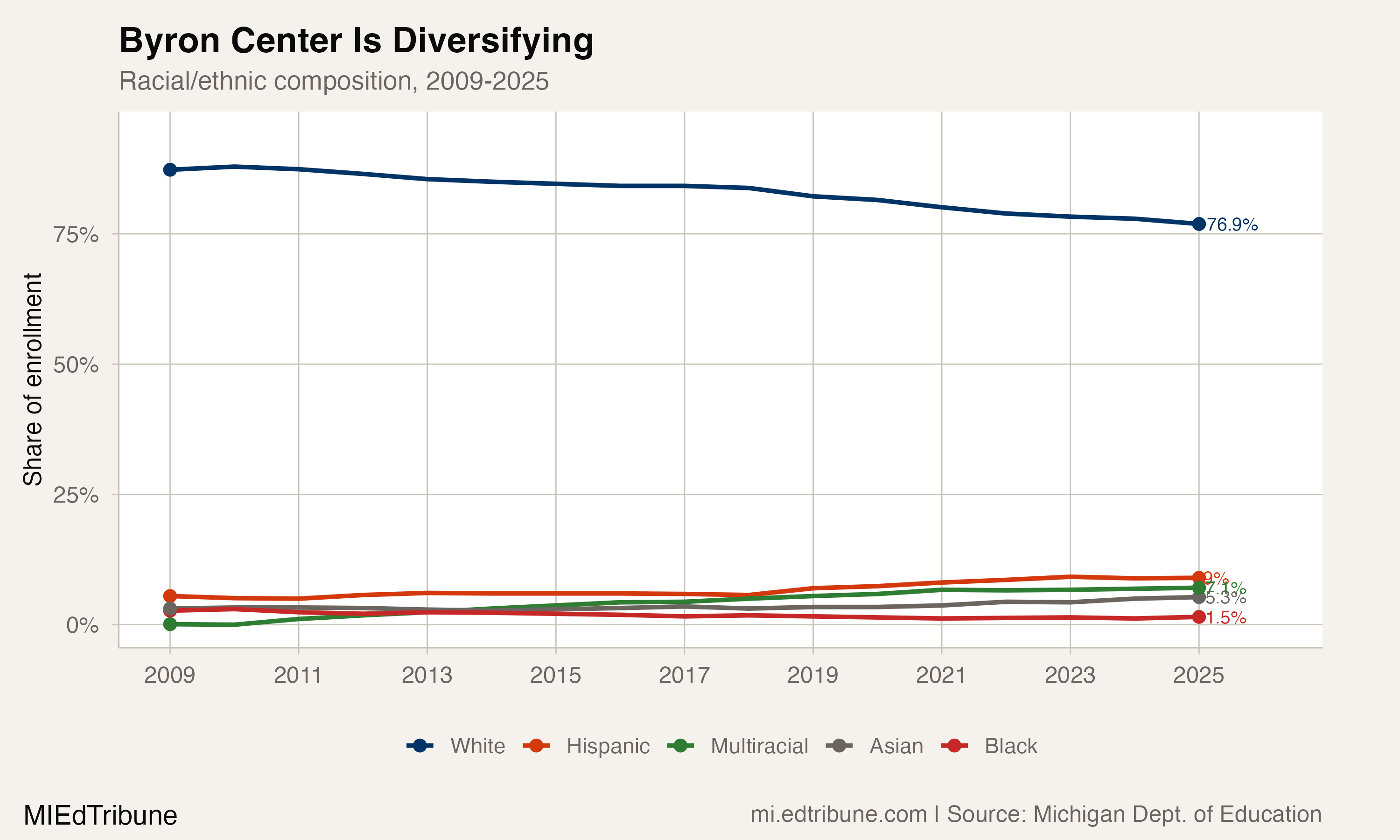
Hispanic enrollment more than doubled, from 177 students (5.5%) to 409 (9.0%). Asian enrollment grew from 101 (3.1%) to 241 (5.3%). Students identifying as multiracial went from 2 in 2009 to 325 in 2025, now representing 7.1% of the district. Some of the multiracial increase reflects changes in how families report race rather than new arrivals, but the overall pattern is clear: Byron Center is growing more diverse faster than it is growing larger.
This mirrors a broader regional dynamic. The families moving to Grand Rapids-area suburbs are not uniformly white, and the outer ring increasingly reflects the demographic composition of the metro area rather than the historically white rural communities these districts once served.
The $9,608 question
The financial stakes embedded in Byron Center's streak are considerable. Michigan allocates $9,608 per student in its foundation allowance. Byron Center's 2,418 additional students since 1997 represent roughly $23 million more in annual state revenue than the district received at the start of its streak. For a district of this size, that is enough to fund dozens of additional teaching positions and a $110 million bond without raising tax rates.
The inverse is equally instructive. Grand Rapids' loss of 13,415 students since 1997 represents approximately $129 million in annual state funding that no longer flows to the district. Michigan's per-pupil funding model means that every student who crosses a district line carries their funding with them. In a schools-of-choice state, enrollment growth is compound interest. Enrollment decline is compound loss.
The math is zero-sum in a way that is easy to miss. Byron Center's 2,418 additional students since 1997 did not materialize from thin air. In a state where the total enrollment pool is shrinking, every family that moves to Byron Township or transfers through schools of choice is a family that a neighboring district no longer counts on its October headcount. Wyoming, sitting between Grand Rapids and Byron Center, lost a third of its students over the same period. Roughly 80% of traditional districts have experienced enrollment declines since 2009. The Citizens Research Council projects the state's school-age population will fall from 1.58 million to 1.48 million by 2050. Fixed costs like building maintenance and utilities do not shrink with enrollment.
What comes next
Byron Center's streak has survived 28 consecutive measurements, but the forces working against it are intensifying. Even a destination district cannot indefinitely outrun a shrinking pool of children.
The near-flatline of 2023, when the district grew by just two students, may have been an anomaly or a warning. Caledonia's 21-year streak ended in 2019. Hudsonville's growth reversed in 2021. Byron Center's neighbors have already hit their ceilings.
Byron Township still has undeveloped land and an active residential construction pipeline. But Michigan recorded roughly 107,000 births in 2019, down 15% from 128,000 in 2006, and those smaller cohorts are entering kindergarten now. The streak's survival depends on whether home construction in one township can outrun a fertility decline affecting the entire state. At some point, even a destination district runs out of families to attract.
Detailed code that reproduces the analysis and figures in this article is available exclusively to EdTribune subscribers.
Discussion
Sign in to join the discussion.
Loading comments...