Correction (July 23, 2026): An earlier version described Dearborn as Michigan's fourth-largest district. By 2024-25 enrollment, Dearborn is the third-largest, behind Detroit and Utica.
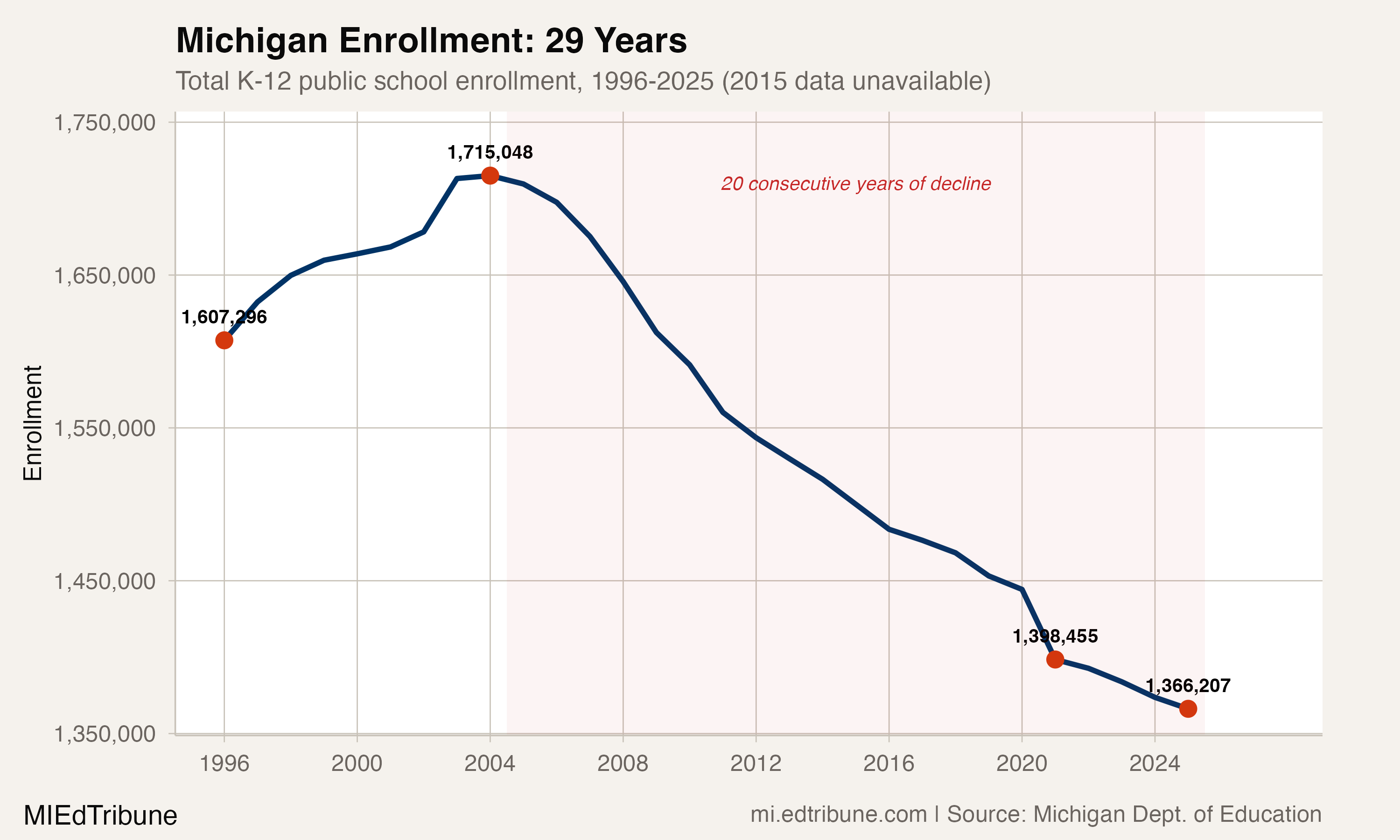
Michigan has lost public school students for 20 consecutive years, a streak unmatched among the ten largest states and one that predates, survived, and outlasted the pandemic. Enrollment peaked at 1,715,048 in the 2003-04 school year and has fallen every year since. Through the Great Recession. Through a fitful recovery. Through COVID and into the present. In 2024-25, Michigan enrolled 1,366,207 students, an all-time low, 348,841 fewer than at peak. That is a 20.3% decline over 20 consecutive years. No year in the dataset reverses it.
At $10,050 per pupil, the state's school system now operates on roughly $3.5 billion less in annual funding capacity than it would at peak enrollment. The loss is not an abstraction. It has closed buildings, eliminated teaching positions, and hollowed out districts that once anchored their communities.
Three eras, one direction
The 20-year decline breaks into distinct chapters, each with its own pace and character.
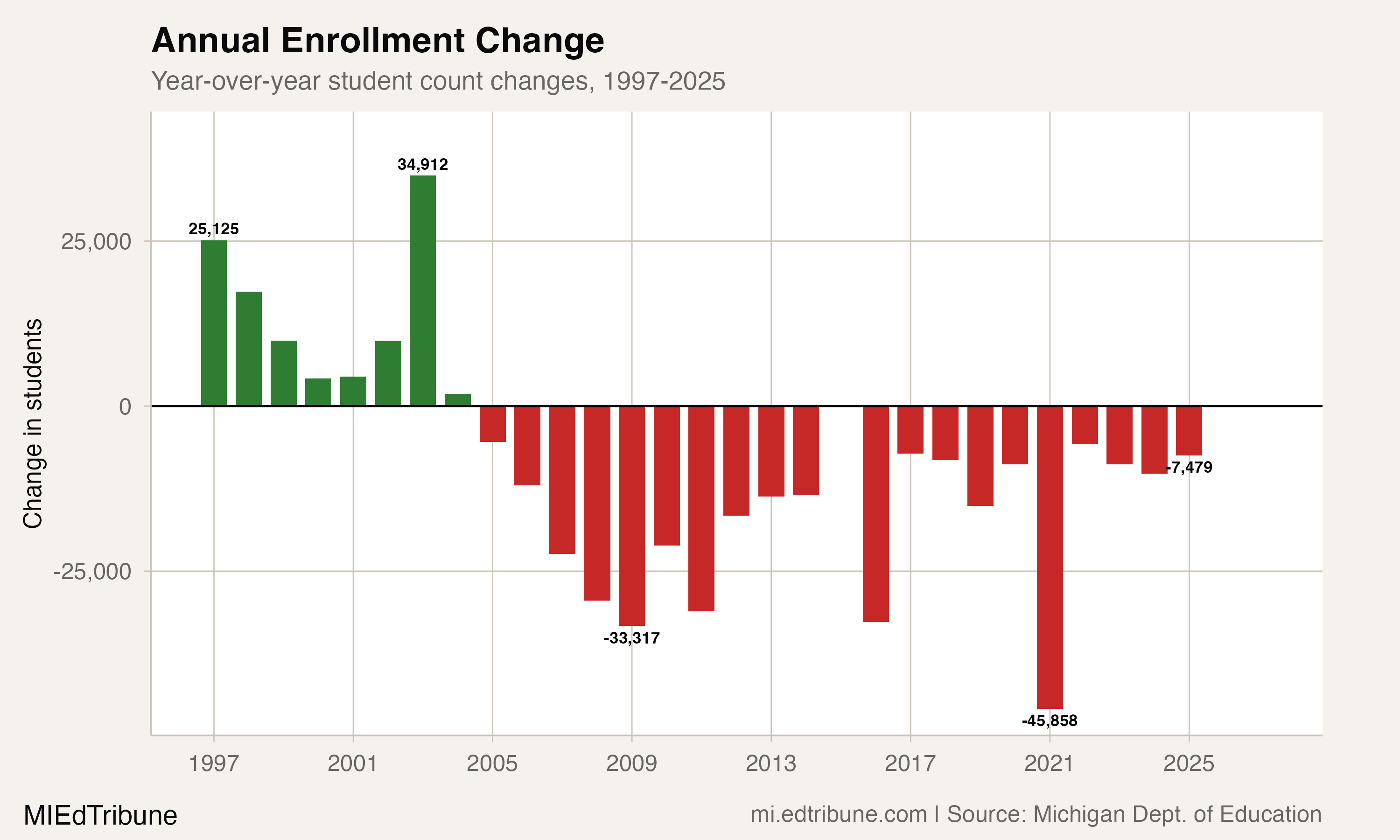
The worst years came first. Between 2005 and 2011, Michigan lost 154,883 students, an average of 22,126 per year, as the auto industry collapsed and the housing crisis hollowed out working-class communities statewide. The single worst non-COVID year was 2009, when enrollment fell by 33,317 students, a 2.0% drop in one year.
The bleeding slowed but never stopped. From 2012 to 2014, the state lost an average of 14,598 students annually. The pre-COVID years from 2016 through 2020 saw losses of about 12,000 per year. Then the pandemic hit: Michigan shed 45,858 students in a single year, its largest annual loss on record.
Since 2021, the pace has moderated. The state has lost an average of 8,062 students per year, roughly a third of the recession-era rate. But this is not recovery. It is a slower rate of decline that still compounds relentlessly.
The math underneath
The root cause is demographic. Michigan's total fertility rate fell below 1.6 by 2023, and the state recorded approximately 99,420 births in 2024 against 102,819 deaths, its fifth consecutive year of natural population decline. State projections show the five- to 17-year-old population falling another 18%, to about 1.26 million, by 2050.
But demographics alone do not explain the full picture. School choice has reshuffled where students go without adding new ones. One in four Michigan K-12 students now attends a charter school or a district other than their home district, according to Bridge Michigan. Charter enrollment reached 154,488 in 2024-25, up 1.7% even as the traditional sector contracted. Virtual school enrollment jumped 17% in the same year.
The state does not track private school enrollment or homeschooling, making it impossible to measure how many students left the public system entirely and how many shifted within it. Some portion of the post-pandemic loss likely reflects families who never returned.
Detroit: nearly a third of the state's losses
Detroit Public Schools Community District↗ET enrolled 165,323 students at its own peak in 1997 and 153,034 in 2004, when the state peaked. By 2025, that number was 48,117. Detroit's post-2004 loss of 104,917 students accounts for 30.1% of the state's total decline.
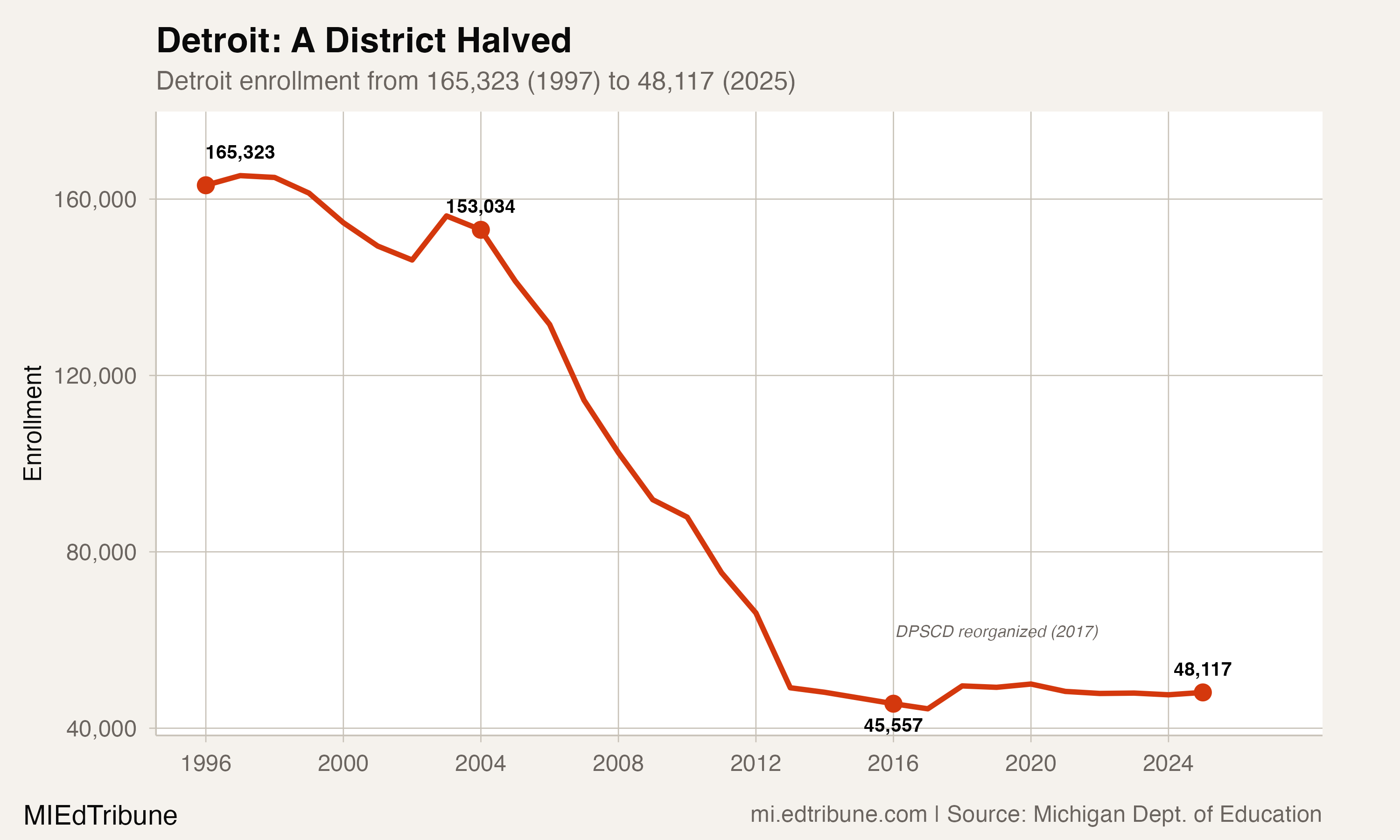
The district's collapse accelerated through the 2000s and culminated in a state-managed reorganization in 2016-17, when the old Detroit City School District was dissolved and replaced by the Detroit Public Schools Community District. Since the reorganization, enrollment has stabilized near 48,000, and the district gained 536 students in 2024-25, its largest recent annual gain.
The stabilization is fragile. About half of Detroit's resident students attend schools outside the traditional district, a competitive dynamic that constrains any rebound. DPSCD has held near 48,000 for eight straight years, but that number sits inside a city where charter operators still enroll the majority of school-age children.
Beyond Detroit, the losses are wide
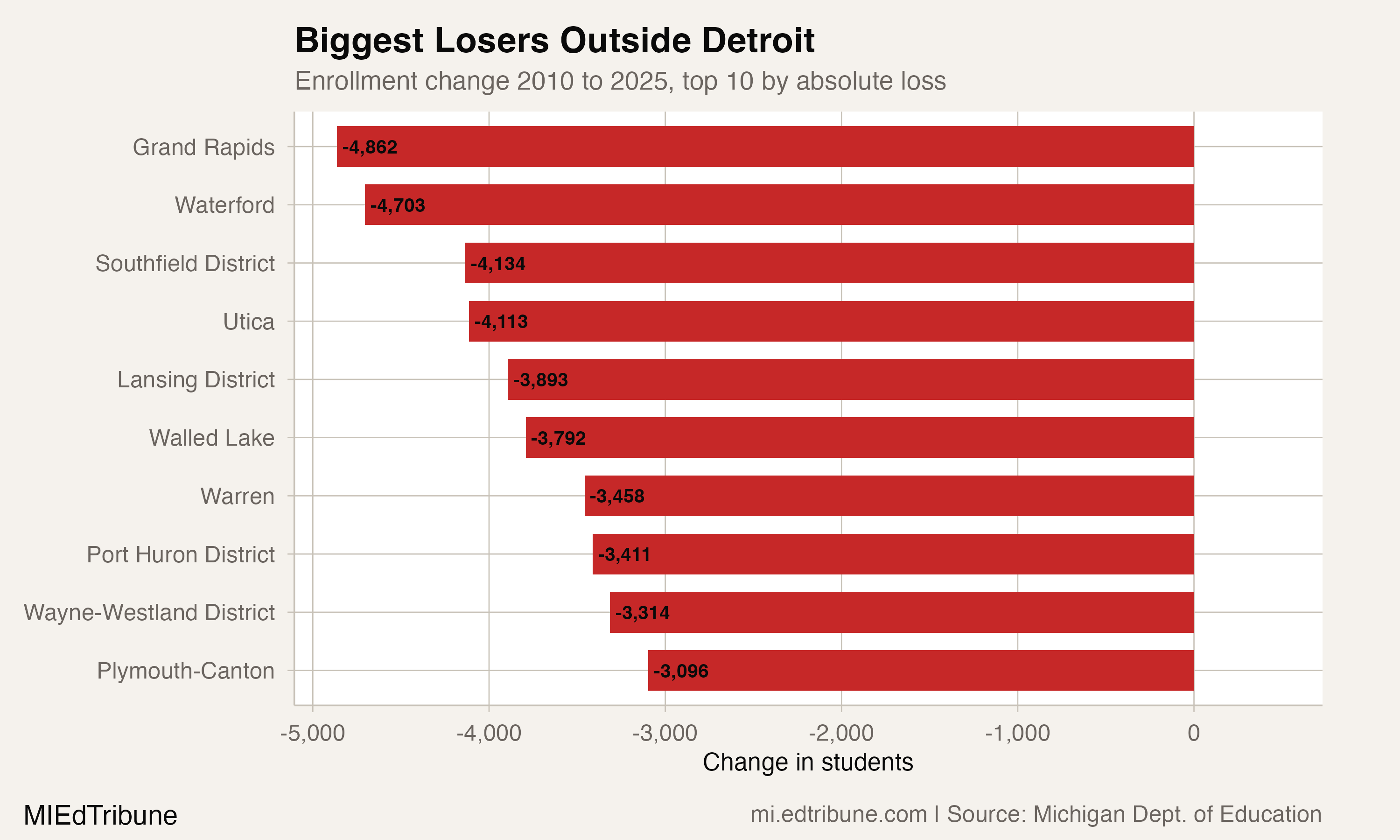
Even excluding Detroit, 447 of 608 Michigan districts with data in both years lost students between 2010 and 2025, a rate of 73.5%. Grand Rapids Public Schools↗ET, the state's second-largest traditional district, fell from 22,401 students in 2004 to 13,566 in 2025, a 39.4% decline. Lansing↗ET lost 6,972 students over the same span, a 41.5% contraction. In 2025, 223 of 862 districts with sufficient data history sat at their all-time enrollment low.
A few districts have grown. Dearborn↗ET, Michigan's third-largest district, added 1,698 students since 2004, reaching 19,168. Several outer-ring suburban and exurban districts expanded, including Byron Center, Hudsonville, and South Lyon. But these pockets of growth are dwarfed by the scale of loss around them.
A shrinking system, differently composed
The students Michigan has lost are overwhelmingly white. White enrollment fell from 1,141,941 in 2009 to 855,383 in 2025, a loss of 286,558 students, 25.1%. Black enrollment dropped 72,854, or 22.8%. These two groups together account for the entirety of the decline and then some.
Hispanic enrollment, meanwhile, rose from 76,663 to 129,236 over the same period, a 68.6% increase. Students identified as multiracial grew from 16,684 to 75,055, a 349.9% increase. White students' share of enrollment fell from 70.8% to 62.6%; Hispanic share rose from 4.8% to 9.5%; multiracial share rose from 1.0% to 5.5%.
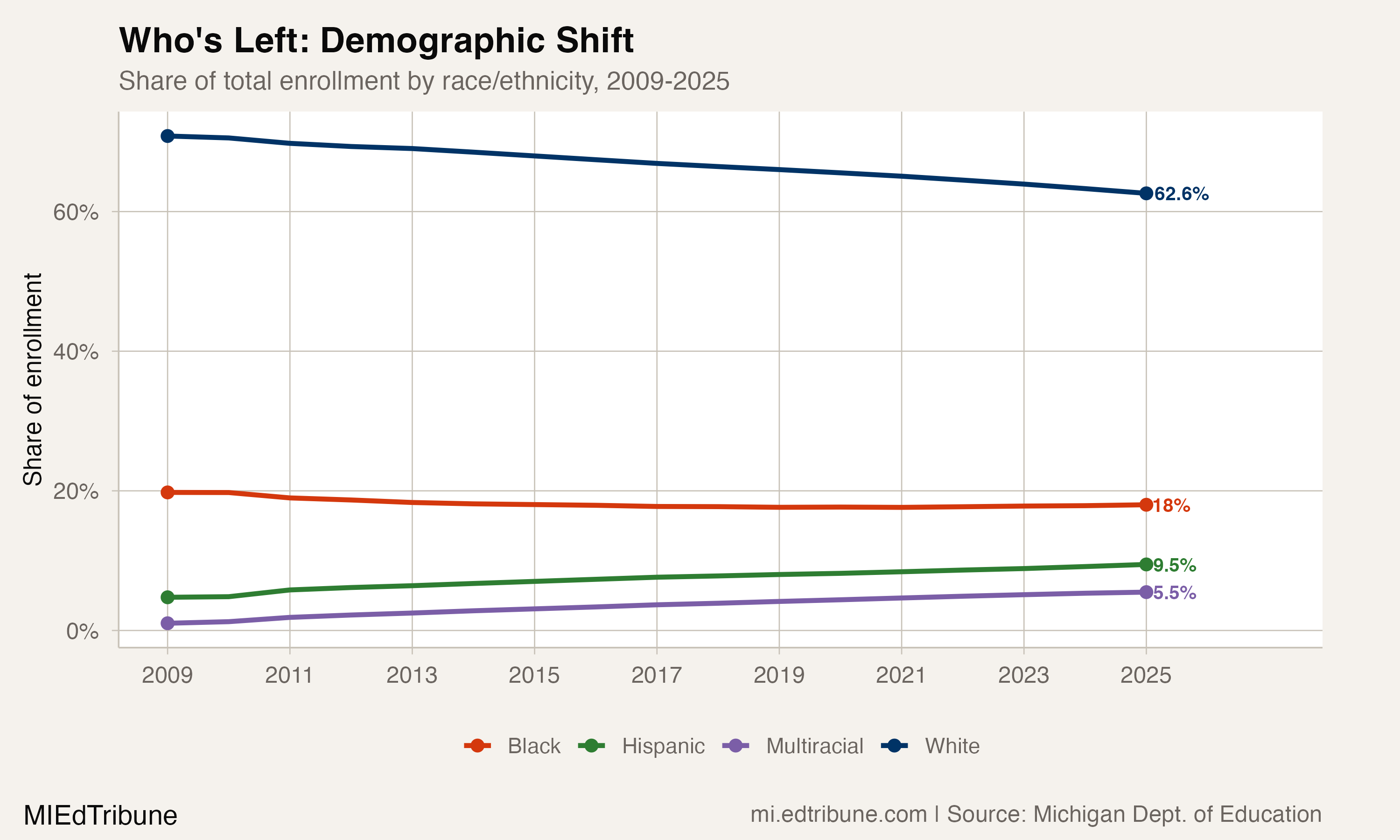
The compositional shift means Michigan's school system is more diverse than at any point in its data history, even as it serves far fewer students. The instructional and staffing implications of this shift, particularly in districts where the student population has changed faster than the teaching workforce, are a separate and consequential question.
What reporting suggests
The Citizens Research Council of Michigan, in a January 2024 analysis, framed the fiscal reality bluntly:
"Schools face enrollment declines and the exhaustion of one-time federal COVID relief aid. They will face the prospect of whether to close buildings with lower enrollments to ensure their long-term fiscal stability."
Craig Thiel, the Council's research director, told Bridge Michigan that districts face "a confluence of both factors, the long-term declining enrollment trend and the expiration of these federal resources." Michigan schools received approximately $6 billion in federal pandemic relief, and the expiration of those funds at the end of 2024 forced districts to confront structural deficits that the one-time money had papered over.
The state has begun offering incentives for consolidation. In April 2025, three districts received a total of $75 million in consolidation grants, and the legislature has set aside at least $237 million for districts considering mergers. But resistance runs deep. As Ypsilanti superintendent Alena Zachery-Ross told Bridge Michigan: "People really value their own identity. They value local control, especially in Michigan."
Kindergarten signals more of the same
Kindergarten enrollment offers the clearest forward indicator, and it offers no comfort. Michigan enrolled 140,309 kindergartners in 1996. In 2025, it enrolled 108,230, a 22.9% decline. The COVID year of 2021 saw kindergarten collapse to 106,539, a number the state has barely recovered from.
With Michigan's fertility rate projected to fall to 1.39 by 2050 and births already running below deaths, the incoming cohorts will continue shrinking. The 20-year losing streak is likely to become a 30-year losing streak before any structural force reverses it.
Michigan still operates 878 school districts, nearly one for every 1,600 students, the fourth-lowest ratio in the country. The state's per-pupil funding model means every departing family carries $9,608 out the door, while the buildings, bus routes, and administrative offices they leave behind still need heating and staffing. Three districts have accepted $75 million in consolidation grants. The other 875 have not. The system was built for 1.7 million students. It now serves 1.37 million and is heading toward 1.2 million.
Detailed code that reproduces the analysis and figures in this article is available exclusively to EdTribune subscribers.
Discussion
Sign in to join the discussion.
Loading comments...