Correction (July 23, 2026): An earlier version said ninth grade is 8.3% of statewide enrollment. The correct figure is 8.2%.
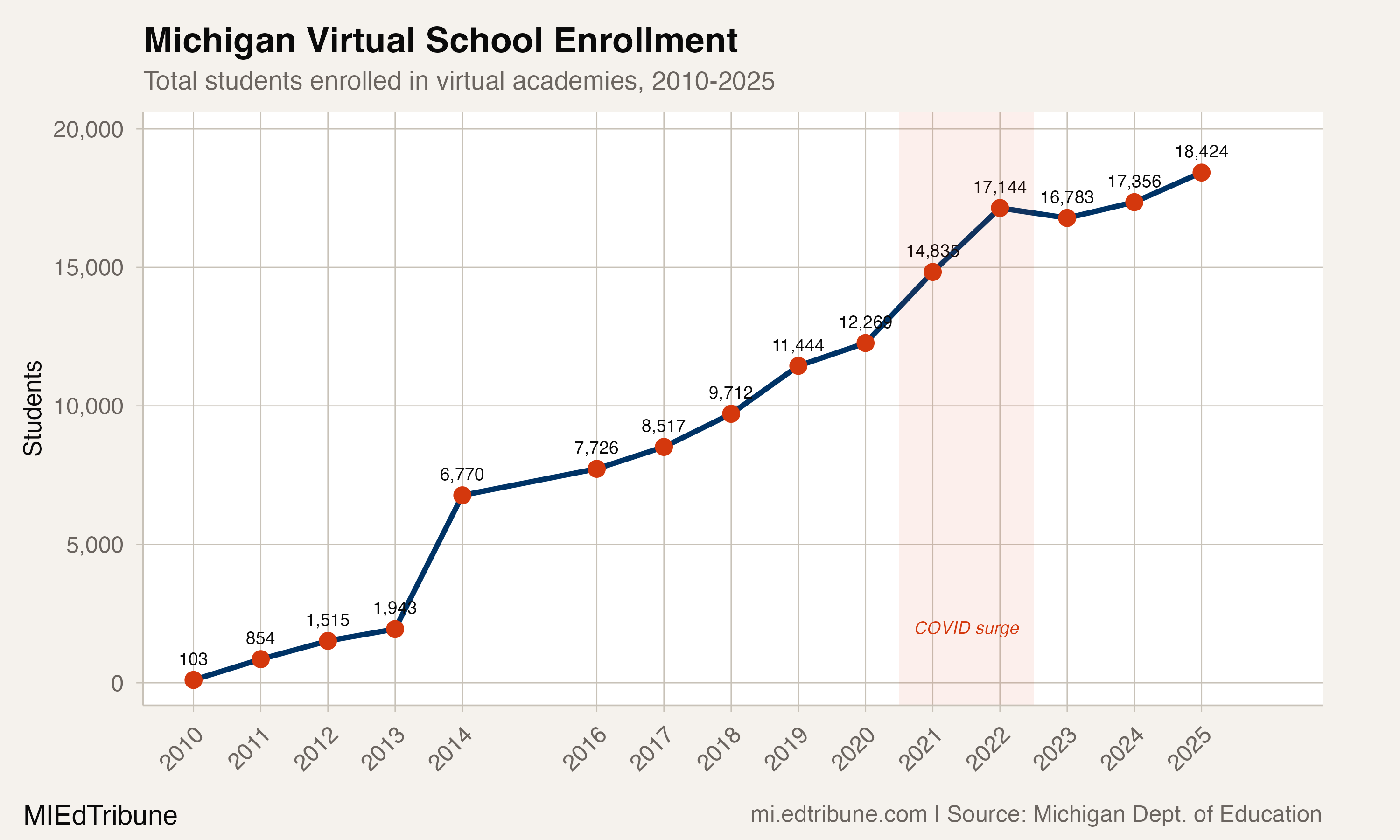
In 2010, exactly one virtual school operated in Michigan. The Virtual Learning Academy of St. Clair County enrolled 103 students. Fifteen years later, nine virtual academies serve 18,424 students, a 17,787% increase. The largest single virtual school, Michigan Great Lakes Virtual Academy, now enrolls 3,936 students, more than 796 of Michigan's 869 traditional districts.
The standard explanation for virtual school growth is COVID-19: families discovered remote learning in 2020, some stayed. That explanation is incomplete. Michigan's virtual sector was already adding hundreds of students per year before the pandemic, with gains exceeding 1,700 in 2019 alone. COVID accelerated the trajectory. It did not create it.
Two surges, one sector
The growth arrived in two distinct waves, neither of which was the pandemic.
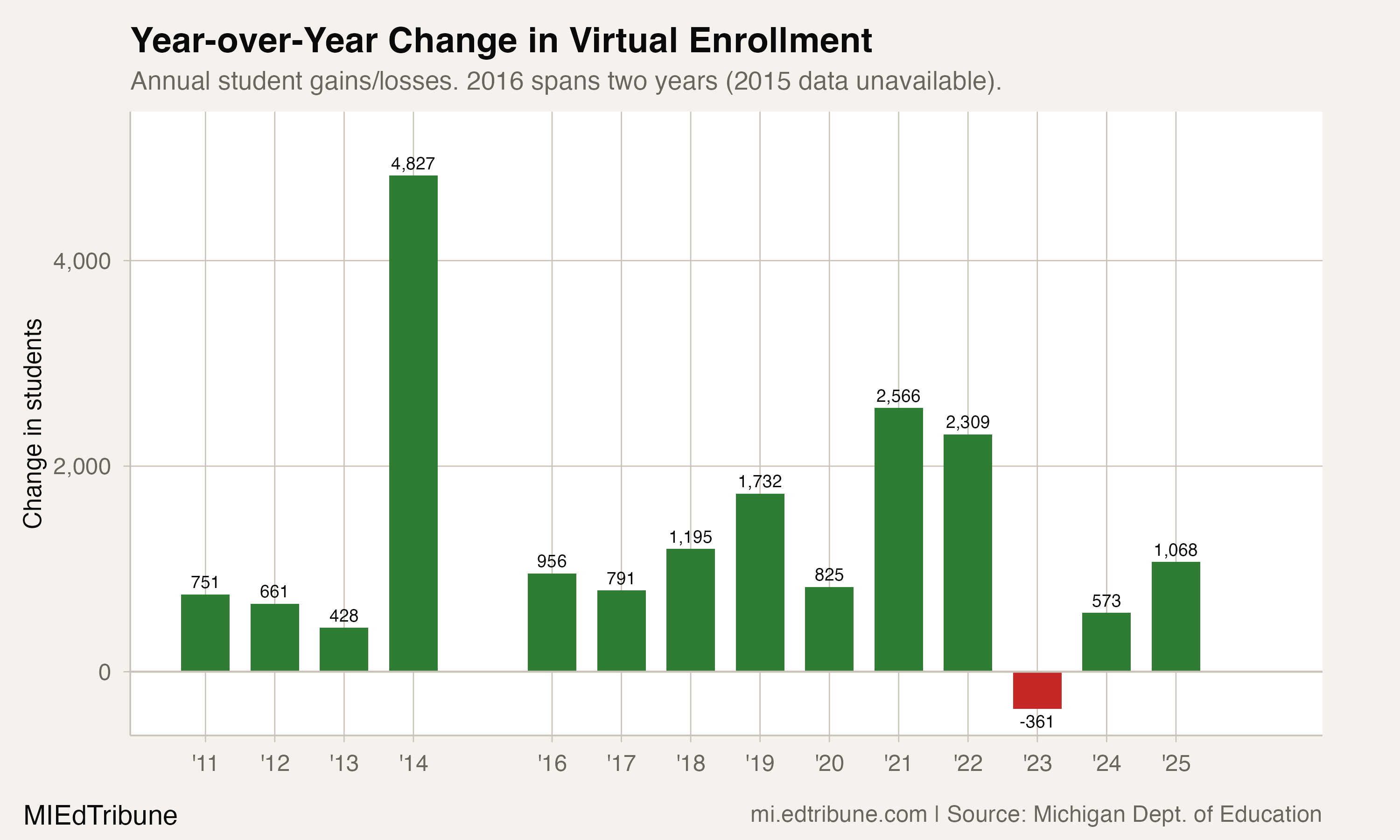
The first came in 2014, when the sector more than tripled in a single year, jumping from 1,943 students to 6,770. Michigan Virtual Charter Academy, a school operated by Stride Inc. (then K12 Inc.), drove the spike, growing from 954 to 4,318 students. Three new virtual schools also opened that year. By the time COVID hit six years later, the sector had already reached 12,269 students.
The second wave was pandemic-fueled. Between 2019-20 and 2021-22, virtual enrollment grew by 4,875 students (39.7%), as Highpoint Virtual Academy more than doubled from 978 to 2,666 and Lighthouse Connections Academy surged from 537 to 2,612.
Then came the correction that wasn't. In 2023, virtual enrollment dipped by 361 students, the sector's only year-over-year loss in the dataset. Nationwide, virtual schools saw a similar pattern of post-COVID leveling. But Michigan's dip lasted exactly one year. By 2025, the sector had climbed to 18,424, a new all-time high.
A sector dominated by three operators
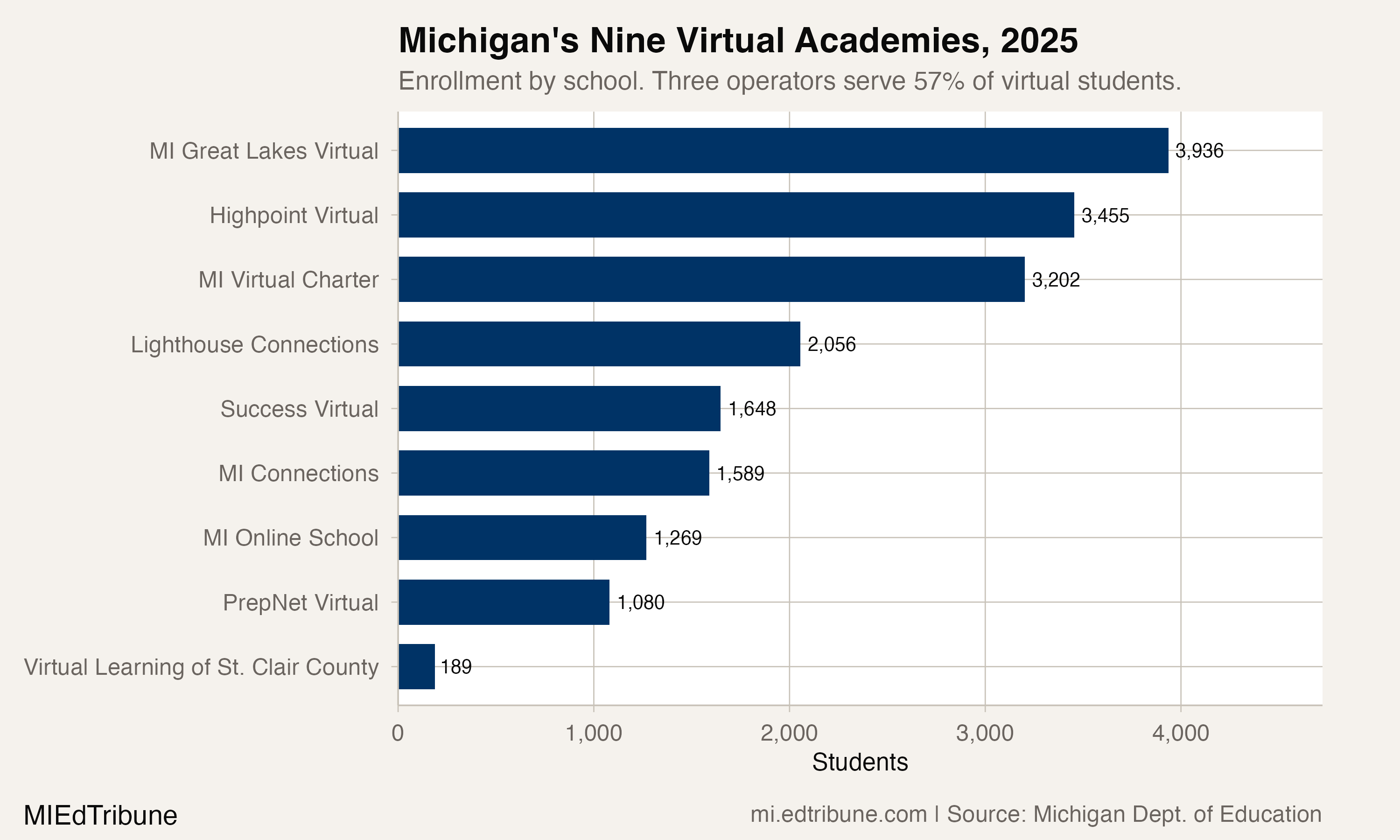
Michigan's nine virtual academies are not nine independent experiments in online education. Three schools operated by Stride Inc., a publicly traded company (NYSE: LRN), enroll 10,593 students, 57.5% of the sector. Michigan Great Lakes Virtual Academy leads at 3,936 students, followed by Highpoint Virtual Academy at 3,455 and Michigan Virtual Charter Academy at 3,202.
Michigan Great Lakes Virtual Academy and Highpoint Virtual Academy alone added a combined 1,100 students in 2024-25, a 17% increase from the prior year. During the same period, traditional public school districts lost approximately 10,100 students.
The smallest virtual school, Virtual Learning Academy of St. Clair County, the sector's original entrant, still enrolls just 189 students. The sector's size distribution is extreme: the top three schools serve 57% of all virtual students, while the bottom three serve 14%.
Who enrolls in virtual schools
The demographic profile of virtual school students diverges from Michigan's statewide average in two notable ways.
Black students make up 27.4% of virtual school enrollment, compared to 18.0% statewide, an overrepresentation of 9.4 percentage points. White students are correspondingly underrepresented: 50.7% of virtual enrollment versus 62.6% statewide. Hispanic students (10.0% virtual vs. 9.5% statewide) and multiracial students (9.8% vs. 5.5%) are also overrepresented, though the multiracial gap is smaller in absolute terms.
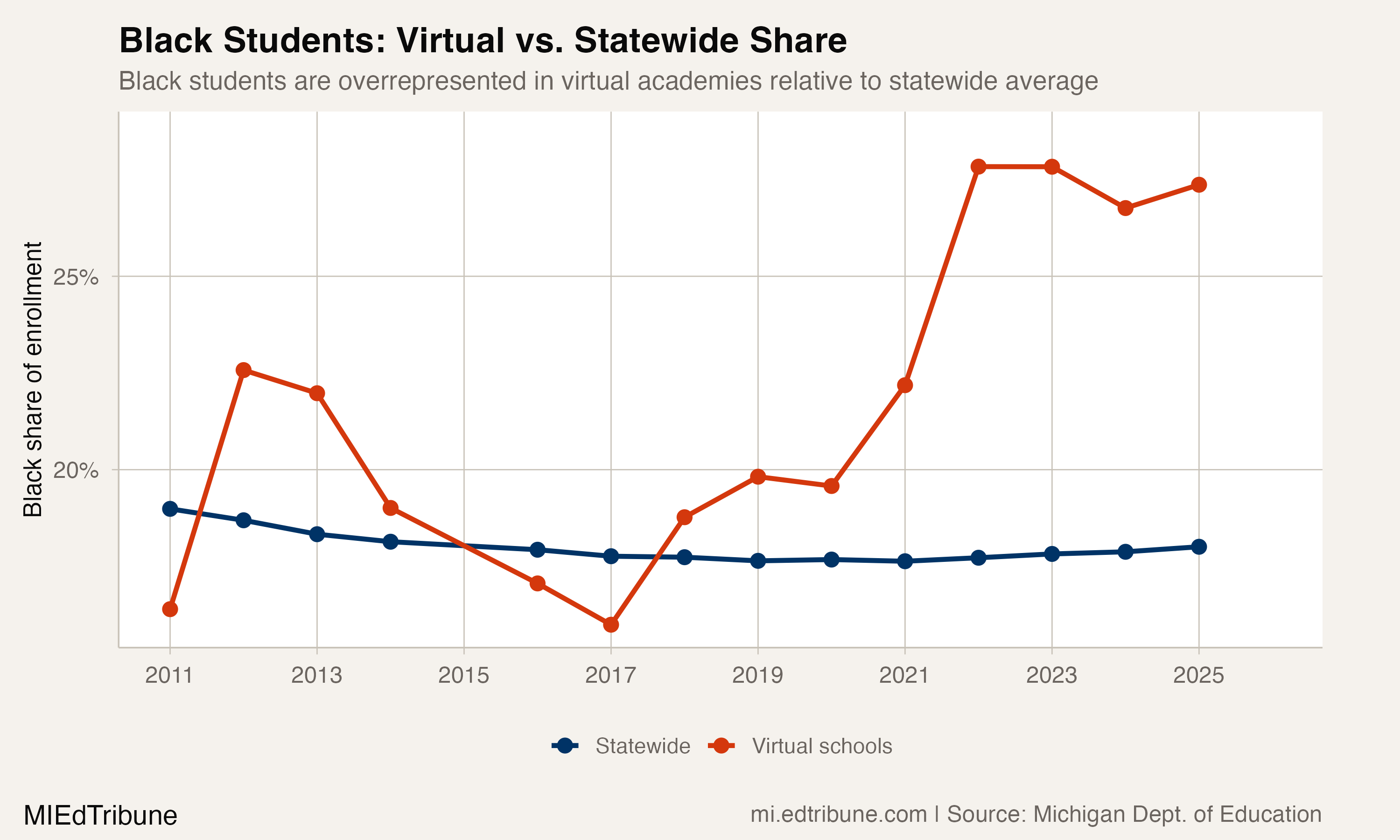
The overrepresentation of Black students has widened since the pandemic. In 2019, Black students were 19.8% of virtual enrollment versus 17.6% statewide, a gap of 2.2 percentage points. By 2022, the gap had grown to 10.1 percentage points (27.8% vs. 17.7%) and has remained near that level since.
This pattern aligns with national research from Michigan Virtual finding that students of color and students in poverty had "markedly different outcomes in their online courses" compared to white and more affluent peers. The question is whether virtual schools are meeting a genuine need for these families or whether the enrollment pipeline operates through different channels for different communities.
The ninth-grade bulge
Virtual schools in Michigan skew heavily toward high school. Students in grades 9-12 account for 47.9% of virtual enrollment, compared to 32.2% statewide. The imbalance is sharpest in ninth grade, which alone accounts for 15.7% of virtual students versus 8.2% statewide.
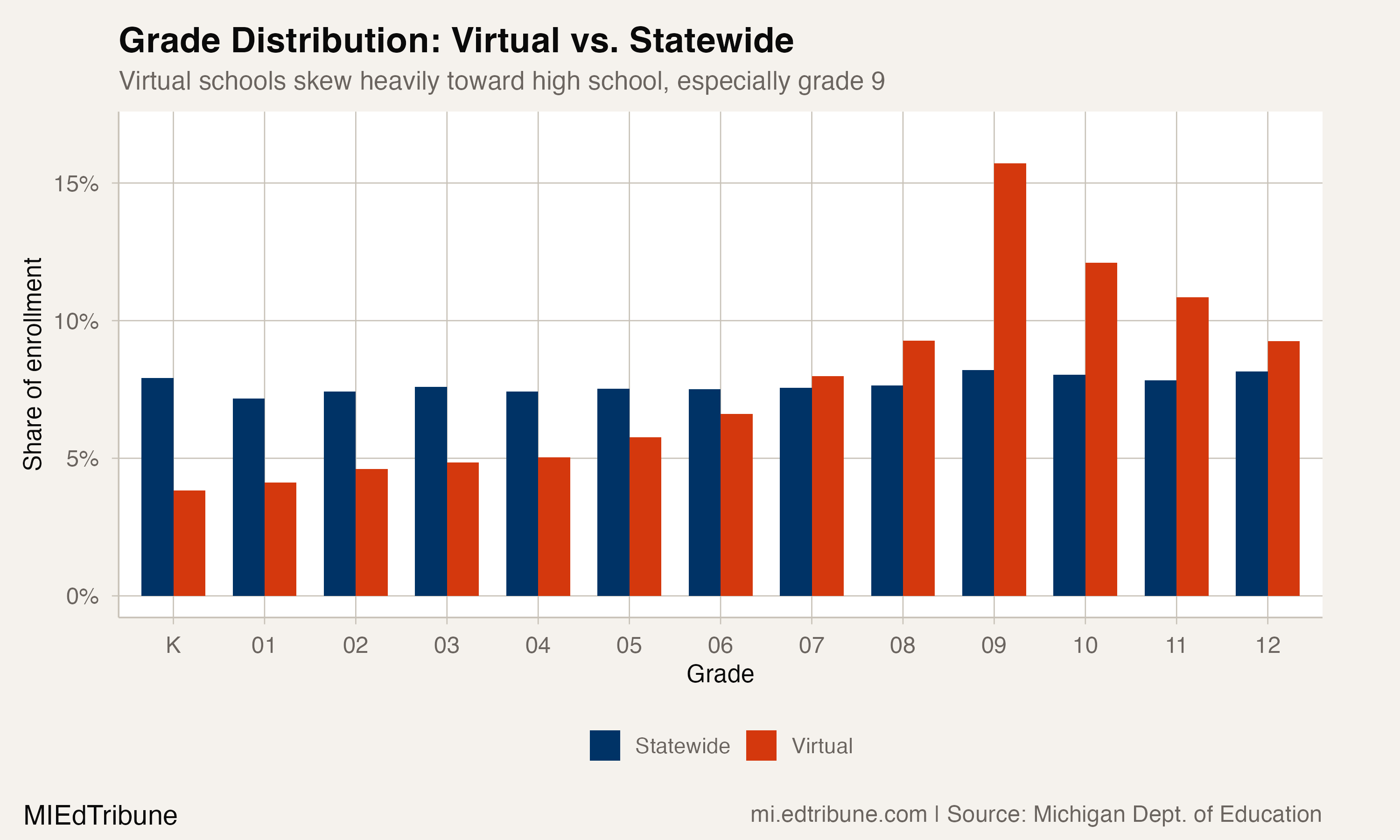
Kindergarten through fifth grade, by contrast, is 28.2% of virtual enrollment versus 45.1% statewide. The grade distribution is consistent with virtual schools serving partly as an alternative for students who leave or struggle in traditional high school settings, whether due to bullying, scheduling conflicts, credit recovery needs, or other factors. EdSurge reported in 2025 that virtual schools nationally serve "students who would otherwise drop out," keeping them enrolled in some form of public education.
The funding question
Virtual charter schools in Michigan receive $9,150 per student, compared to $9,608 for traditional districts, according to Bridge Michigan. At 18,424 students, the virtual sector represents roughly $168.6 million in annual state aid.
That money follows the student. When a family in Ann Arbor enrolls a child in Michigan Great Lakes Virtual Academy, Ann Arbor loses $9,608 and the virtual school gains $9,150. Ann Arbor, which has lost students steadily in recent years, imposed $20.4 million in cuts for 2024-25. Virtual schools account for only a fraction of the enrollment loss, but the per-pupil funding model means every departure compounds.
Tara Kilbride, interim associate director of Michigan State University's Education Policy Innovation Collaborative, told Bridge Michigan that the trend is clear:
"People are leaving traditional public schools, and a lot of them are choosing charter schools."
Charter schools overall, including virtual academies, have gained enrollment 17 of the last 18 years in Michigan, now serving more than 154,000 students, about 10.6% of public school enrollment.
A 65% graduation rate, growing at 17% a year
Virtual schools nationally graduate students at far lower rates than brick-and-mortar schools. The National Education Policy Center found that full-time virtual schools averaged a 65.1% four-year graduation rate, compared to 86.5% nationally. Michigan's own record-high graduation rate of 84% in 2024-25, announced by the state, reflects the traditional system. School-level data for virtual academies tells a different story.
Stride Inc., which operates three of Michigan's nine virtual academies, has faced scrutiny in other states. A 2016 California settlement resulted in a $168.5 million penalty for inflating attendance numbers. A 2023 Texas lawsuit alleged fraudulent enrollment practices. Michigan-specific accountability data for Stride-operated schools is published through the state's school index system but is not broken out separately in the enrollment data analyzed here.
The enrollment data analyzed here does not contain graduation rates, assessment scores, or other outcome measures for virtual schools. With 27.4% Black enrollment in a sector that nationally graduates one in three students at sub-65% rates, the performance question is not academic.
The 1.35% that keeps growing
Michigan's virtual sector remains small in absolute terms: 18,424 students out of 1,366,207 statewide, or 1.35%. But the growth rate tells a different story. The sector has grown every year except one since 2010, adding students even as the state has shed 225,073 over the same period, a 14.1% decline.
The Michigan Virtual Learning Research Institute reports that 11% of all Michigan public school students have taken at least one virtual course and 68% of districts report at least one full-time virtual enrollment. The infrastructure for virtual learning runs far deeper than 1.35% suggests.
At roughly 800 additional students per year, the sector will approach 22,000 by the end of the decade. Michigan Great Lakes Virtual Academy alone is already larger than 796 of the state's 869 traditional districts. Three Stride-operated schools collect $97 million in annual state aid without maintaining a single building, heating a single classroom, or running a single bus route. When Ann Arbor cut $20.4 million from its 2024-25 budget, some of those lost students were sitting at home, logged into a virtual school chartered 200 miles away. That is Michigan's school choice model working exactly as designed.
Detailed code that reproduces the analysis and figures in this article is available exclusively to EdTribune subscribers.
Discussion
Sign in to join the discussion.
Loading comments...