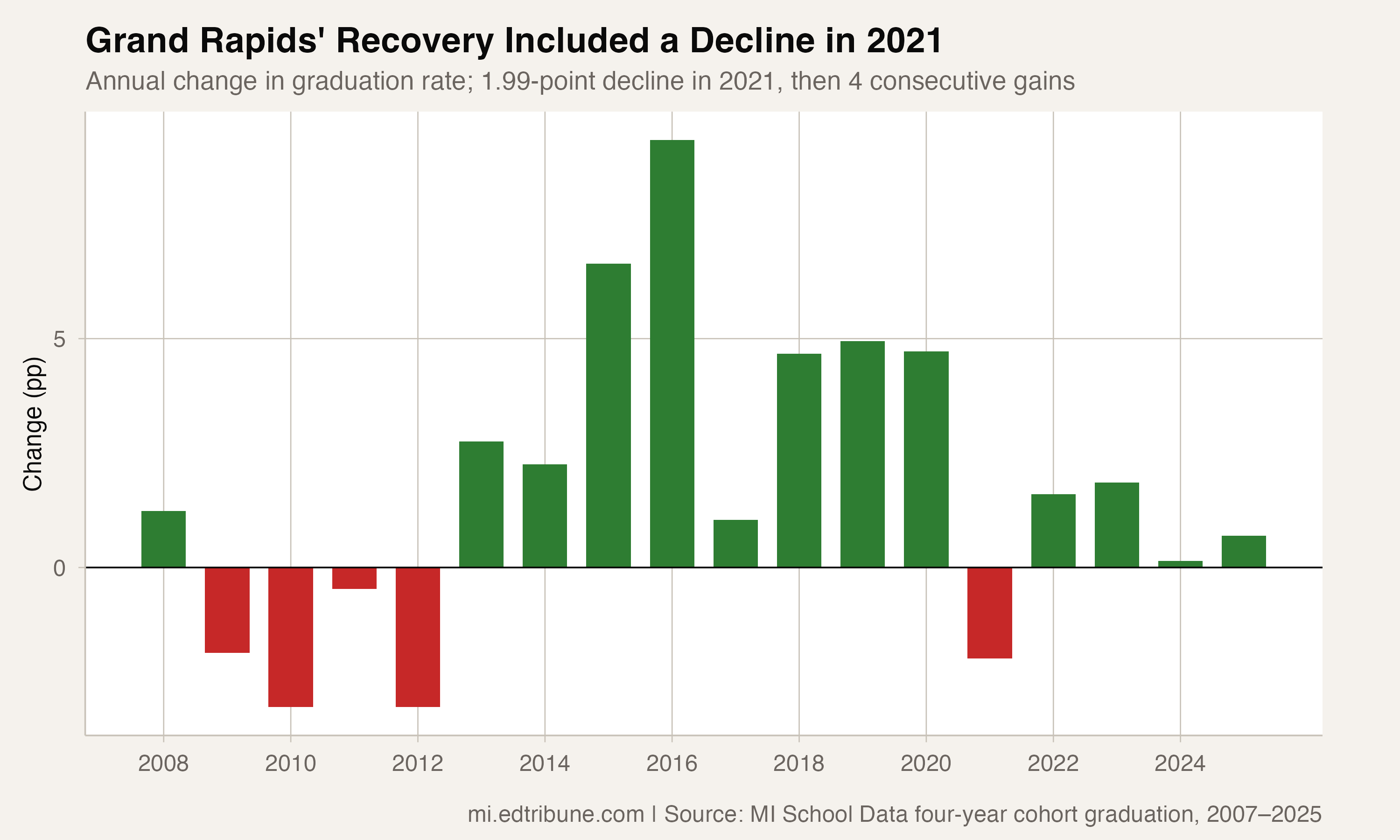
Correction (October 8, 2026): This article now includes published graduation records previously omitted from the comparison. They show a decline in 2021 followed by four consecutive annual gains. An earlier version incorrectly described uninterrupted improvement.
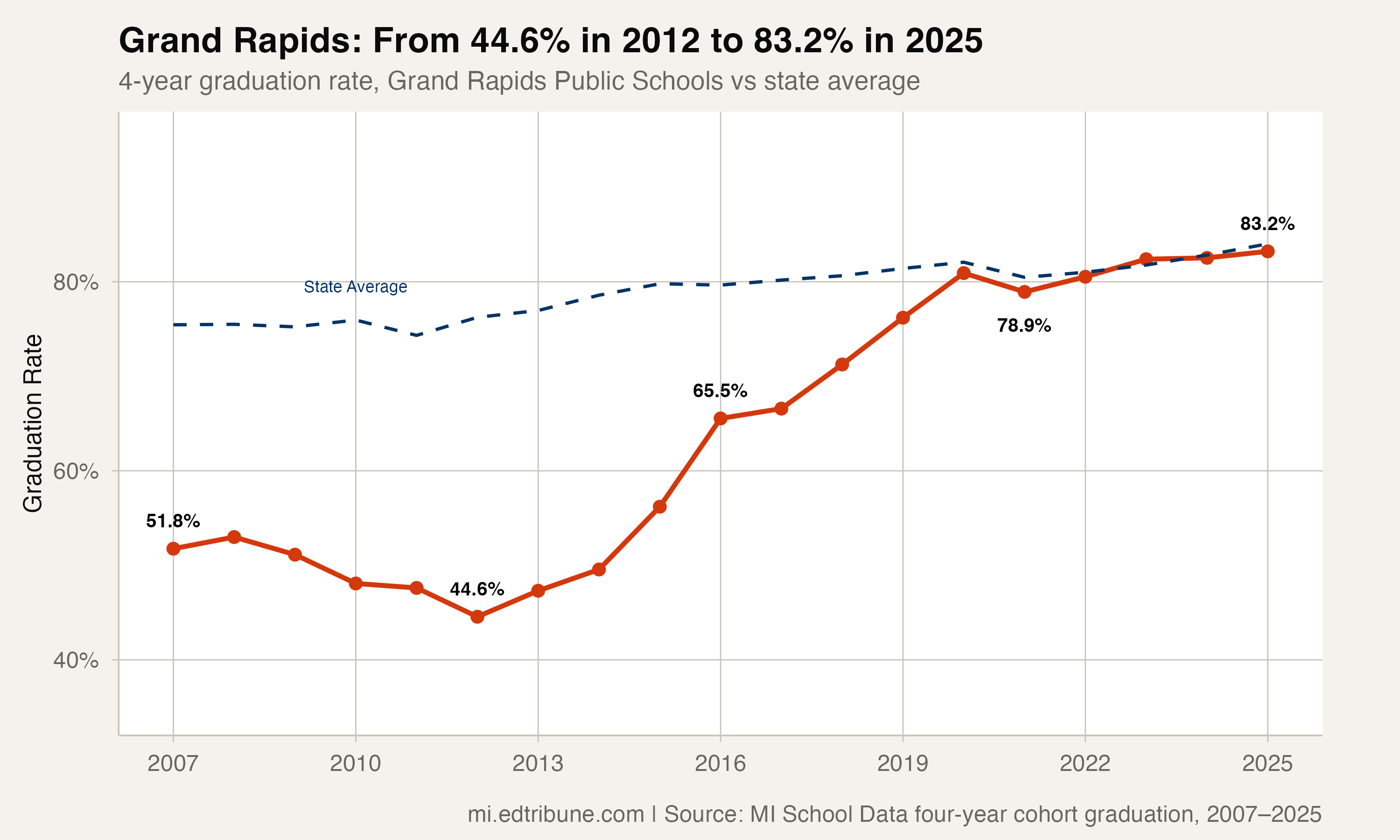
In 2012, Grand Rapids Public Schools↗ET hit bottom. Fewer than half its students -- 44.6% of a cohort of 1,102 -- graduated on time. Its rate declined in each year from 2008 through 2011, falling from 53.0% to 47.6%.
Thirteen years later, the rate was much higher. Grand Rapids graduated 83.2% of its students in 2025, a gain of 38.7 percentage points off the trough. The class of 2025, from the 2024-25 school year, is the most recent published cohort in the records used here during the 2026-27 school year. Among the 46 Michigan systems with a 2025 cohort of at least 500 students, two posted larger gains from their lowest published rates since 2007: Michigan Great Lakes Virtual Academy↗ET rose 52.4 points, from 11.8% in 2014 to 64.2% in 2025, and Lansing↗ET climbed 43.1 points, from its 2011 low of 50.7% to 93.8%. The 500-student comparison cutoff is an editorial choice; those systems accounted for 34.6% of the published statewide graduating cohort.
The two Grand Rapids
East Grand Rapids Public Schools↗ET has not posted a rate below 91.2% in any published year in the dataset. Its 2025 rate was 97.9%.
In 2024-25, 22.1% of Grand Rapids Public Schools students were white. Among its 2025 graduating cohort, 624 of 906 students, or 68.9%, were economically disadvantaged. Against the state average, Grand Rapids had nearly closed the gap: 83.2% versus 84.0%, a difference of 0.8 percentage points.
In 2012, that gap was 31.7 points.
How the record changed
The improvement was not linear. Grand Rapids bounced along the bottom from 2007 to 2014, hovering between 44.6% and 53.0%. The turning point came in 2015 when the rate jumped to 56.2%, then vaulted to 65.5% in 2016 -- a 9.3 percentage point gain in a single year, the kind of number that invites scrutiny.
The gains did reverse. Grand Rapids reached 76.2% in 2019 and 80.9% in 2020, then fell to 78.9% in 2021, a 1.99-point decline. It subsequently improved in four consecutive annual transitions across the five reporting years from 2021 through 2025, reaching 83.2%.
Annual gains varied from less than a point between 2024 and 2025 to 9.3 points in 2016. The long-term improvement was substantial, but it was not uninterrupted.
Michigan also changed which students count in district graduation rates. Its published methodology now includes students regardless of how long they were enrolled; earlier district rules required a minimum enrollment period. The reported trend therefore spans changes in counting rules as well as changes in outcomes. The records cannot isolate the effect of any particular district program.
The shrinking denominator
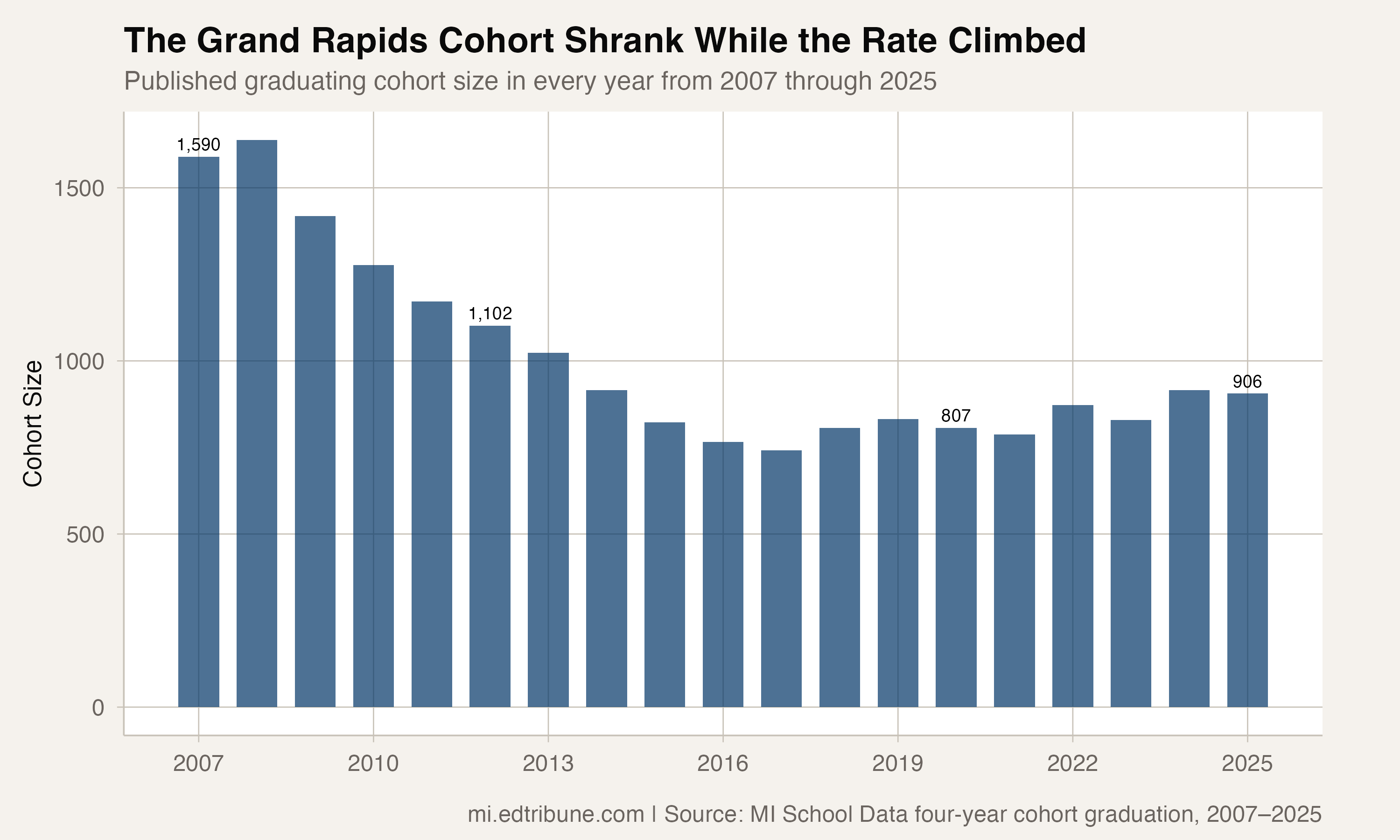
One complication: Grand Rapids's graduating cohort shrank substantially during this period. The 2007 cohort was 1,590 students. By 2025, it was 906. The district lost 43% of its cohort, meaning it is graduating a much higher share of a much smaller group.
The aggregate records do not identify why the cohort shrank or attribute the graduation-rate increase to a particular mechanism. They do show that the count of students earning a diploma rose from 502 in 2016 to 754 in 2025, an increase of 252, even as the cohort remained smaller than it was in 2007.
The Detroit parallel
Grand Rapids and Detroit landed on the same number in 2025: 83.2% each. The two cities got there by different routes. Detroit Public Schools Community District↗ET enters the state cohort file with the class of 2017 at 78.2%, then slipped in each of the next three years to 72.4% in 2020 before recovering. Grand Rapids started from a much deeper low, 44.6%, but its recovery also included a reversal in 2021.
Both districts were within one point of the state average. Economically disadvantaged students made up 68.9% of the Grand Rapids graduating cohort and 80.7% of Detroit's. The class of 2025 puts both districts at the same milestone; the published data do not show what happens next.
By the numbers: Grand Rapids Public Schools graduated 83.2% of its 906-student cohort in 2025, up from a 44.6% trough in 2012, a 38.7 percentage point turnaround. The district was 0.8 percentage points below the state average, after trailing by 31.7 points at its low point.
Source: The MIEdTribune analysis of Michigan four-year cohort graduation and enrollment data from the official MI School Data portal. The class of 2025 is the most recent graduation cohort in the records analyzed here.
Detailed code that reproduces the analysis and figures in this article is available exclusively to EdTribune subscribers.
Discussion
Sign in to join the discussion.
Loading comments...