Michigan reports Early Middle College students as a distinct graduation subgroup. In 2025, that subgroup posted an 88.7% graduation rate, 4.7 percentage points above Michigan's 84.0% statewide rate.
The result caps four consecutive annual gains. It does not describe a program that improved every year, and it does not describe a cohort that kept growing without interruption.
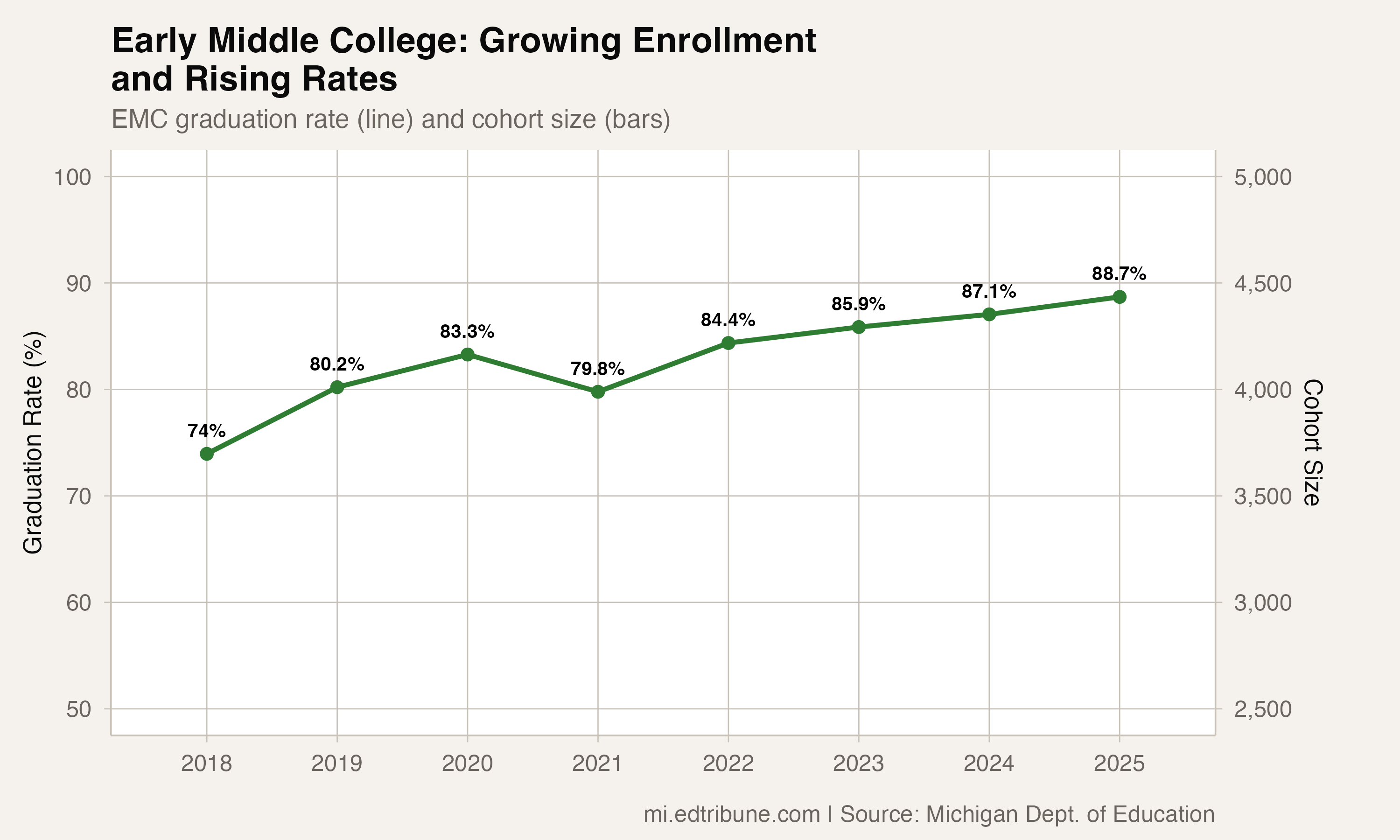
The missing years change the story
The full published series begins at 74.0% in 2018 and rises to 83.3% in 2020. The rate then fell to 79.8% in 2021, a 3.5-point decline. From that low, it rose to 84.4% in 2022, 85.9% in 2023, 87.1% in 2024 and 88.7% in 2025.
Across the whole window, the rate gained 14.7 points. The four-year run after 2021 is real, but the 2021 setback matters because it rules out a smooth, uninterrupted climb.
The cohort record is similarly mixed. It grew from 2,353 students in 2018 to 3,173 in 2025, an increase of 820 students, or 34.8%. But the cohort peaked at 3,523 in 2022. The 2025 count was 350 students, or 9.9%, below that peak.
That makes 2025 a high-rate year at a still-large scale, rather than the endpoint of continuous enrollment growth.
What Early Middle College offers
The Michigan Department of Education describes Early Middle College as an approved five-year program that lets students remain enrolled in high school for an additional year while taking college classes. Students may complete an associate degree, an approved credential or up to sixty transferable college credits while earning their high school diploma.
That design supplies useful context for the subgroup. It does not prove that the program caused the graduation pattern. The state graduation file reports outcomes and cohort sizes; it does not provide a matched group showing what the same students would have done outside Early Middle College.
Selection is therefore a competing explanation. Students who enter these programs may differ from other students in ways the graduation file does not measure. Program design as the cause of the higher rate remains suggestive context, not direct evidence.
A strong result without a counterfactual
In 2025, 2,814 members of the 3,173-student Early Middle College cohort graduated. The subgroup's 88.7% rate exceeded the statewide rate, and its published rate had improved for four consecutive years.
Those are substantial descriptive results. They do not establish how many of those students would have graduated through another pathway, and they do not support a forecast that expanding the program would preserve the same rate. The published record supports a narrower conclusion: Early Middle College ended 2025 with its highest rate in the eight-year series, while serving a cohort that remained larger than in 2018 but smaller than at its 2022 peak.
Graduation rates, cohort counts and graduate counts come from Michigan's public graduation data, published by the Michigan Center for Educational Performance and Information. The Michigan Department of Education's 2025 release provides statewide context. The analysis uses the complete 2018-2025 Early Middle College subgroup series.
Detailed code that reproduces the analysis and figures in this article is available exclusively to EdTribune subscribers.
Discussion
Sign in to join the discussion.
Loading comments...