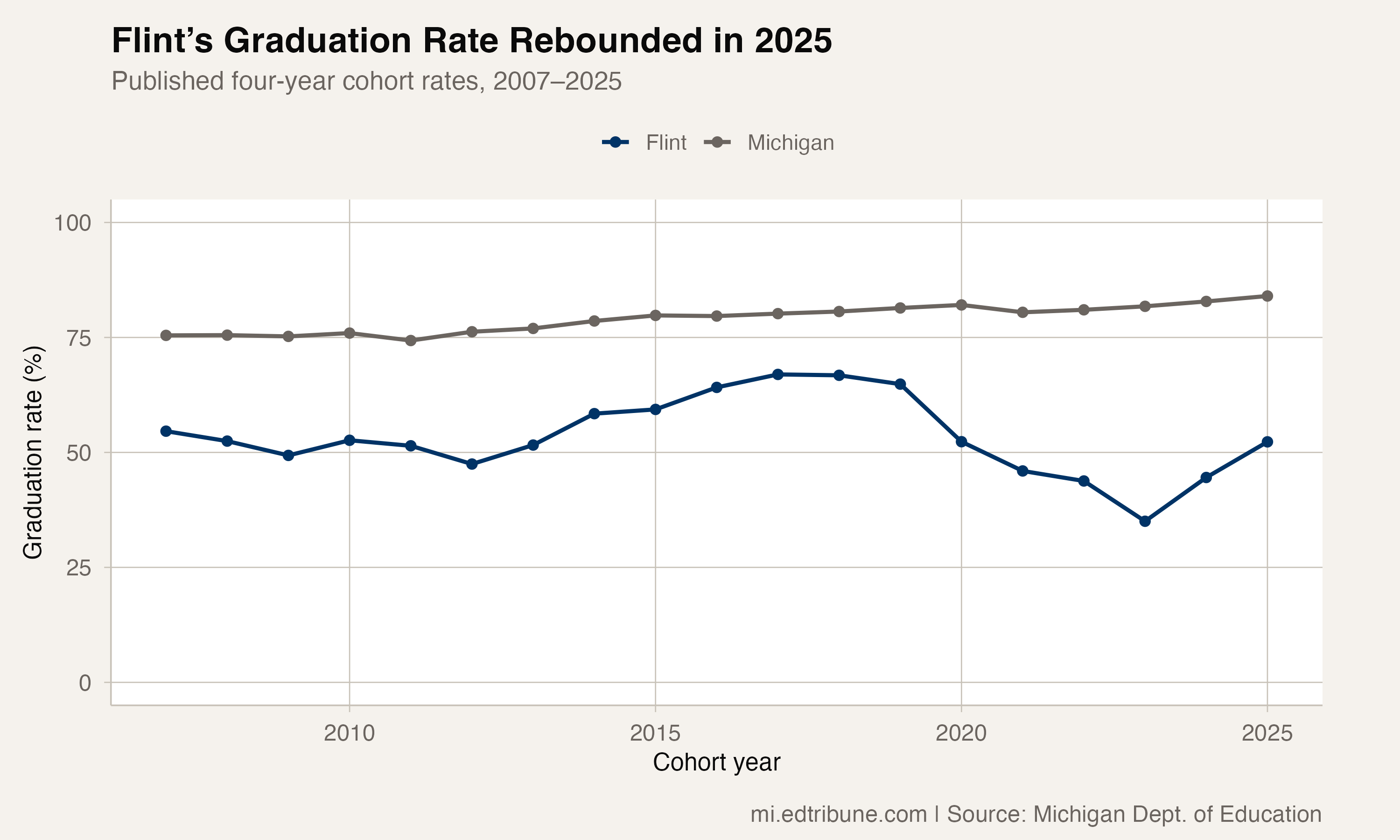
Flint’s published four-year graduation rate rose to 52.3% for the 2025 cohort, up from 44.6% for the preceding cohort. That improvement left the district well below Michigan’s statewide rate of 84.0%.
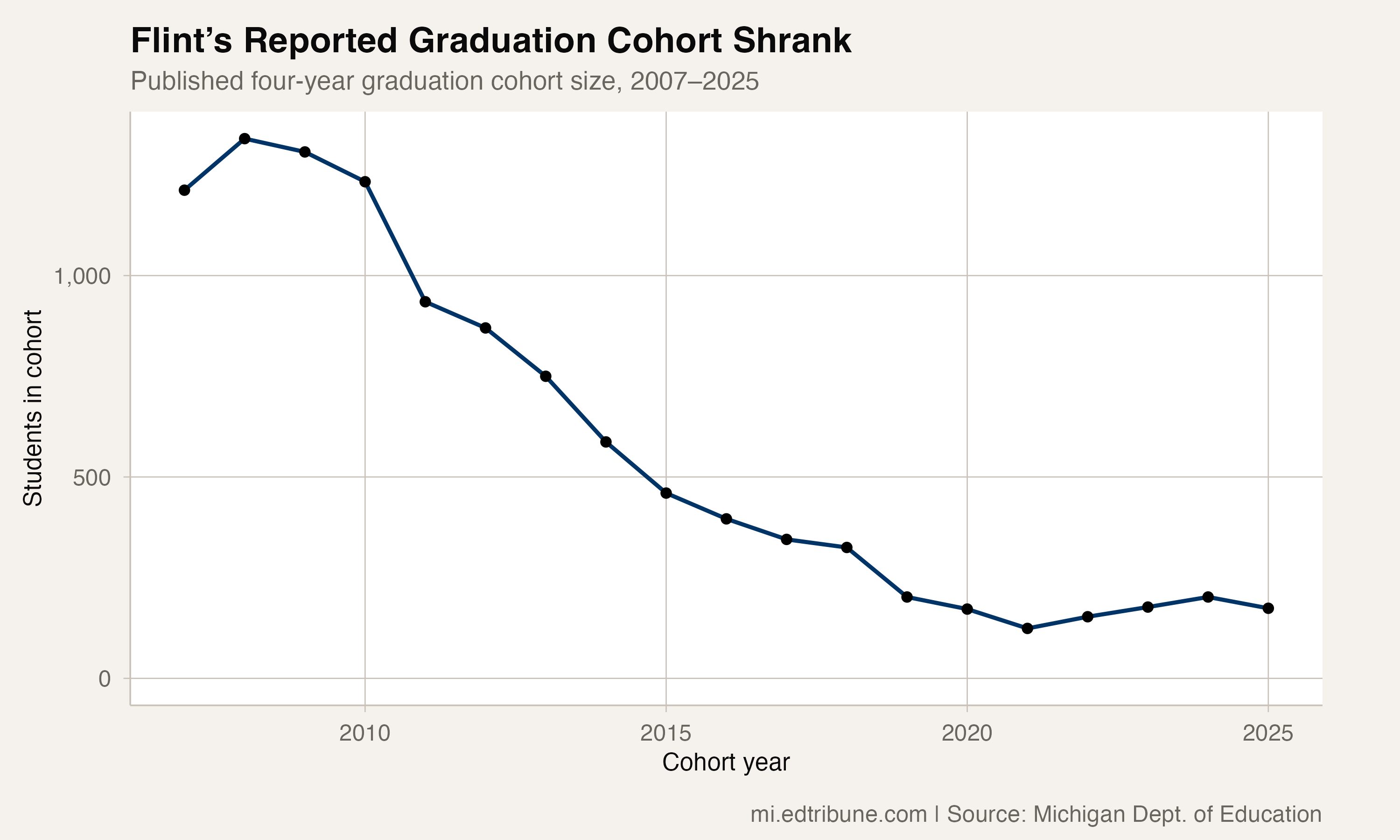
The graduating cohort was much smaller than it had been in the earliest reported year used here. It contained 174 students, compared with 1,212 in 2007 — a decline of 85.6%. Those are graduation-cohort counts, not counts of everyone enrolled in the district.
A rebound from the previous report
Using the published rates before rounding, Flint’s increase from 2024 to 2025 was 7.8 percentage points. Its gap below the state rate for the 2025 cohort was 31.7 points.
The figures describe a completed cohort year. They are the most recent published graduation observations used in this analysis, rather than a reading of students’ progress during the current school year.
A smaller cohort changes what the rate describes
The state’s table records 91 on-time graduates in Flint’s 2025 cohort. Subtracting that published count from the cohort total leaves 83 students who did not graduate on time. That remainder should not be called a dropout count: the figures shown here do not establish the later outcomes of those students.
The smaller cohort also means that comparing rates alone misses part of the district’s change. A rate describes the share of a particular cohort graduating on time; it does not show how many students entered the district, moved away, transferred or enrolled elsewhere over the intervening years. The table does not establish why the cohort became smaller.
Improvement did not erase the longer gap
Flint’s published rate was 54.6% in 2007. The 2025 rate was therefore slightly lower, rather than unchanged from the beginning of the series. Among the published Flint observations shown here, the highest rate was 67.0% in 2017 and the lowest was 35.0% in 2023.
The complete reporting history adds context to the recent improvement. Flint’s rate fell below its earlier low before rising in the last two cohort years. That sequence is visible in the annual observations; it does not identify which students returned to school or what caused the recovery.
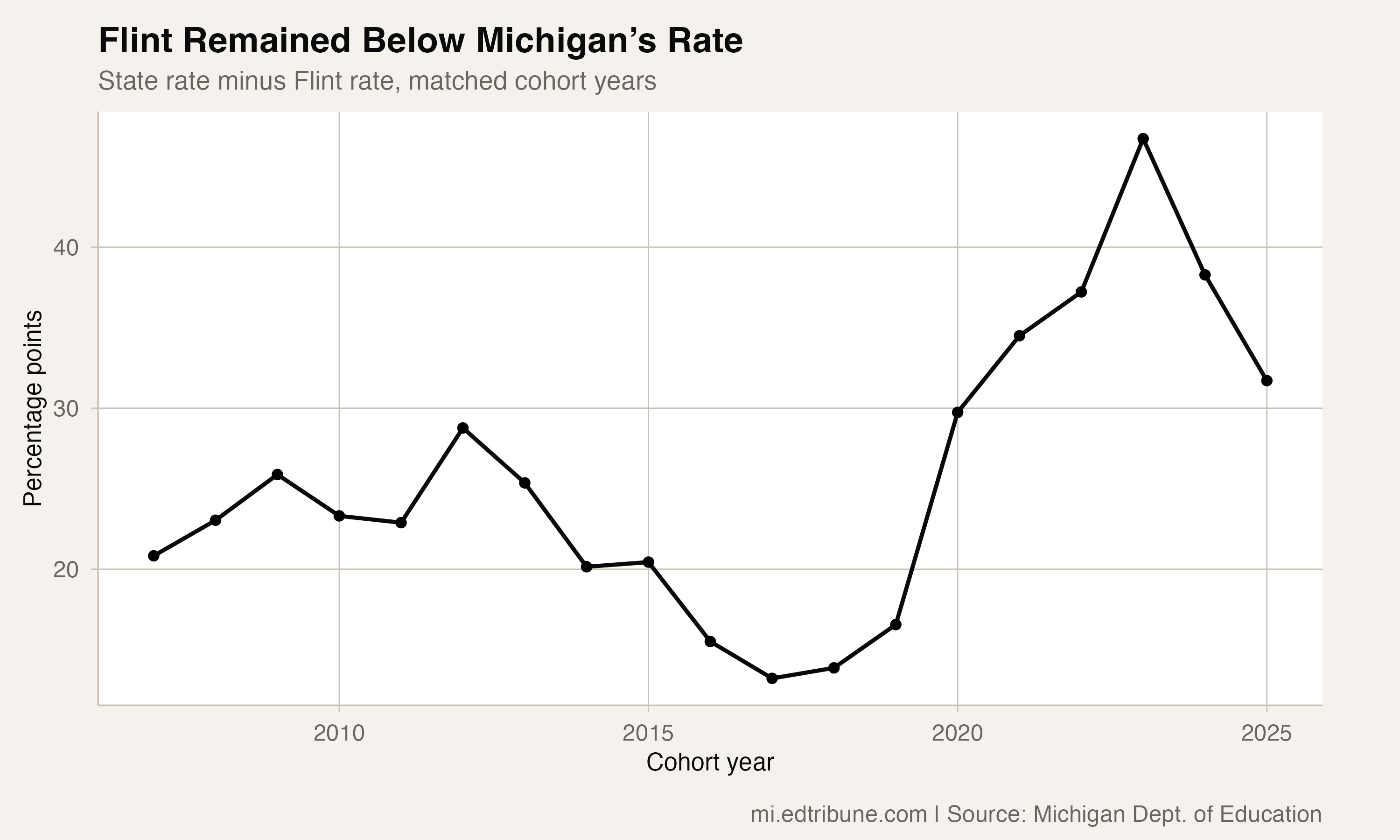
The defensible conclusion is narrower than a claim about the city’s future: Flint improved on its preceding reported cohort, while its on-time graduation rate remained below the statewide rate and its cohort was substantially smaller than at the start of the observed period. The graduation tables do not identify causes or establish what would reverse either pattern.
Detailed code that reproduces the analysis and figures in this article is available exclusively to EdTribune subscribers.
Discussion
Sign in to join the discussion.
Loading comments...