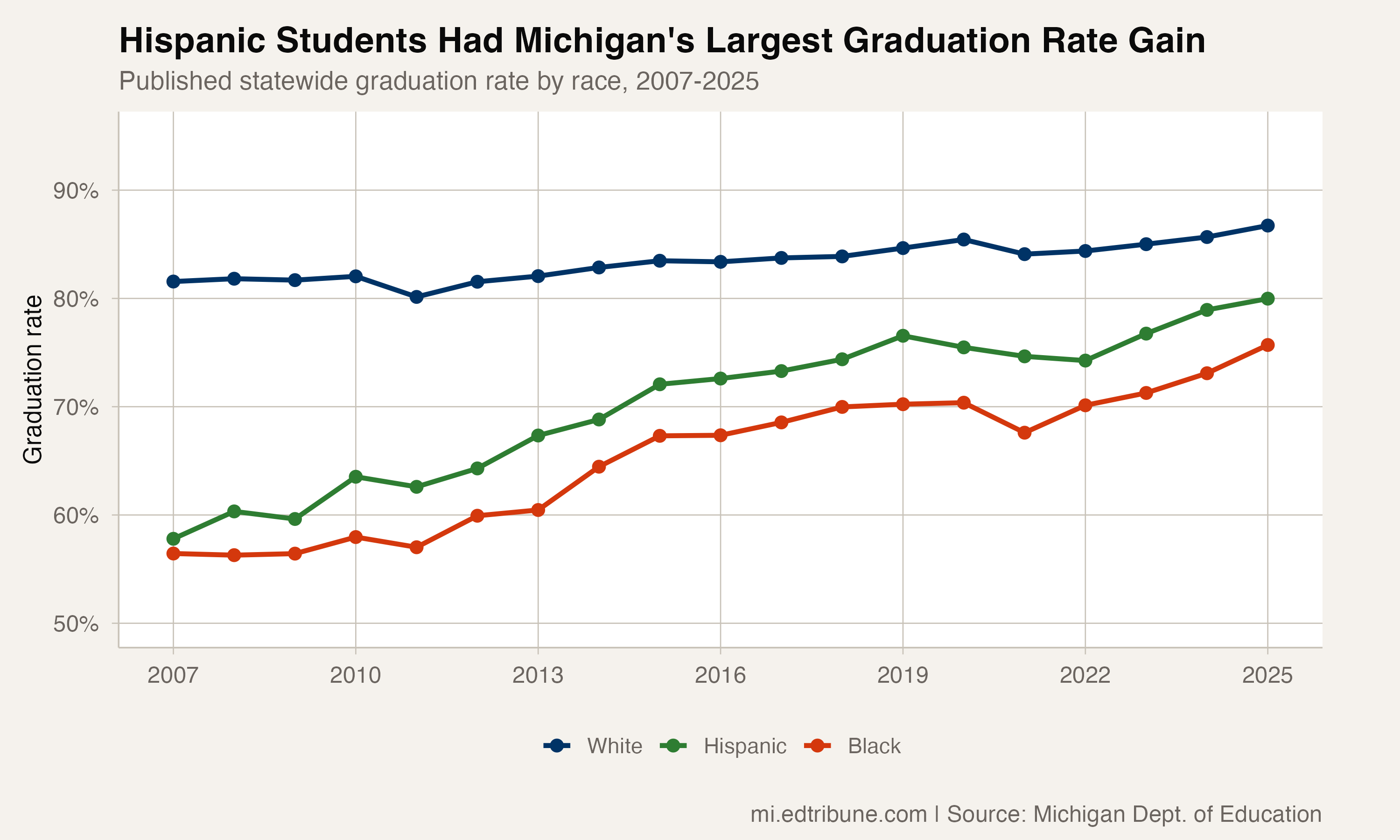
In 2007, Hispanic students in Michigan graduated at 57.8%, compared with 81.6% for White students. The 23.8-point gap was 1.3 points narrower than the Black-White gap that year (25.1 points). The two graduation rates were 1.4 points apart.
With the class of 2025, Michigan's most recently published class, the Hispanic rate was 80.0% and the White-Hispanic gap was 6.8 percentage points. The 2025 rate was within 0.2 points of Michigan's 80.2% overall rate in 2017 (Michigan CEPI cohort graduation and dropout reports).
The 22.2 percentage point gain is the largest of any racial subgroup in the state. It exceeds the Black gain of 19.3 points, the Asian gain of 8.2 points, and the White gain of 5.2 points.
A different trajectory than the Black-White gap
The Black-White gap in Michigan went from 25.1 to 11.0 percentage points, a 14.1-point reduction. The Hispanic-White gap went from 23.8 to 6.8, a 17.0-point reduction. In 2007, Hispanic and Black students' rates were 57.8% and 56.4%. By 2025, the Hispanic rate was 4.3 percentage points higher than the Black rate (80.0% vs. 75.7%).
The state data report graduation rates by subgroup but do not explain why the two paths differed.
A three-year decline, then recovery
The rate fell from 76.6% in 2019 to 75.5% in 2020, then continued downward: 74.7% in 2021 and 74.3% in 2022, its lowest level since 2018. From 2019 to 2020, 14 of the other 17 published state subgroups held steady or improved; three declined.
The rate first rose above its 2019 level in 2023, reaching 76.8%. It then climbed to 78.9% in 2024 and 80.0% in 2025. It took four graduating classes for the rate to move above its 2019 mark.
The 6.8 point question
At 6.8 percentage points, the White-Hispanic gap is far smaller than it was in 2007. But it did not narrow in 2025. It was 6.7 points in 2024 and 6.8 in 2025; before rounding, the two differ by two hundredths of a point. Whether this represents a plateau or a one-year fluctuation will require several more years of data to determine.
This is a statewide comparison; it does not measure differences between individual districts.
By the numbers: Hispanic students in Michigan graduated at 80.0% in 2025, up 22.2 percentage points from 57.8% in 2007, the largest gain of any racial subgroup. The White-Hispanic gap narrowed from 23.8pp to 6.8pp, closing faster than the Black-White gap (25.1pp to 11.0pp).
Michigan CEPI publishes cohort graduation and dropout rates by student subgroup.
Detailed code that reproduces the analysis and figures in this article is available exclusively to EdTribune subscribers.
Discussion
Sign in to join the discussion.
Loading comments...