Correction: Earlier versions described decline runs across successive available reports as consecutive calendar years. The wording now reflects the gap in the statewide series.
Manchester Community Schools↗ET has lost students in each of its last 19 available reports. From a peak of 1,344 in 2004-05, the district has shed half its enrollment, falling to 677 in 2024-25.
Michigan's legislature looked at districts like Manchester and allocated $475 million to incentivize consolidation. The program's first round produced zero district mergers. Three districts received a combined $75 million, but none involved two districts combining into one. The grants funded building closures and renovations within existing district boundaries.
More districts, fewer students
The core paradox is visible in the enrollment data. In 1996, Michigan had 607 districts educating 1,607,296 students. By 2024-25, the state had 878 districts educating 1,366,207 students. Enrollment fell 15.0%. The reported district count rose 44.6%.
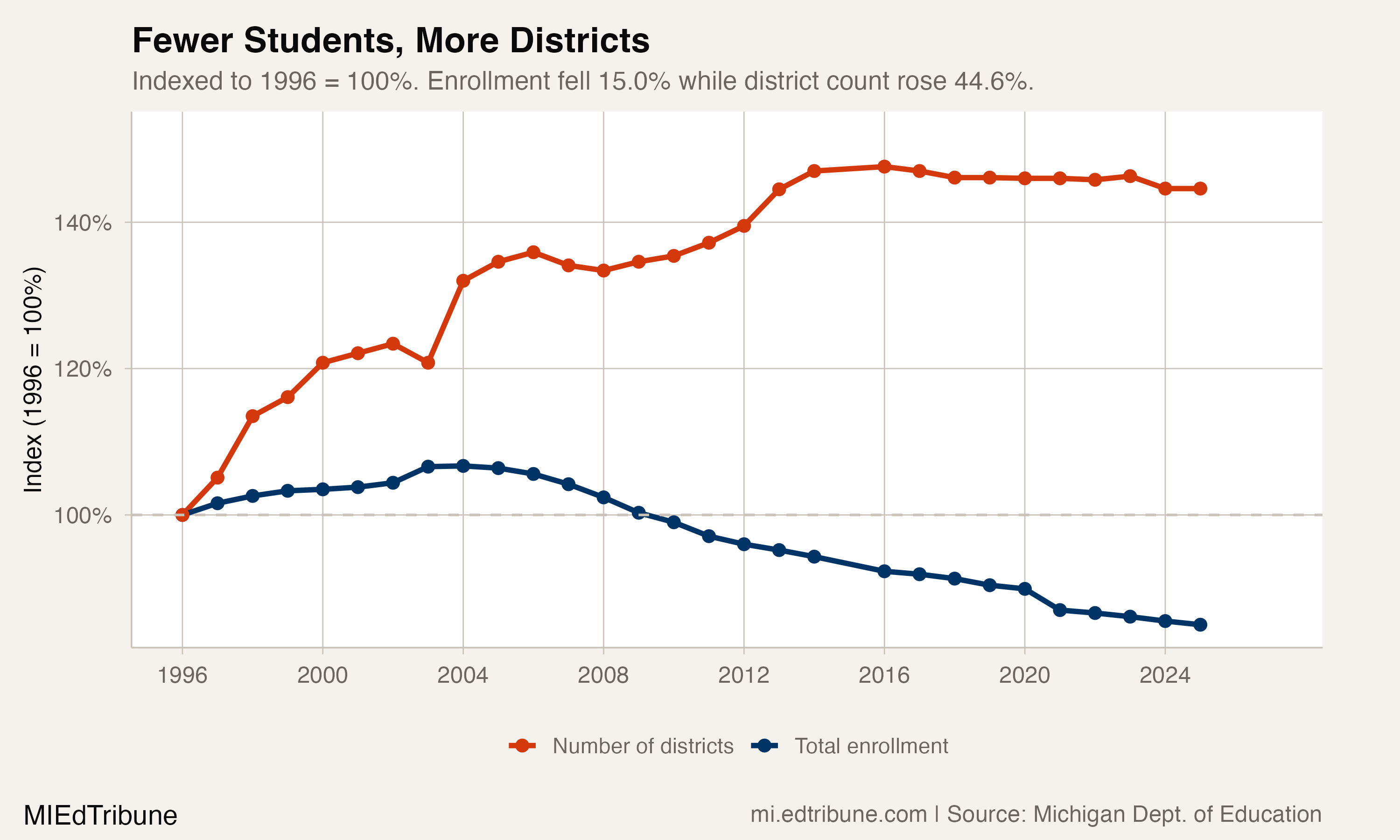
Michigan now reports more districts serving a smaller student population. The median district enrolled 1,501 students in 1996. In 2024-25, the median is 725, less than half.
Of 878 districts, 329 enroll fewer than 500 students, 37.5% of all districts serving just 5.3% of the state's children. Another 204 districts fall between 500 and 999 students. Combined, 533 districts, 60.7% of the total, educate fewer than 1,000 students each. They account for 16% of statewide enrollment.
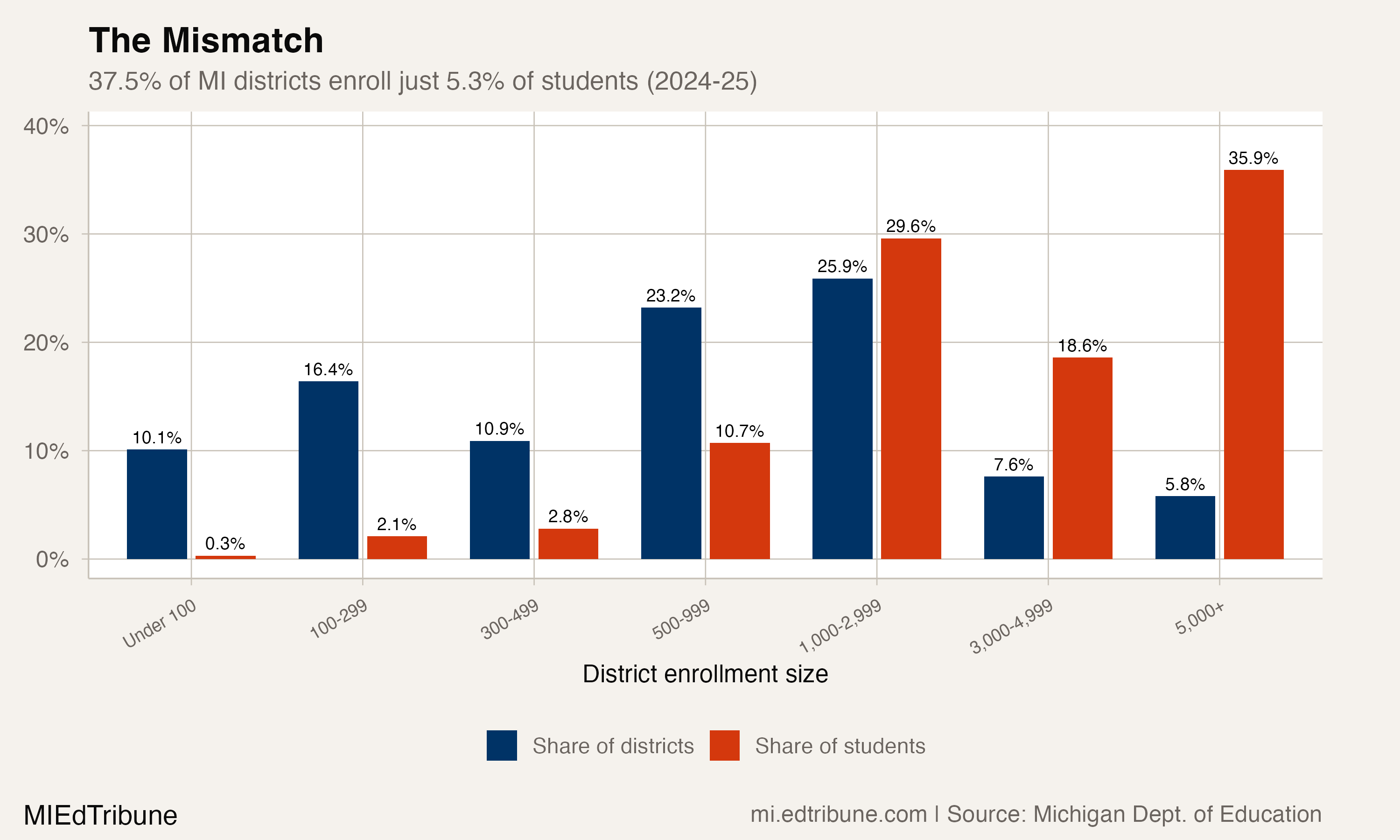
At the other end, 51 districts above 5,000 students, just 5.8% of the total, educate 35.9% of all Michigan students.
Where the money went
The legislature's consolidation push began in 2022 with a $5 million appropriation for districts to study whether merging made sense. Sixteen districts used the funds to explore the idea. None followed through. The state then escalated to $475 million, with half earmarked for consolidation-related projects.
When the Michigan Department of Education opened the first $75 million grant round, 51 applicants requested more than $626 million, more than eight times the available funding. Three winners were selected:
- Flint Community Schools↗ET: $35.9 million to close four underutilized buildings, reducing the active total from 11 to seven, not to merge with another district. Flint enrolled 25,011 students in 1996 and now enrolls 2,541, an 89.8% decline.
- North Central Area Schools↗ET: $15.4 million to consolidate two buildings into one. The Upper Peninsula district enrolls 284 students, down from 594 in 1997.
- Union City Community Schools↗ET: $23.6 million to combine three buildings into two. The district enrolls 909 students, down from 1,400 in 1999.
Each project addresses the consequences of enrollment decline, closing or renovating buildings designed for student populations that no longer exist. None involves two districts agreeing to become one.
Why the money isn't enough
The barriers to consolidation are cultural and political, not primarily financial.
"It's a challenge to consolidate districts. People really value their own identity. They value local control, especially in Michigan." — Alena Zachery-Ross, Ypsilanti Community Schools Superintendent, Bridge Michigan
Zachery-Ross speaks from direct experience. Ypsilanti Public School District merged with Willow Run Public Schools in 2013, one of the last true district consolidations in Michigan. She told Bridge Michigan the new identity "took a long time" to establish. That single data point, more than a decade old, remains the state's most recent voluntary merger.
The political obstacles compound the emotional ones. Merging districts means reconciling different debt loads, salary schedules, tax rates, and union contracts. Peter Spadafore of the Michigan Alliance for Student Opportunity told Bridge Michigan that consolidation requires addressing "debt, school taxes, construction and salary schedules," and described the process as far more than "a simple flipping a switch." In 2001, St. Clair Shores voters overwhelmingly rejected a proposal to combine three districts. In 2021, Troy's school board rejected absorbing the struggling Clawson district.
State Sen. Ed McBroom (R-Waucedah), whose Upper Peninsula district includes many of the state's smallest school systems, acknowledged to Bridge Michigan that "unless we see a dramatic turnaround to population decline, consolidation's going to be necessary," but called it "not a panacea."
The slow squeeze
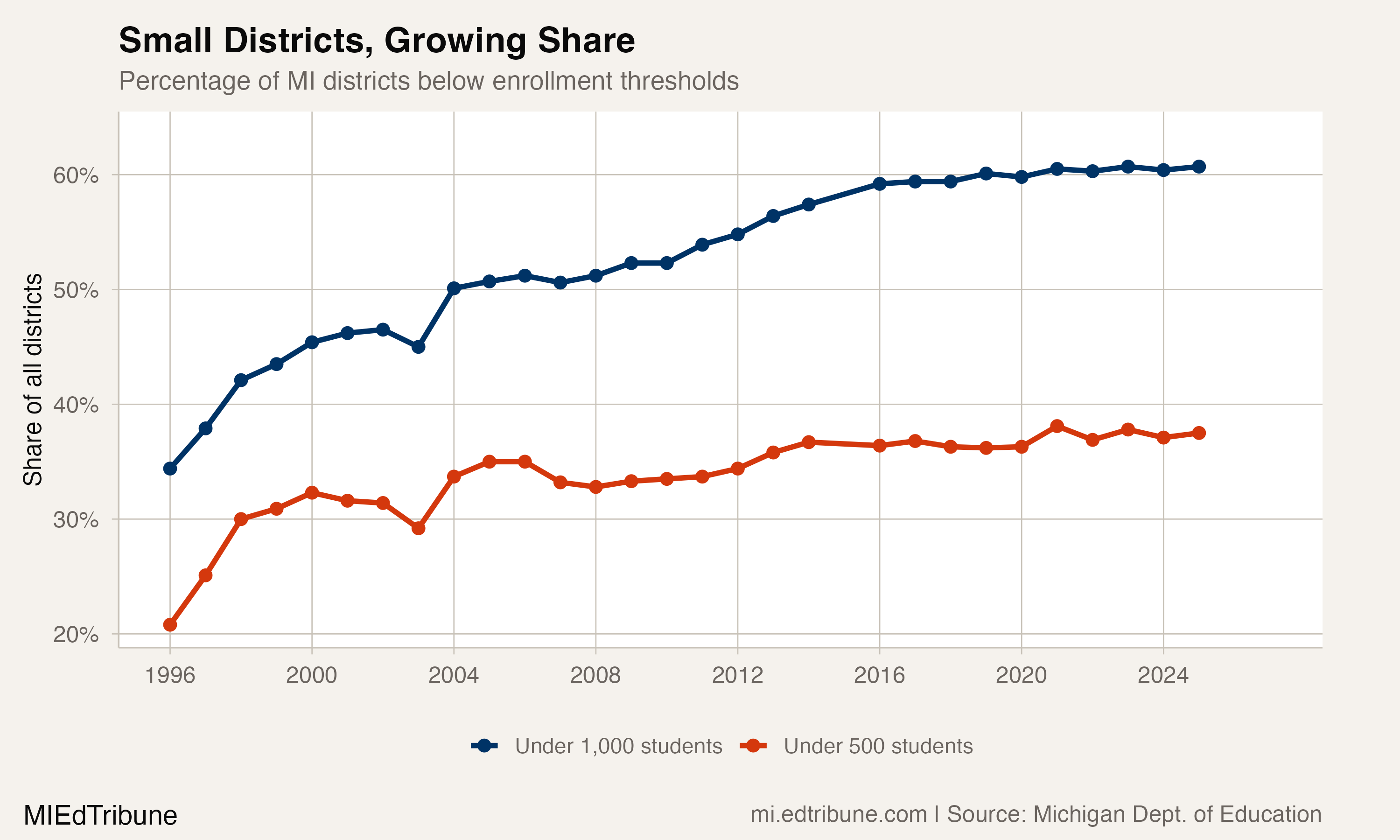
The share of Michigan districts below 1,000 students increased overall, from 34.4% in 1996 to 60.7% in 2024-25. Districts below 500 climbed from 20.8% to 37.5% over the same period, though both shares moved down in some intervening reports. Midsize districts are shrinking into the small category.
Thirty-four districts have active runs of at least 10 declines across successive available reports. Fourteen have runs of 15 or more, and eight have runs of 20 or more. Because the series lacks a 2014-15 report, these are runs across reported observations, not consecutive calendar years.
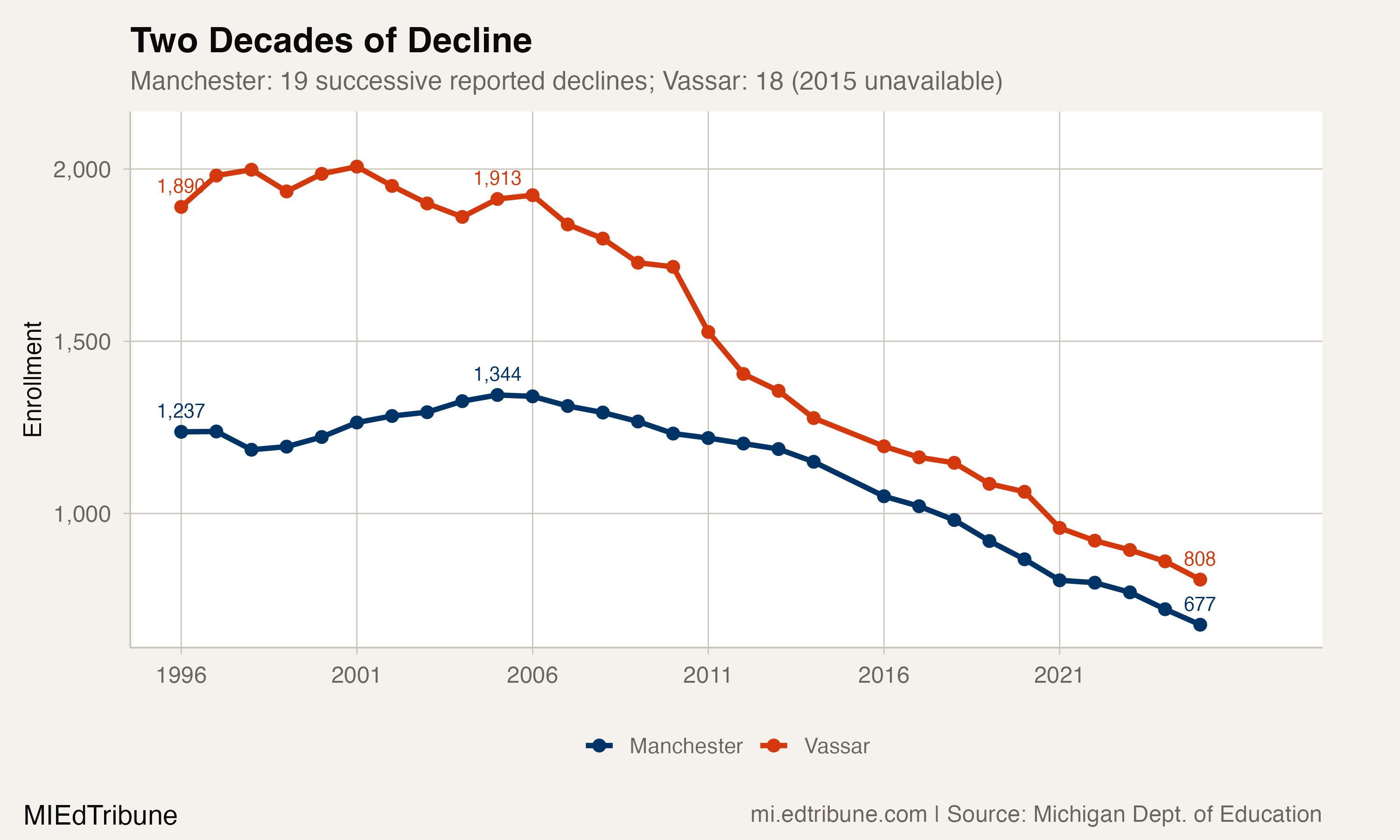
Manchester↗ET and Vassar Public Schools↗ET illustrate the pattern. Manchester peaked at 1,344 students in 2004-05; its 19 successive reported declines have cut enrollment to 677, a loss of 49.6%. Vassar peaked at 2,007 students in 2000-01; its current run covers 18 successive reported declines, leaving enrollment 59.7% lower at 808.
The Manchester Mirror reported that Manchester's location has not attracted students through school choice, and that declining program breadth, both academic and athletic, makes the problem self-reinforcing. Fewer students means fewer offerings, which means fewer families choose to stay.
The research complicates the narrative
The assumption behind consolidation incentives is that larger districts are more cost-effective. Research specific to Michigan suggests that's only partly true. A Mackinac Center study found the most cost-effective district size in Michigan is roughly 2,900 students. Both smaller and larger districts tend to spend more per pupil.
The same study estimated that the annual cost premium from excessively small districts is approximately $31 million statewide, while the premium from excessively large districts is roughly $363 million, nearly 12 times greater. By that measure, breaking up the largest districts would save more money than merging the smallest ones. The political appetite for either is negligible.
206 districts set new observed lows
The consolidation question is not abstract. In 2024-25, 206 Michigan districts with at least 10 available reports set a new observed enrollment low. The list includes some of the state's largest systems.
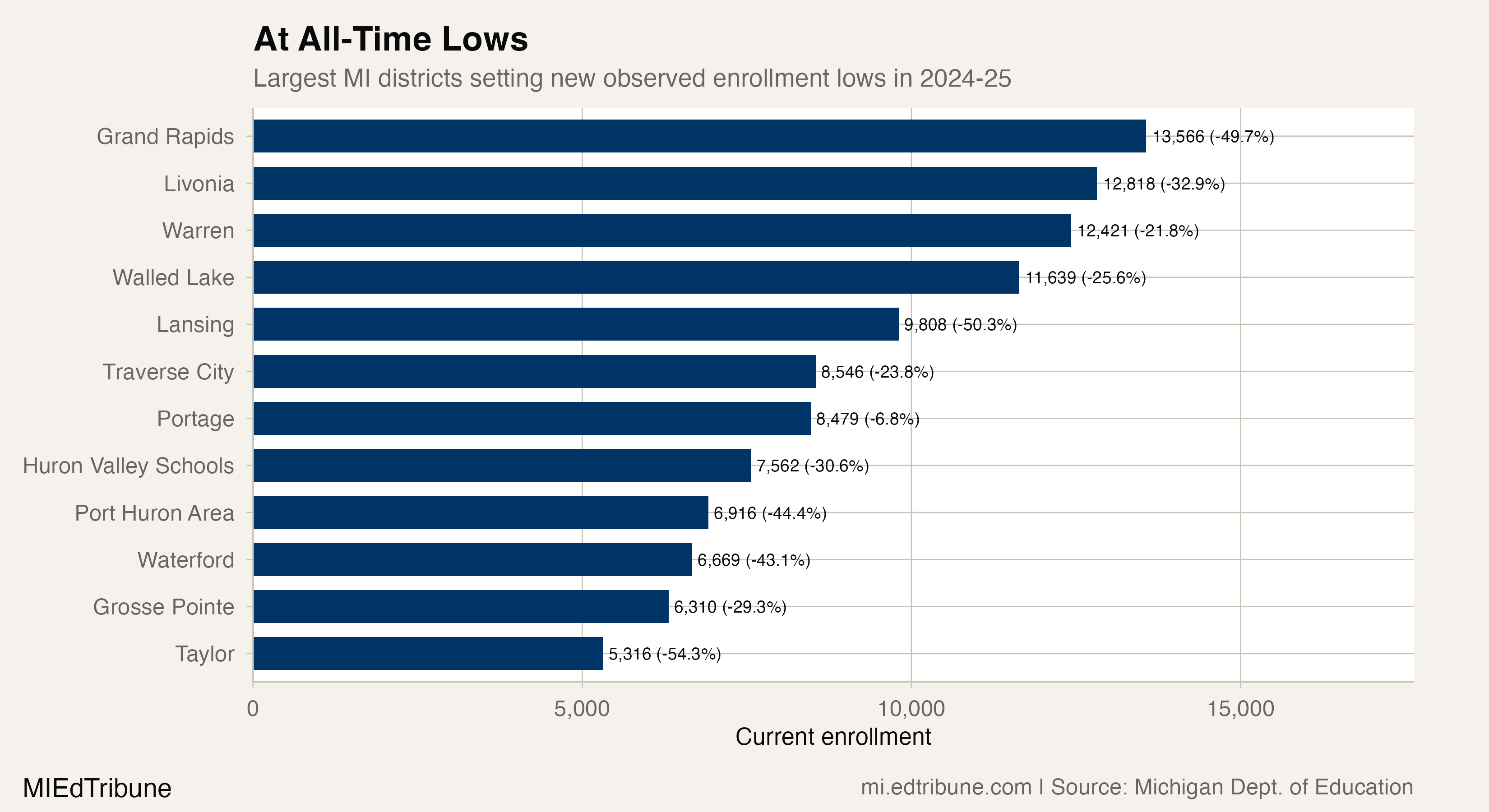
Grand Rapids↗ET has lost 49.7% of its enrollment since 1997, falling from 26,981 to 13,566 students. Lansing has lost 50.3%. Taylor has lost 54.3%. These are urban and suburban systems with thousands of students and buildings designed for much larger enrollment.
Michigan's FY 2025-26 education budget raised the per-pupil foundation allowance to $10,050. But per-pupil funding follows students while buildings, heating bills, transportation routes and administrative positions do not shrink in direct proportion to enrollment.
Diane Golzynski, deputy superintendent of business at the Michigan Department of Education, told Bridge Michigan that "from our perspective, there are too many districts in the state of Michigan," but added that "we need the locals to be interested and willing to look at where there might be consolidation." The state has the money. It does not have the mechanism to compel local action.
What to watch
The FY 2025-26 budget appropriated $150 million for building closures, shared administrative systems and district-merger incentive payments. The mix preserves the central policy tension: most of the appropriation can improve operations within existing boundaries without producing a district merger.
Michigan still reports 329 districts below 500 students and 34 districts with at least 10 successive reported declines. The state has allocated $475 million to consolidation incentives, and its first round funded internal building consolidations rather than district mergers.
Joshua Cowen, a Michigan State University education policy professor, posed the core question to Bridge Michigan: "I'm struggling to figure out who has real skin in the game, politically. Which hill are they going to die on to really push consolidation through?"
The first round left that question unanswered.
Enrollment counts come from Michigan's Center for Educational Performance and Information.
Detailed code that reproduces the analysis and figures in this article is available exclusively to EdTribune subscribers.
Discussion
Sign in to join the discussion.
Loading comments...